All species › Passerines › New World warblers › Chestnut-sided Warbler
Chestnut-sided Warbler | Setophaga pensylvanica
Roestflankzanger | Reinita de Pensilvania
The Chestnut-sided Warbler breeds in young deciduous woodland and clearings in eastern North America and winters mainly in Central America, with its centre in Costa Rica and Panama. It largely migrates across the Gulf of Mexico and through Central America, so in the Caribbean it passes through mainly in the west and only in small numbers.
Voice
The call is a rather low chip, the flight call a buzzy bzrr. The song is a clear whistled series with an emphatic ending, rendered as pleased pleased pleased to MEETCHA; it is rarely heard in the region.
Recording: Mario Reyes Jr — CC BY-NC-SA 4.0 · converted to mono · xeno-canto
Identification
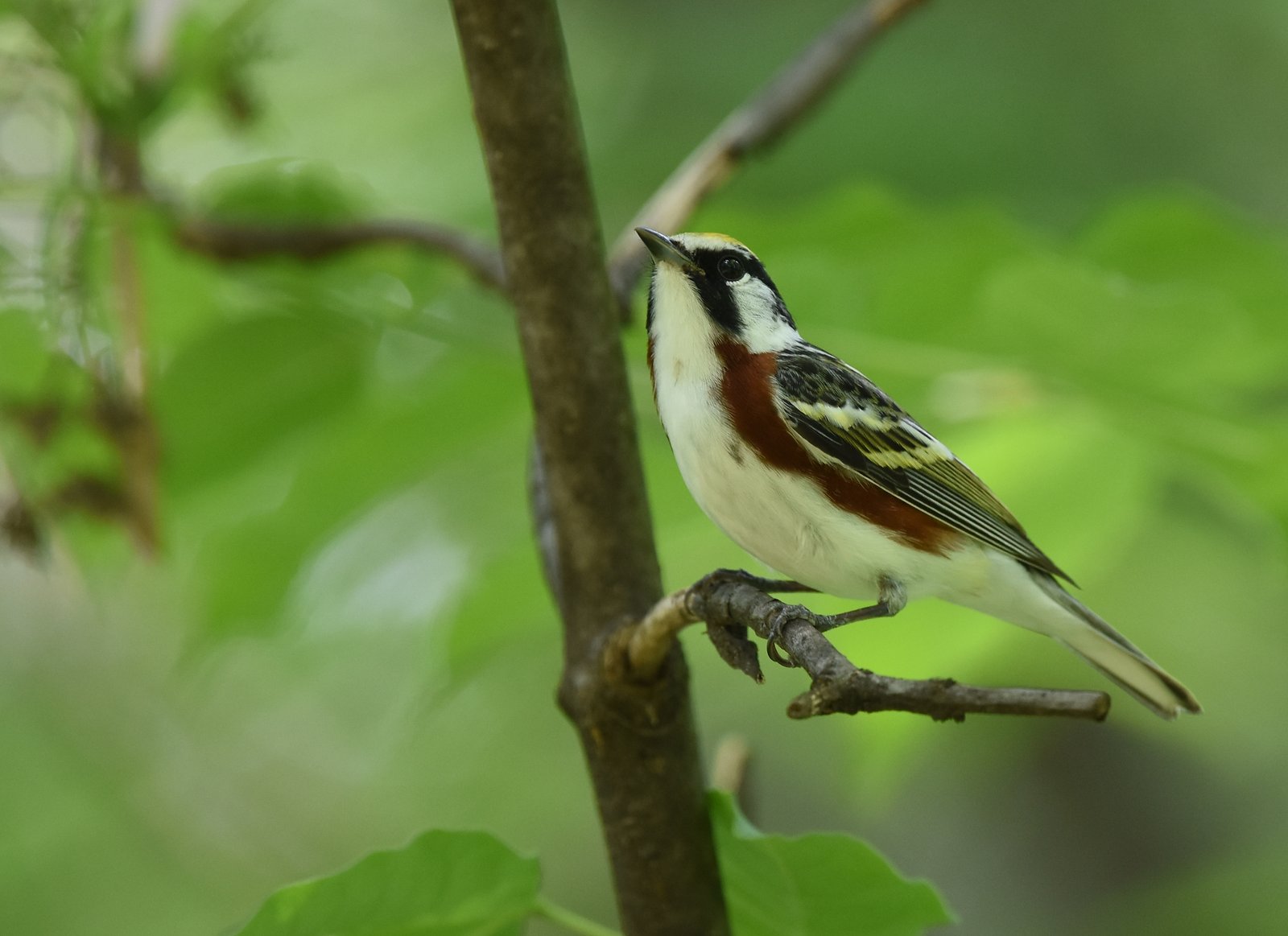
12–14 cm, slim, with a fairly long tail often held cocked. In breeding plumage the male has a yellow crown, a black mask and malar stripe, white cheeks and underparts and a chestnut stripe along the flank; the female is duller. The autumn and winter plumage differs: bright green crown and upperparts, a grey face with a white eye-ring, plain greyish-white underparts, sometimes with a trace of chestnut on the flank, and two pale yellow wing bars.
Confusion species
The autumn plumage is distinguished by the green back, white eye-ring and greyish-white underparts. Bay-breasted Warbler Setophaga castanea and Blackpoll Warbler Setophaga striata have streaked backs in autumn and no distinct eye-ring. Tennessee Warbler Leiothlypis peregrina lacks wing bars and has a supercilium instead of an eye-ring.
Habitat
On migration in moist and dry forest, forest edge, coastal woodland and gardens with shrubs and trees. It forages in the lower and middle levels, hopping from branch to branch and searching for insects and caterpillars on the undersides of leaves; outside the breeding season it also eats berries.
Where the bird is most at home, classified by the vegetation types of the Caribbean.




Range and movements
Scarce passage migrant in the Bahamas, Cuba and the Cayman Islands, rarer in Jamaica; occasionally a bird stays the winter. In Hispaniola, Puerto Rico, the Virgin Islands, the Lesser Antilles, the ABC Islands, San Andrés and Trinidad and Tobago rare to vagrant. Breeds in southern Canada and the north-eastern United States, south along the Appalachians, and winters from southern Mexico to Panama and north-western South America.
- Summer visitor (c. Oct–Mar)
- Winter visitor (c. Apr–Sep)
- Passage (Mar–Apr, Oct–Nov)
- dark = core range, pale = thinly spread
How and when to look
The best chance is in September and October in gardens and coastal woodland in western Cuba, the Cayman Islands and the Bahamas, among other migrant warblers. A white eye-ring in a grey face and yellow wing bars on a bright green back are enough to identify an autumn bird.
Conservation status
Not threatened. The species benefited from the conversion of old-growth forest into young woodland and clearings; for some decades numbers have been slowly declining again as those forests mature.
Scientific name
Setophaga pensylvanica | (Linnaeus, 1766)
Linnaeus described the species in 1766 as Motacilla pensylvanica; because it was later moved to another genus, the author and year stand in brackets. The genus Setophaga was introduced in 1827 by Swainson. Setophaga is Greek, from sēs, sētos 'moth' and -phagos '-eating': 'moth-eater'. pensylvanica refers to Pennsylvania, where the type locality lies. The specimen the first description was based on came from near Philadelphia, Pennsylvania, United States.