All species › Passerines › New World warblers › Bay-breasted Warbler
Bay-breasted Warbler | Setophaga castanea
Kastanjezanger | Reinita castaña
The Bay-breasted Warbler is a fairly large, sluggish warbler of the spruce forests of Canada that winters in southern Central America and north-western South America. Most birds migrate across or around the Gulf of Mexico, so the Caribbean lies off the main route and the species passes through here mainly in the west and in small numbers.
Voice
The call is a soft chip, the flight call a thin see. The song is a very high, thin series of even notes, teesee-teesee-teesee, and is rarely heard on the islands.
Recording: David Darrell-Lambert — CC BY-NC-SA 4.0 · converted to mono · xeno-canto
Identification
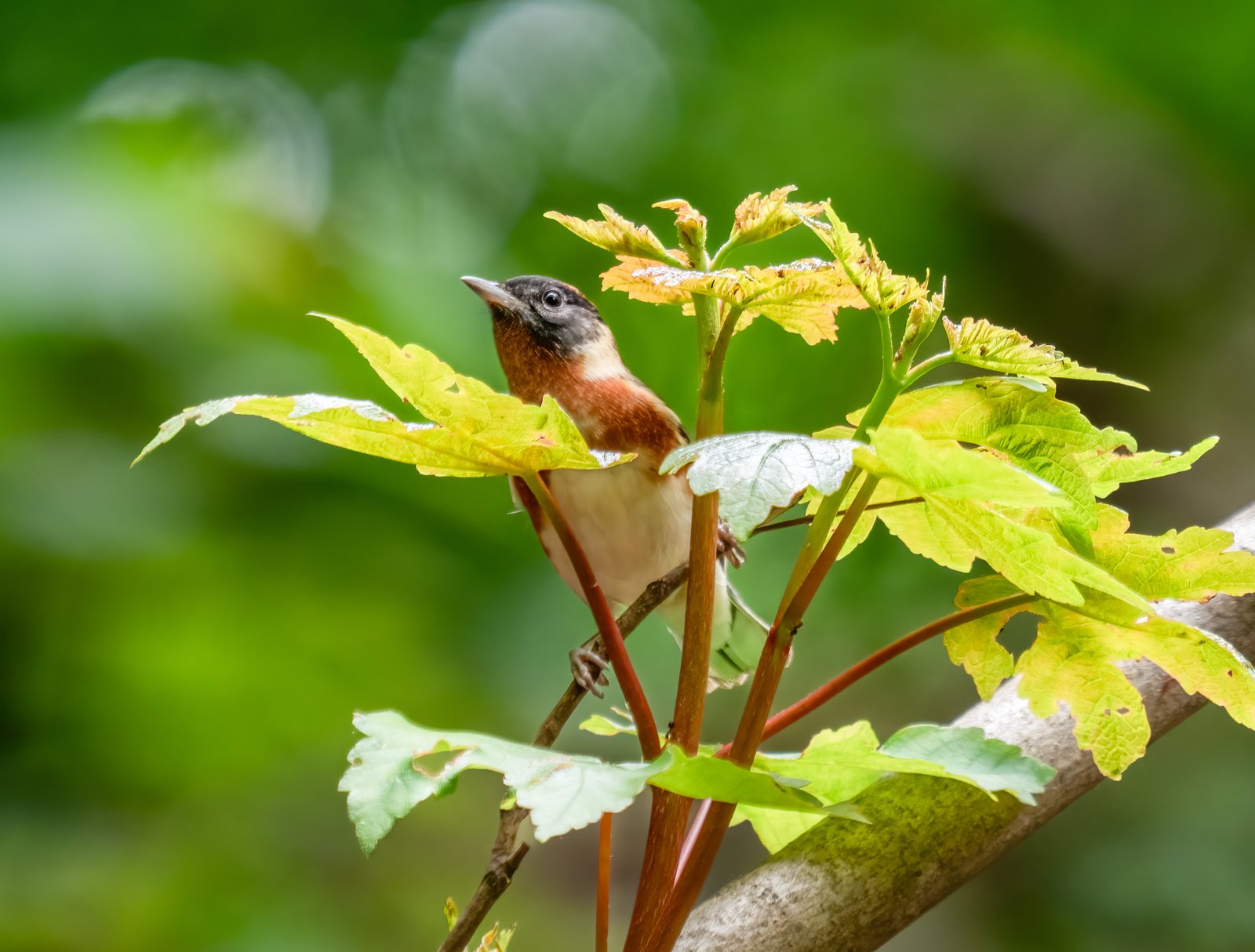
13–15 cm, rather bulky and short-tailed, with two white wing bars. The breeding male has a chestnut crown, throat and flanks, a black mask and a pale buff patch on the side of the neck. The female is duller, with a hint of chestnut on the crown and flanks. In autumn birds are olive-green above with faint back streaks and pale buff below, with almost unstreaked flanks that in many birds still show a rusty wash. The undertail coverts are buff and the legs dark.
Confusion species
In autumn mainly confused with Blackpoll Warbler Setophaga striata, which has blurry streaked flanks, white undertail coverts and pale legs with yellow soles. Pine Warbler Setophaga pinus has an unstreaked back, a yellow-green head with a pale eye-ring and duller wing bars. Chestnut-sided Warbler Setophaga pensylvanica has a yellow crown and white cheeks in breeding plumage, and a bright green back and greyish-white underparts in autumn.
Habitat
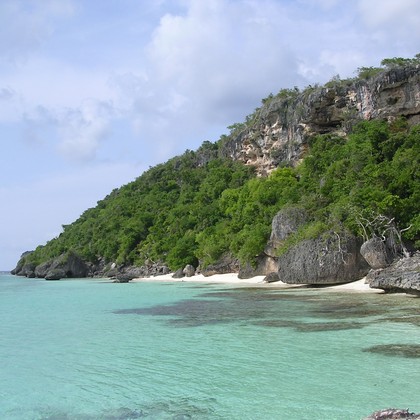
On migration in moist and dry broadleaf forest, coastal woodland and forest edge, also parks and gardens with large trees. It forages in the middle and upper levels, often slowly and staying long on one branch, for insects and caterpillars; outside the breeding season it also eats fruit.
Where the bird is most at home, classified by the vegetation types of the Caribbean.



Range and movements
Rare passage migrant in the west of the region: Cuba, the Cayman Islands, Jamaica and the Bahamas. In Hispaniola, Puerto Rico, the Virgin Islands, the Lesser Antilles, the ABC Islands, San Andrés and Trinidad and Tobago very rare or vagrant. Breeds in the boreal conifer forests of Canada and the far north-eastern United States and winters from Costa Rica and Panama to northern Colombia and Venezuela.
- Summer visitor (c. Oct–Mar)
- Winter visitor (c. Apr–Sep)
- Passage (Mar–Apr, Oct–Nov)
- dark = core range, pale = thinly spread
How and when to look
Chances are best in October and early May in coastal woodland and gardens in western Cuba and the Cayman Islands, especially among flocks of other migrant warblers. Autumn birds need a good look at the undertail and legs to separate them from Blackpoll Warbler.
Conservation status
Not threatened. Numbers fluctuate strongly with spruce budworm outbreaks on the breeding grounds, rising during an outbreak and falling afterwards. Over the long term the population has declined.
Scientific name
Setophaga castanea | (Wilson, 1810)
Wilson described the species in 1810 as Sylvia castanea; because it was later moved to another genus, the author and year stand in brackets. The genus Setophaga was introduced in 1827 by Swainson. Setophaga is Greek, from sēs, sētos 'moth' and -phagos '-eating': 'moth-eater'. castanea is Latin for 'chestnut', after the male's chestnut crown, throat and flanks. The specimen the first description was based on came from Pennsylvania, United States.