All species › Pigeons and doves › Pigeons and doves › Bridled Quail-Dove
Bridled Quail-Dove | Geotrygon mystacea
Grote kwartelduif | Paloma perdiz de Martinica
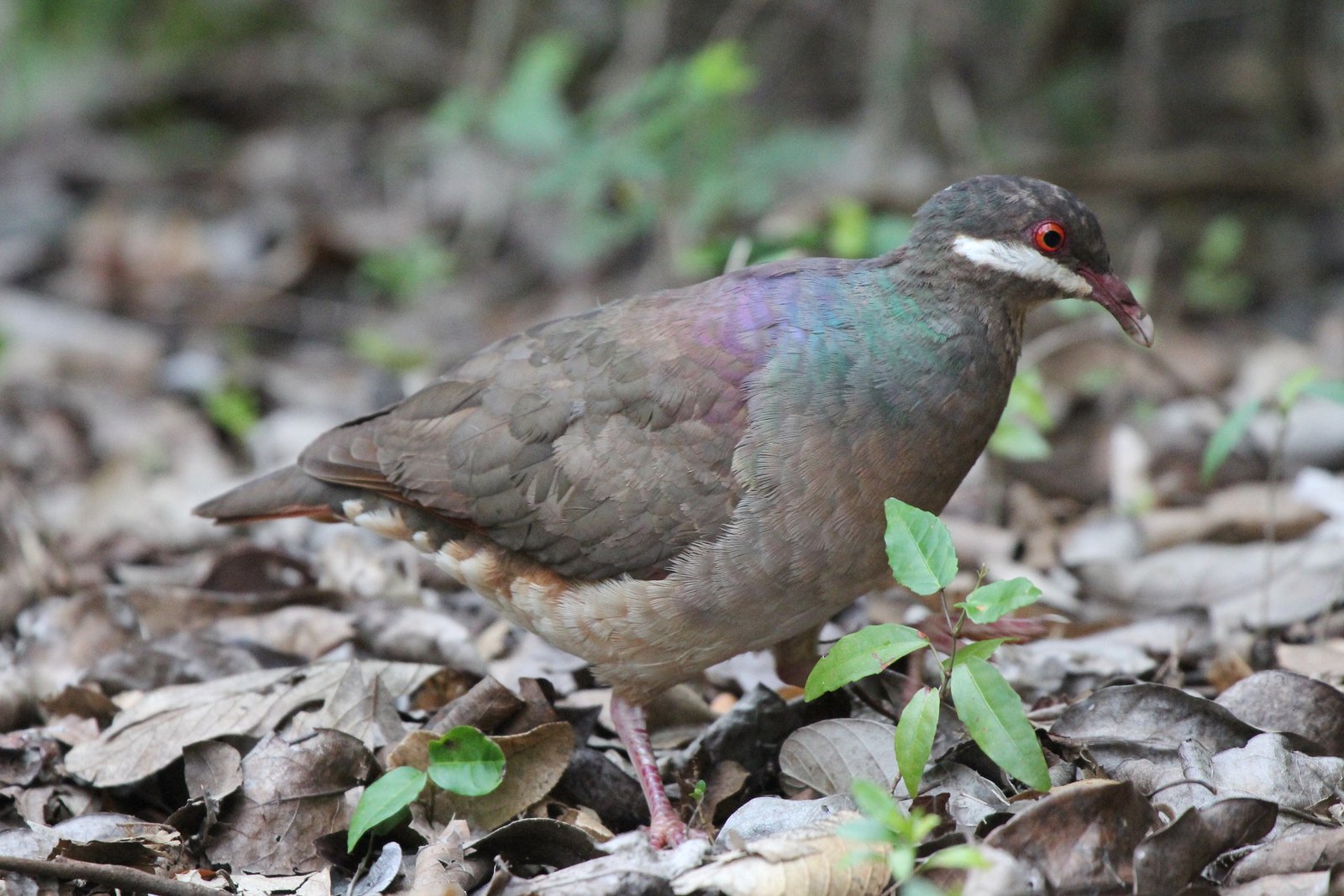
The Bridled Quail-Dove is the quail-dove of the northern Lesser Antilles and the Virgin Islands, and the only member of the group confined to this part of the Caribbean. It lives hidden on the floor of dense, moist forest and is heard far more often than seen. Its name refers to the white stripe across the cheek, which recalls the cheek strap of a bridle.
Voice
A deep, resonant call, hoo-hooooo, the second note longer and falling; sometimes a single hooooo. The call is repeated at regular intervals, often from the ground or a low branch, and carries a long way through the forest. It is heard mainly in the early morning and in the breeding season.
Recording: Étienne Leroy — CC BY-NC-SA 4.0 · converted to mono · xeno-canto
Identification
28–30 cm, a fairly large, compact quail-dove. The upperparts are mainly brown, with a purple to bronze-green gloss on the hindneck and mantle. A distinctive white stripe runs from the base of the bill below the eye towards the rear, with a dark moustachial stripe below it, and there is a small white patch on the throat. The breast is greyish brown, the belly and undertail coverts rufous to cinnamon. The legs are reddish. The sexes are similar; juveniles are duller and have pale fringes to the feathers of the upperparts.
Confusion species
Ruddy Quail-Dove Geotrygon montana, which lives on some of the same islands, is smaller and clearly rusty brown above, with a pale, less sharply defined cheek stripe; the female is olive-brown. Key West Quail-Dove Geotrygon chrysia, which occurs alongside it in Puerto Rico, is a warmer rufous above, with a stronger gloss and a pale belly. Zenaida Dove Zenaida aurita is more often seen in the open, is slimmer and has white wing edges and black spots on the wing.
Habitat
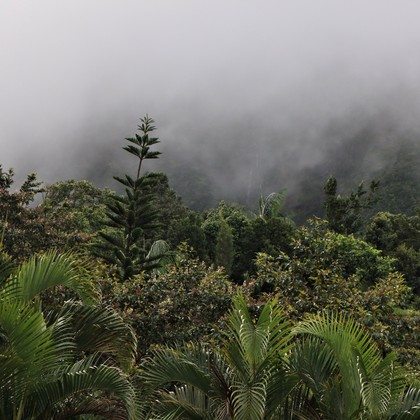
Dense, moist forest with rich undergrowth and a deep layer of leaf litter, mainly on mountain slopes but also in moist parts of drier lowland forest and in ravines. It forages on foot on the ground for seeds, fallen fruit and small invertebrates. The nest is a small platform of twigs, low in creepers, shrubs or trees. Breeding takes place mainly from May to July, with further nesting in the autumn.
Where the bird is most at home, classified by the vegetation types of the Caribbean.


Range and movements
In Puerto Rico very scarce, mainly on Vieques and Culebra; also in the US and British Virgin Islands. Further on Saba, St Eustatius, St Kitts and Nevis, Antigua and Barbuda, Montserrat, Guadeloupe, Dominica, Martinique and St Lucia, the southern limit of the range. There are a few scattered records from St Martin and St Barthélemy. The species does not occur outside the Caribbean.
- Resident
- dark = core range, pale = thinly spread
How and when to look
Guadeloupe and the US Virgin Islands produce the most records, but even there the bird is shy. Standing quietly on a forest track in moist forest at first light, and listening for the low call, gives the best chance. Where the species is used to visitors, as on some well-walked trails, it sometimes walks across the path at close range.
Conservation status
Not threatened. Globally the species is of least concern, but on several islands it is scarce and vulnerable to forest loss, hunting and introduced predators such as mongoose, cats and rats. In Puerto Rico it is regarded as a high-priority species for conservation because of its low numbers.
Scientific name
Geotrygon mystacea | (Temminck, 1811)
Temminck described the species in 1811 as Columba mystacea; because it was later moved to another genus, the author and year stand in brackets. The genus Geotrygon was introduced in 1847 by Gosse. Geotrygon is Greek, from gē 'earth, ground' and trugōn 'turtle dove': 'ground dove'. mystacea comes from Greek mustax 'moustache', after the white stripe below the eye. The specimen the first description was based on came from America (unspecified; Santo Domingo probably in error).