All species › Pigeons and doves › Pigeons and doves › Key West Quail-Dove
Key West Quail-Dove | Geotrygon chrysia
Cubaanse kwartelduif | Paloma perdiz barbiqueja
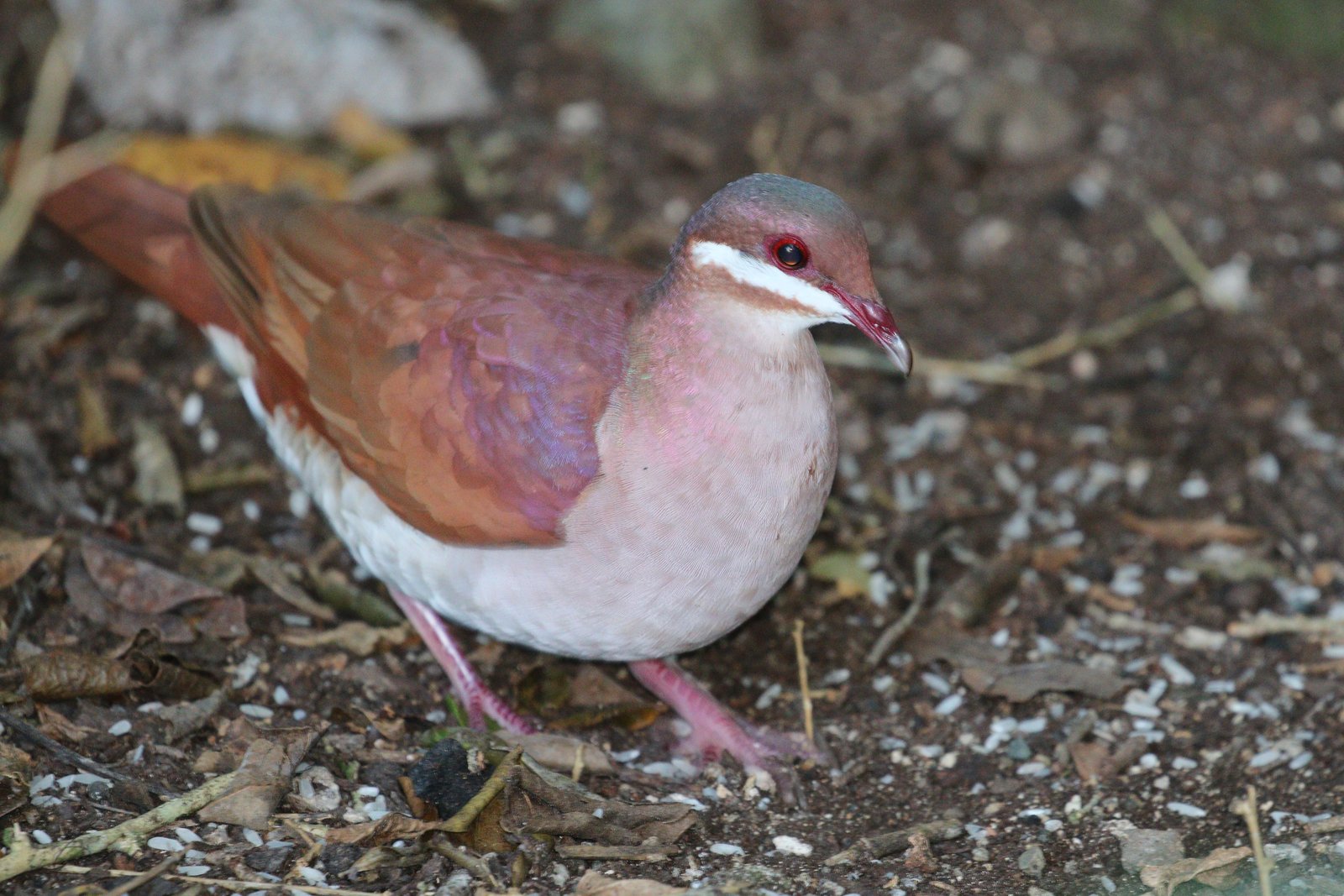
The Key West Quail-Dove is the most widespread quail-dove of the northern Caribbean, but here too it is a shy bird that spends most of its time walking on the forest floor. Its name recalls that it formerly bred in the Florida Keys; there it is now only a rare vagrant. In the region covered by this guide it is a resident of the Bahamas, Cuba, Hispaniola and Puerto Rico.
Voice
A low moaning note on a single pitch, ooooo, swelling and fading and repeated at intervals. The sound resembles that of White-tipped Dove and is ventriloquial. It calls mainly in the early morning from the ground or a low branch.
Recording: GABRIEL LEITE — CC BY-NC-SA 4.0 · shortened to the first 60 s, mono · xeno-canto
Identification
27–31 cm, a medium-sized, compact quail-dove. The upperparts are warm rufous, with a green to amethyst gloss on the crown, hindcrown and hindneck and a purplish-red gloss on the mantle, back and rump. A broad white stripe runs from the base of the bill below the eye towards the rear, with a rufous moustachial stripe below it. The throat is white, the breast greyish to pinkish and the belly pale. The female is duller and more olive-brown above, with less gloss.
Confusion species
Ruddy Quail-Dove Geotrygon montana is also rufous but lacks the gloss and has a pale, less sharply defined cheek stripe; its female is olive-brown. Bridled Quail-Dove Geotrygon mystacea, found in Puerto Rico and the Virgin Islands, is a duller brown above, without rufous tones, and has a rufous belly. In Cuba, Grey-fronted Quail-Dove Geotrygon caniceps and Blue-headed Quail-Dove Starnoenas cyanocephala, are distinguished by their grey or blue head patterns; in Hispaniola the same applies to White-fronted Quail-Dove Geotrygon leucometopia.
Habitat
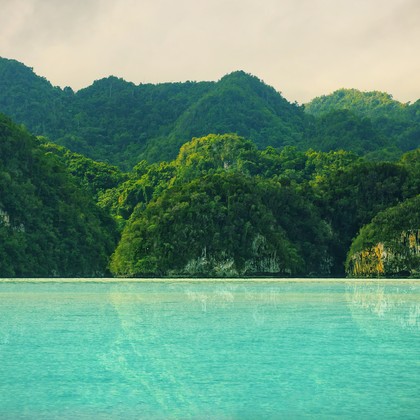
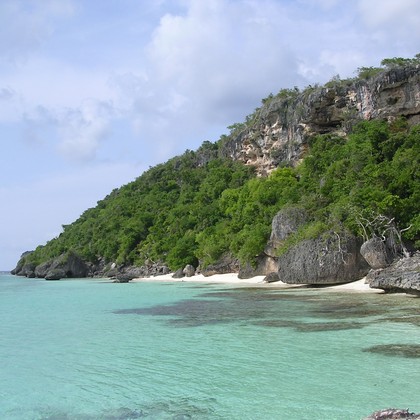
Dry and semi-evergreen forest, limestone forest and coastal woodland with dense undergrowth and plenty of leaf litter, and also dense scrub in dry areas. In Puerto Rico mainly in coastal forest and in the karst hills. It walks over the forest floor in search of seeds, fallen fruit and small invertebrates and is seen in trees less often than on the ground. The nest is a loose platform of twigs, low in shrubs or creepers.
Where the bird is most at home, classified by the vegetation types of the Caribbean.


Range and movements
In the Bahamas mainly on the northern islands; also reported from the Turks and Caicos Islands. In Cuba, including Isla de la Juventud, widespread in forested areas; in Hispaniola in both the Dominican Republic and Haiti. In Puerto Rico scarce and local, including in the south-west west of Ponce, in the karst hills between Arecibo and Isabela, and on Mona and Vieques. It is absent from Jamaica. It formerly occurred in the Cayman Islands; it no longer breeds in Florida or the Keys.
- Resident
- dark = core range, pale = thinly spread
How and when to look
In Cuba the Zapata Peninsula is a good site, where the species walks across the forest tracks in the early morning together with other quail-doves. In Puerto Rico the dry forests of the south-west and the karst forests of the north offer the best chances. A quiet watch on a track at first light produces more than walking about; the bird usually walks off rather than taking flight.
Conservation status
Not threatened. Across its range as a whole the species is of least concern, but locally it is scarce owing to forest loss, hunting and introduced predators such as mongoose, cats and rats. It has disappeared as a breeding bird from the Florida Keys and the Cayman Islands.
Scientific name
Geotrygon chrysia | Bonaparte, 1855
Bonaparte described the species in 1855 and placed it straight away in the genus where it still stands. The genus Geotrygon was introduced in 1847 by Gosse. Geotrygon is Greek, from gē 'earth, ground' and trugōn 'turtle dove': 'ground dove'. chrysia comes from Greek khruseos 'golden', after the golden sheen on the back and nape. The specimen the first description was based on came from Florida.