All species › Pigeons and doves › Pigeons and doves › White-tipped Dove
White-tipped Dove | Leptotila verreauxi
Verreaux' duif | Paloma montaraz común
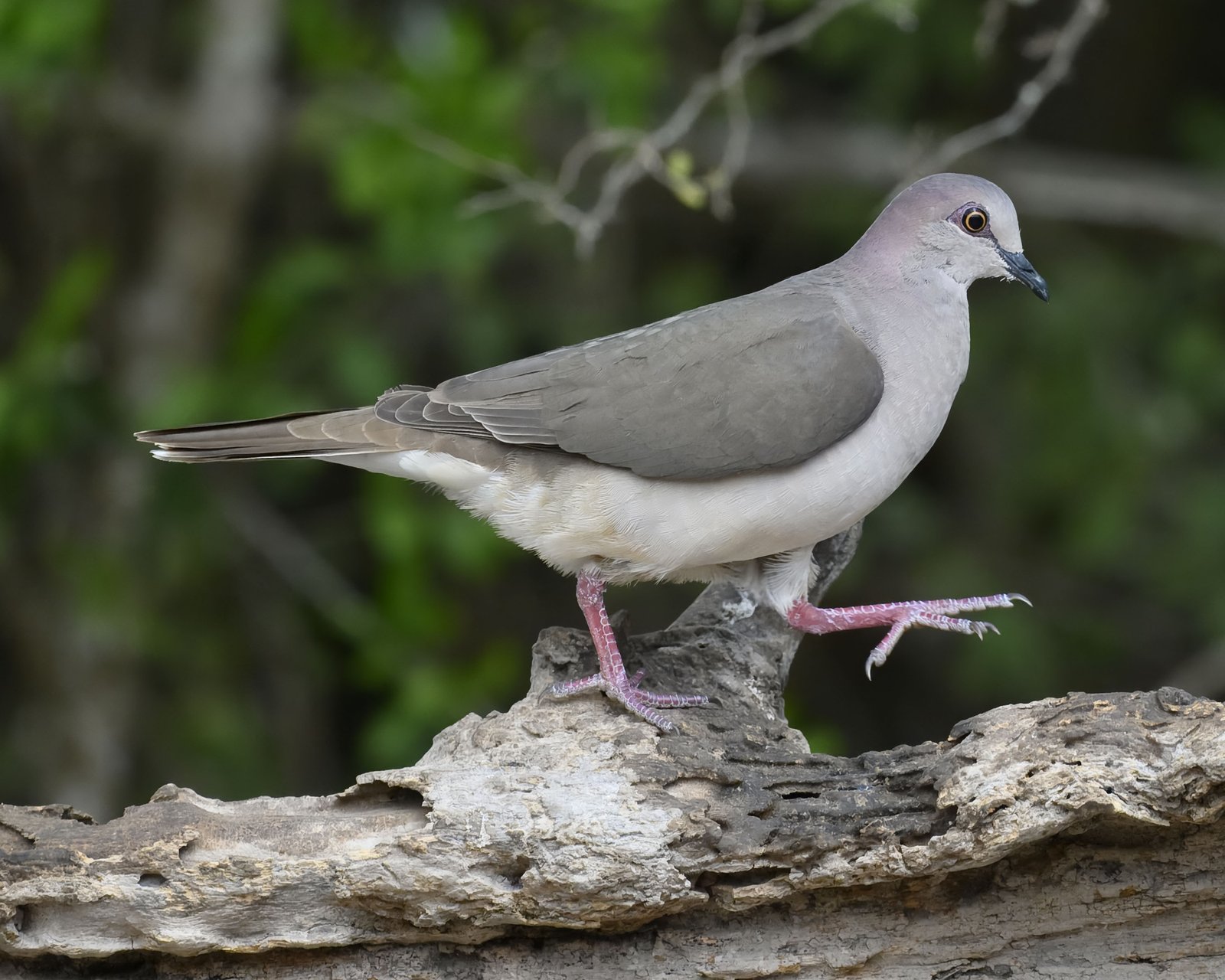
White-tipped Dove is a large, pale ground dove found from Texas to Argentina, which in the Caribbean lives only on the islands off the coast of South America: the ABC Islands and Trinidad and Tobago. There it is common in scrub, dry forest and gardens. It walks singly or in pairs over shaded ground and, when disturbed, flies off low to cover with clattering wings, flashing the white tail corners.
Voice
A low, hollow call, oo-woooo, with a short opening note and a longer second note at the same pitch, like blowing across the neck of a bottle. It is heard mainly in the first and last hour of the day from dense cover and carries far. On take-off the wings make a whistling or clattering sound.
Recording: JAYRSON ARAUJO DE OLIVEIRA — CC BY-NC-SA 4.0 · converted to mono · xeno-canto
Identification
25–31 cm, a heavy dove with a small head and a fairly long, rounded tail. The forehead is pale, greyish to whitish, the crown and hindneck grey with a purple or green gloss on the nape. The upperparts are plain olive-brown, without spots on the wing. The throat is whitish, the breast pale pinkish grey and the belly white. Around the pale eye there is bare skin, red or bluish depending on the subspecies; the legs are red. The tail is dark with white corners, best seen on take-off; the underwing is rufous. The sexes are alike.
Confusion species
Grey-fronted Dove Leptotila rufaxilla, only in Trinidad, has a blue-grey crown, a warmer, more rufous tone to the face and neck and less white in the tail; it lives more in the interior of moist forest. Eared Dove Zenaida auriculata is smaller and slimmer, with black spots on the wing and a small black mark behind the eye. Bare-eyed Pigeon Patagioenas corensis in the ABC Islands is larger, sits much in trees and has a white wing band and blue bare skin around the eye. Ruddy Quail-Dove Geotrygon montana in Trinidad and Tobago is rusty brown and lacks the white tail corners.
Habitat
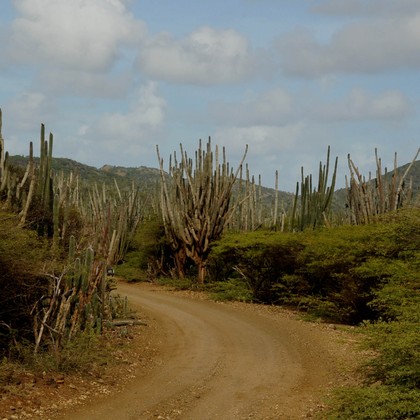
In the ABC Islands thorn scrub, cactus scrub and dry forest, but also yards, gardens and small-scale farmland (the kunuku). In Trinidad and Tobago forest edges, secondary forest, scrub, plantations and gardens, from the lowlands into the hills; it largely leaves the closed interior of moist rainforest to Grey-fronted Dove. It forages on foot on the ground for seeds, fallen fruit and small invertebrates and stays close to cover. The nest is a loose platform of twigs in a shrub or low tree.
Where the bird is most at home, classified by the vegetation types of the Caribbean.




Range and movements
A common resident in Aruba, Curaçao and Bonaire and in Trinidad and Tobago. It is absent elsewhere in the Caribbean; a few reports from Jamaica are unconfirmed. Beyond the region from the extreme south of Texas through Mexico and Central America into South America, south to Peru, Uruguay and central Argentina, including islands off the coast of Venezuela. Many subspecies are recognised, differing in tone and size.
- Resident
- dark = core range, pale = thinly spread
How and when to look
In Curaçao and Bonaire the species walks along sandy tracks and paths in the kunuku and in parks such as Christoffelpark and Washington-Slagbaai in the early morning, and comes into yards for spilt grain. In Tobago and Trinidad it is common along forest edges and roadsides. The hollow call is the first lead; on take-off the white tail corners and rufous underwing are visible.
Conservation status
Not threatened. The species has a very large range and is common across most of it. On the islands in the region it adapts well to man-made landscapes such as gardens and farmland, and there is no evidence of a decline.
Scientific name
Leptotila verreauxi | Bonaparte, 1855
Bonaparte described the species in 1855 and placed it straight away in the genus where it still stands. The genus Leptotila was introduced in 1837 by Swainson. Leptotila is Greek, from leptos 'slender' and ptilon 'feather', after the abruptly narrowed outermost primary. verreauxi honours the French naturalist and natural-history dealer Jules Verreaux (1807–1873). The specimen the first description was based on came from Colombia.