All species › Passerines › Vireos › Blue Mountain Vireo
Blue Mountain Vireo | Vireo osburni
Osburns vireo | Vireo de Osburn
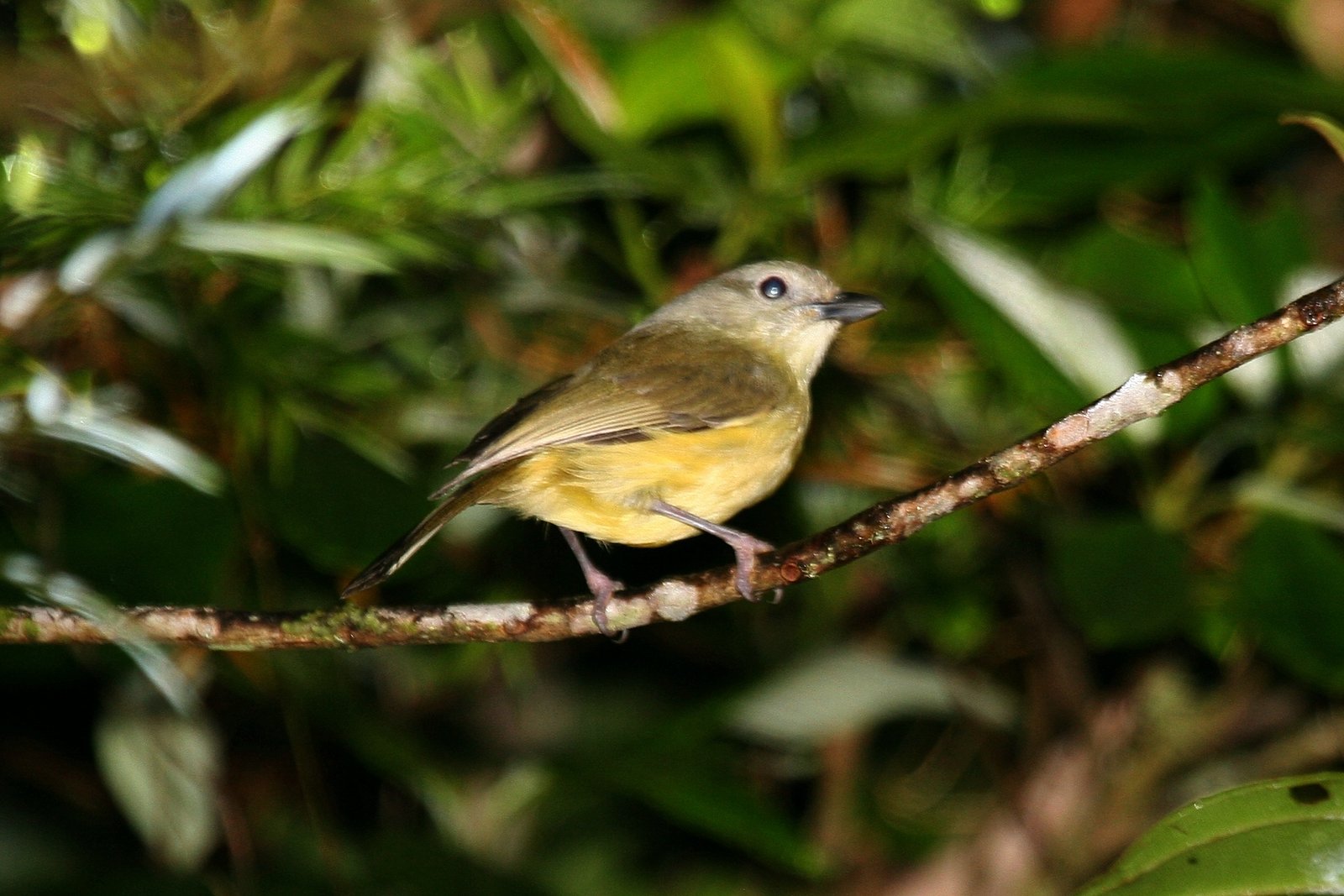
The Blue Mountain Vireo is a bulky, plain vireo found only in the montane forests of Jamaica. It lives hidden in the dense mid-storey and is heard far more often than seen. At about 20 grams it is one of the heaviest vireos in the region, despite being no longer than a Black-whiskered Vireo.
Voice
The song is a trilling or bubbling whistle that drops slightly in pitch, often given from dense cover. The call is a harsh, rolling brrr that falls at the end.
Recording: Ross Gallardy — CC BY-NC-SA 4.0 · converted to mono · xeno-canto
Identification
12.5–15 cm, robust, with a thick, dark bill. The head is grey-brown and the face plain, without eye-ring, supercilium or malar stripe. The upperparts are grey-brown with an olive tone; the wings lack bars and the flight feathers have grey-green edges. The throat is dull white with a yellow wash, the upper breast mottled yellow and grey-brown, the rest of the underparts yellowish white with yellower flanks. The iris is brown and the legs grey. The sexes are alike.
Confusion species
Jamaican Vireo Vireo modestus is much smaller, with two white wing bars, pale spectacles and a pale iris. Black-whiskered Vireo Vireo altiloquus, present in Jamaica in summer, has a white supercilium, a black malar stripe and a red iris. Jamaican Elaenia Myiopagis cotta is smaller and slimmer, with a thin bill and a concealed yellow crown patch, and perches upright like a flycatcher.
Habitat
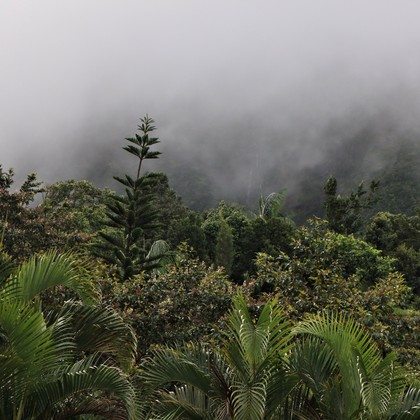
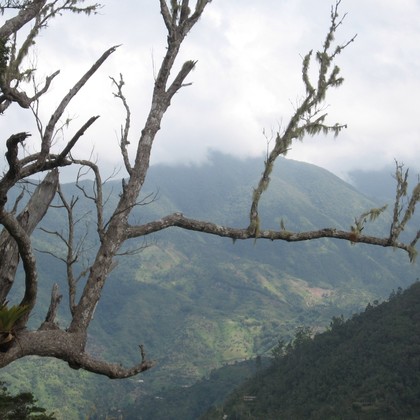
Moist to wet montane forest on limestone and volcanic rock, cloud forest and upland woodland; also shade coffee and gardens, but only where these adjoin forest. Usually given as occurring from about 500 m, but locally lower. It forages in the mid-storey for large insects, snails and berries. Little is known about its breeding.
Where the bird is most at home, classified by the vegetation types of the Caribbean.


Range and movements
Only in Jamaica, scattered through the hills and mountains, including the Blue Mountains, the John Crow Mountains and Cockpit Country. The area actually occupied within this range is small. The species does not occur outside Jamaica.
- Resident
- dark = core range, pale = thinly spread
How and when to look
Best chances are in the forest of the Blue Mountains, for example around Hardwar Gap, and in Cockpit Country. The trilling song is the best lead; the bird itself often sits still in dense foliage and shows only after a long wait.
Conservation status
Near Threatened. The population appears to be declining through loss of montane forest to coffee and pine plantations, charcoal burning, fires, small-scale farming and building.
Scientific name
Vireo osburni | (Sclater, 1861)
Sclater described the species in 1861 as Laletes osburni; because it was later moved to another genus, the author and year stand in brackets. The genus Vireo was introduced in 1808 by Vieillot. Vireo was used by Latin authors for a small, green, migratory bird, probably the Eurasian golden oriole, though the European greenfinch has also been suggested. osburni honours W. Osburn, who collected birds in Jamaica and obtained the type specimen; he died shortly before the description in 1861. The specimen the first description was based on came from Freeman's Hall, Trelawny, Jamaica.