All species › Pigeons and doves › Pigeons and doves › Blue-headed Quail-Dove
Blue-headed Quail-Dove | Starnoenas cyanocephala
Blauwkopkwartelduif | Paloma perdiz cubana
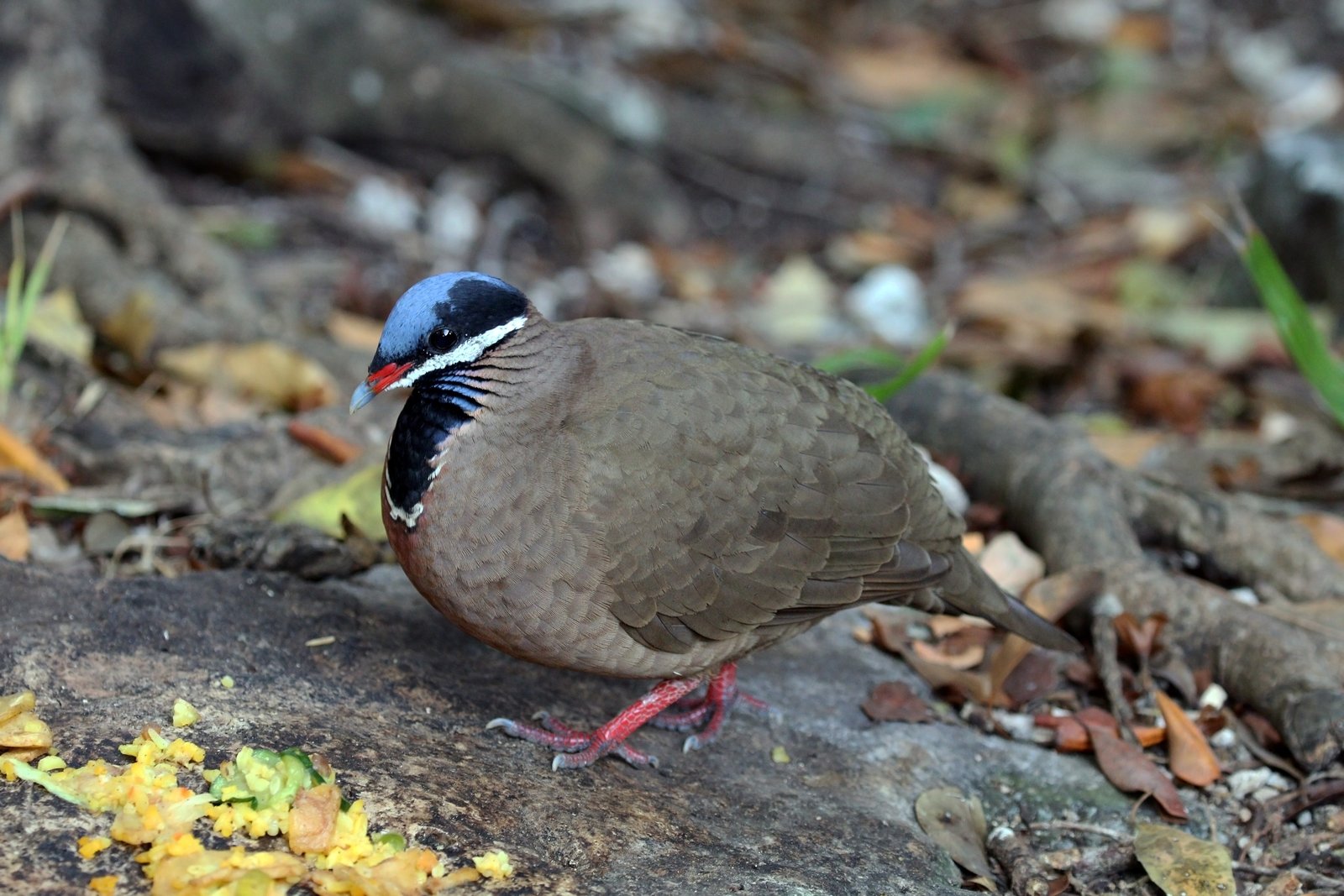
The Blue-headed Quail-Dove is a stocky forest dove found only in Cuba and the only species in the genus Starnoenas. With its bright blue crown, black-and-white face pattern and black, white-bordered bib it is one of the island's most sought-after endemics. It lives on the forest floor, walks with a nodding head through the leaf litter and is shy. In Cuba it is called paloma perdiz, 'partridge dove'.
Voice
A low, hollow, rising whooo-oop, repeated at intervals and often the first sign that the species is present. On take-off the wings clatter loudly, and the flight is fast and low between the trunks.
Recording: Julia Wittmann — CC BY-NC-SA 4.0 · converted to mono · xeno-canto
Identification
30–33 cm, large for a quail-dove, with a rounded body, short tail and fairly long legs. Head and body are mainly cinnamon to chocolate brown. The crown is bright blue. A black stripe runs through the eye, and below it a broad white stripe runs from the chin to the back of the head. The throat carries a black bib, narrowly bordered white and mottled blue at the edges. The underparts are warm brown, the wings and tail plain brown. The sexes are alike; juveniles are duller, with a less clean-cut head pattern.
Confusion species
No other dove in Cuba has a blue crown and a black bib. Ruddy Quail-Dove Geotrygon montana is smaller and rufous, with a pale stripe below the eye but no blue and no bib. Key West Quail-Dove Geotrygon chrysia also has a white stripe below the eye, but a rufous back glossed purple and green and a pale throat. Grey-fronted Quail-Dove Geotrygon caniceps has a grey head and a dark, glossy bluish-purple back, and no bib either. On a brief view of a bird walking away, size and stocky build are the main clues.
Habitat
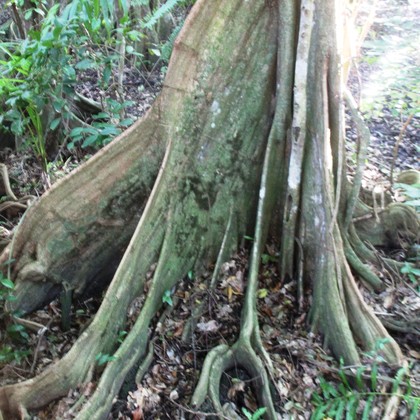
Lowland forest with a closed canopy, an open understorey and a thick layer of leaf litter, in both semi-evergreen and drier deciduous forest, and swamp forest; less often in montane forest. It walks over the forest floor, often in pairs, taking seeds, berries and snails. The nest is on or just above the ground; the breeding season falls mainly between April and June.
Where the bird is most at home, classified by the vegetation types of the Caribbean.


Range and movements
Only in Cuba, scattered and local, with strongholds around the Zapata Swamp and in Pinar del Río province. Also in other forest areas on the island, but scarce there. The species does not occur outside Cuba.
- Resident
- dark = core range, pale = thinly spread
How and when to look
The Zapata Swamp, among other places in the forests of Soplillar and Bermejas, early in the morning. The birds sometimes walk across a forest track or a clearing on the forest floor and can then be watched well by waiting quietly; elsewhere they slip away on foot or with loud wing-claps as soon as they notice someone. The low, rising call helps to locate them in denser forest.
Conservation status
Endangered. The world population is estimated at 1,000 to 2,499 birds and is declining. The main threats are hunting and the loss of lowland forest; severe hurricanes can also damage large tracts of forest. Part of the habitat lies within protected areas such as the Zapata Swamp.
Scientific name
Starnoenas cyanocephala | (Linnaeus, 1758)
Linnaeus described the species in 1758 as Columba cyanocephala; because it was later moved to another genus, the author and year stand in brackets. The genus Starnoenas was introduced in 1838 by Bonaparte. Starnoenas is probably Greek, from starna 'partridge' and oinas 'pigeon': 'partridge-dove', after the plump, ground-dwelling bird. cyanocephala is Greek, from kuanos 'dark blue' and -kephalos '-headed', after the blue head. The specimen the first description was based on came from America (not specified).