All species › Passerines › Cotingas › Bearded Bellbird
Bearded Bellbird | Procnias averano
Baardklokvogel | Campanero barbudo
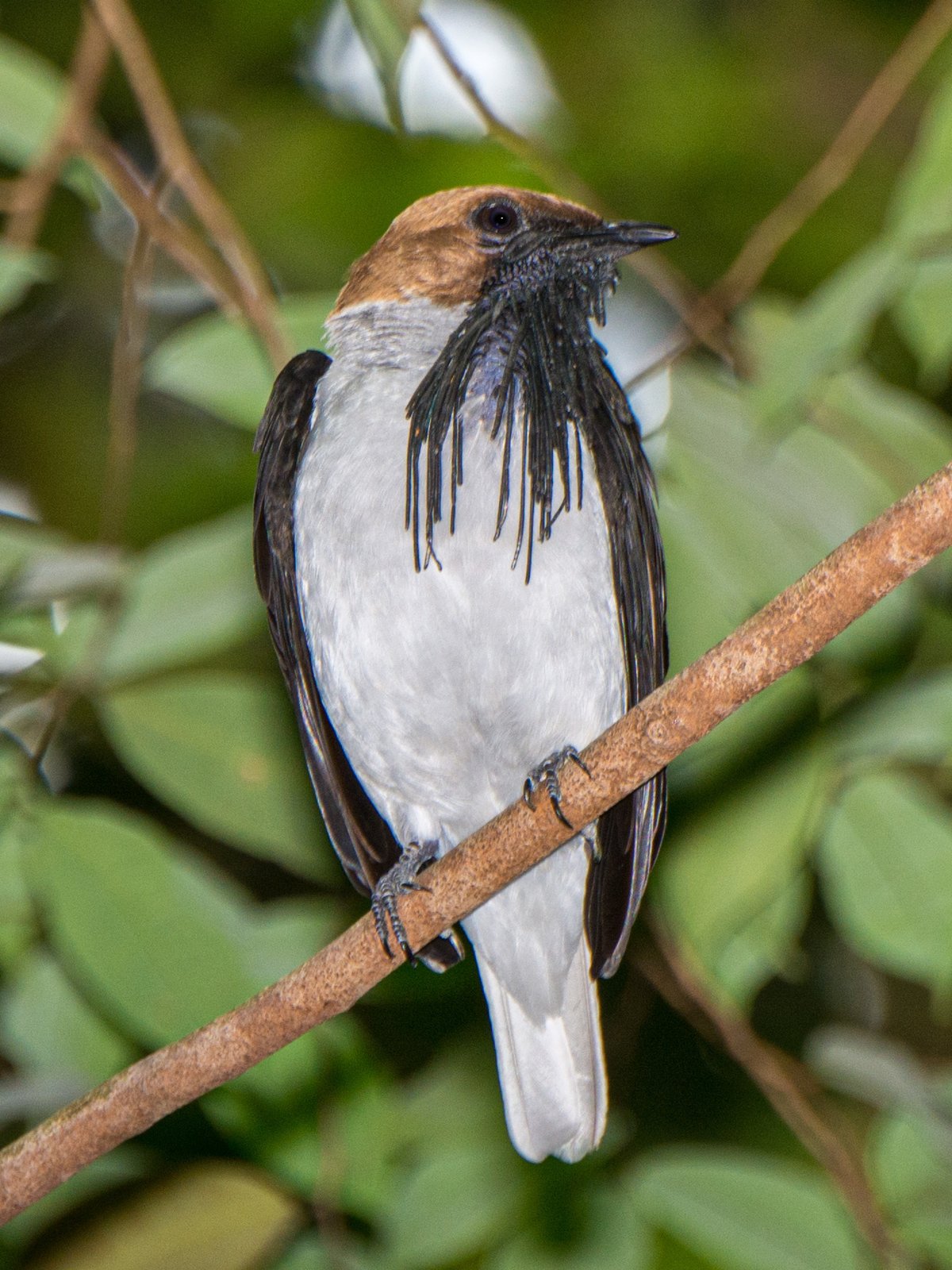
The Bearded Bellbird is a cotinga of northern South America and in the region occurs only on Trinidad. The male is usually heard long before it is seen: its loud, metallic call carries far through the forest. The name refers to the tuft of black, string-like wattles that hangs from its throat.
Voice
A very loud, dry bock, repeated every few seconds, and a metallic series of 20–30 knocks, like a hammer striking an anvil. The direction of the sound is often unclear. The female is practically silent.
Recording: JAYRSON ARAUJO DE OLIVEIRA — CC BY-NC-SA 4.0 · converted to mono · xeno-canto
Identification
27–28 cm, the female slightly smaller than the male. A sturdy bird with a short bill that is very broad at the base. The male is white, with a chocolate-brown head and black wings; a dense tuft of black, worm-like wattles hangs from the chin and throat. The female is olive-green above and yellow below, with green streaks on the throat and breast. Young males at first resemble the female and acquire the white plumage over several years, through intermediate plumages mixing green, white and brown.
Confusion species
The adult male is the only white bird in the region with a brown head and black throat wattles. Black-tailed Tityra Tityra cayana is also white with black wings, but has a black cap, a black tail and red around the eye and at the bill base. The female is larger and heavier than the other green, yellow-streaked forest birds on Trinidad and has the short, broad bill of a cotinga.
Habitat
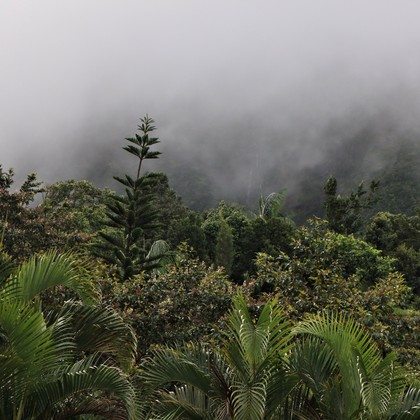
Humid evergreen forest and the lower parts of montane rainforest. It feeds entirely on fruit, often plucked in flight, especially of the laurel family and Burseraceae. The male calls from a regular bare branch high in the forest. The female alone builds a flimsy nest of stems and twigs on a branch and lays a single egg, incubated for a little over three weeks. The main breeding season runs from April to July, with a second period in October and November.
Where the bird is most at home, classified by the vegetation types of the Caribbean.


Range and movements
In the region only on Trinidad, mainly in the forested hills of the Northern Range; it is absent from Tobago. Trinidad birds belong to the subspecies carnobarba, which also occurs in Venezuela, Colombia, Guyana and northern Brazil; the nominate form lives in north-eastern Brazil. Some mainland populations move to lower elevations outside the breeding season.
- Resident
- dark = core range, pale = thinly spread
How and when to look
In the Northern Range, for example at the Asa Wright Nature Centre, where calling males are regularly heard and seen from the trails. The sound is the best lead; the male usually sits on a bare branch high in the forest and stays in the same place for long periods.
Conservation status
Near Threatened according to the IUCN, owing to forest loss and trapping for the cage-bird trade, which mainly affects birds in Brazil. On Trinidad the species occurs in the forested parts of the Northern Range.
Scientific name
Procnias averano | (Hermann, 1783)
Hermann described the species in 1783 as Ampelis Averano; because it was later moved to another genus, the author and year stand in brackets. The genus Procnias was introduced in 1811 by Illiger. Procnias refers to Procne of Greek mythology, who was transformed into a swallow. averano is the name 'Averano' given to this bellbird by Buffon, derived from Portuguese ave de verão 'summer bird'. The specimen the first description was based on came from northeastern Brazil.