All species › Passerines › Manakins › Golden-headed Manakin
Golden-headed Manakin | Ceratopipra erythrocephala
Goudkopmanakin | Saltarín cabecidorado
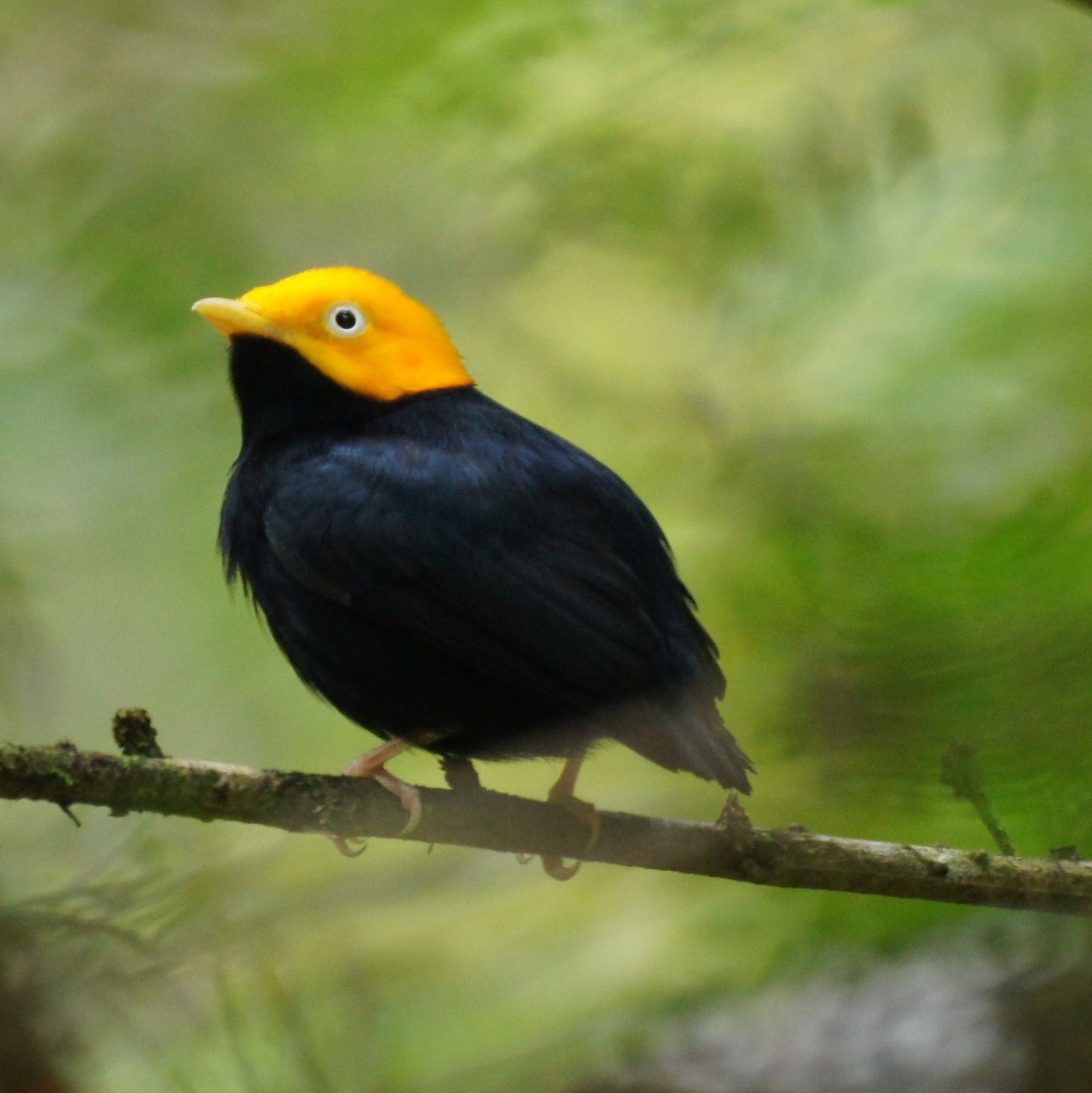
The Golden-headed Manakin is the smallest manakin in the region and common in moist forest on Trinidad. The males display higher in the forest than White-bearded Manakins, on horizontal branches in the middle storey, with rapid flights between branches, buzzing calls and quick sliding movements along the branch. The species was formerly placed in the genus Pipra.
Voice
A short, sharp zit, often repeated at the display site, and a buzzing series pir-pir-prrrrrt. In display flights the wings make a whirring sound.
Recording: Juan Freile — CC BY-NC-SA 4.0 · shortened to the first 60 s, mono · xeno-canto
Identification
9–10 cm, small and compact, with a very short tail. The male is glossy black with a golden-yellow head that has a thin reddish border at its lower edge. The eye is white, the bill yellowish, and the thighs are white and red, visible mainly in display. The legs are pink to flesh-coloured. The female is olive-green, paler and greyer below, with a grey eye. Young males resemble the female.
Confusion species
In the region the male resembles no other species. The female is told from the female White-bearded Manakin Manacus manacus by its smaller size and flesh-coloured to grey rather than orange legs. Blue-backed Manakin Chiroxiphia pareola lives only on Tobago, where Golden-headed Manakin is absent.
Habitat
Moist forest, secondary growth and forest edges, also cacao plantations, from the lowlands into the mountains. It feeds mainly on small fruits, plucked in flight, supplemented by insects and spiders. Males display in loose groups of up to about twelve birds on horizontal branches 6–12 m above the ground. The female builds a shallow cup nest low in a tree; the two eggs are incubated for 16–17 days. The breeding season runs from January to August, peaking from March to July.
Where the bird is most at home, classified by the vegetation types of the Caribbean.




Range and movements
In the region only on Trinidad, where it is common in forested areas across the whole island; it is absent from Tobago. Outside the region from eastern Panama through northern South America to the northern Amazon basin.
- Resident
- dark = core range, pale = thinly spread
How and when to look
In the forests of the Northern Range, for example at the Asa Wright Nature Centre. The buzzing calls and whirring wings give away the display site; the males perch there in the middle storey, often on a bare horizontal branch.
Conservation status
Not threatened. Common, and also present in secondary growth and plantations.
Scientific name
Ceratopipra erythrocephala | (Linnaeus, 1758) (GBIF: Pipra erythrocephala)
Linnaeus described the species in 1758 as [Parus] erythrocephalus; because it was later moved to another genus, the author and year stand in brackets. The genus Ceratopipra was introduced in 1854 by Bonaparte. Ceratopipra combines Greek keras 'horn' with the genus Pipra, after the horn-like crest feathers of the type species, the Scarlet-horned Manakin. erythrocephala is Greek for 'red-headed', from eruthros 'red' and kephalē 'head', after the male's golden-red head. The specimen the first description was based on came from Suriname.