All species › Passerines › Tityras and becards › Black-tailed Tityra
Black-tailed Tityra | Tityra cayana
Zwartstaarttityra | Titira colinegra
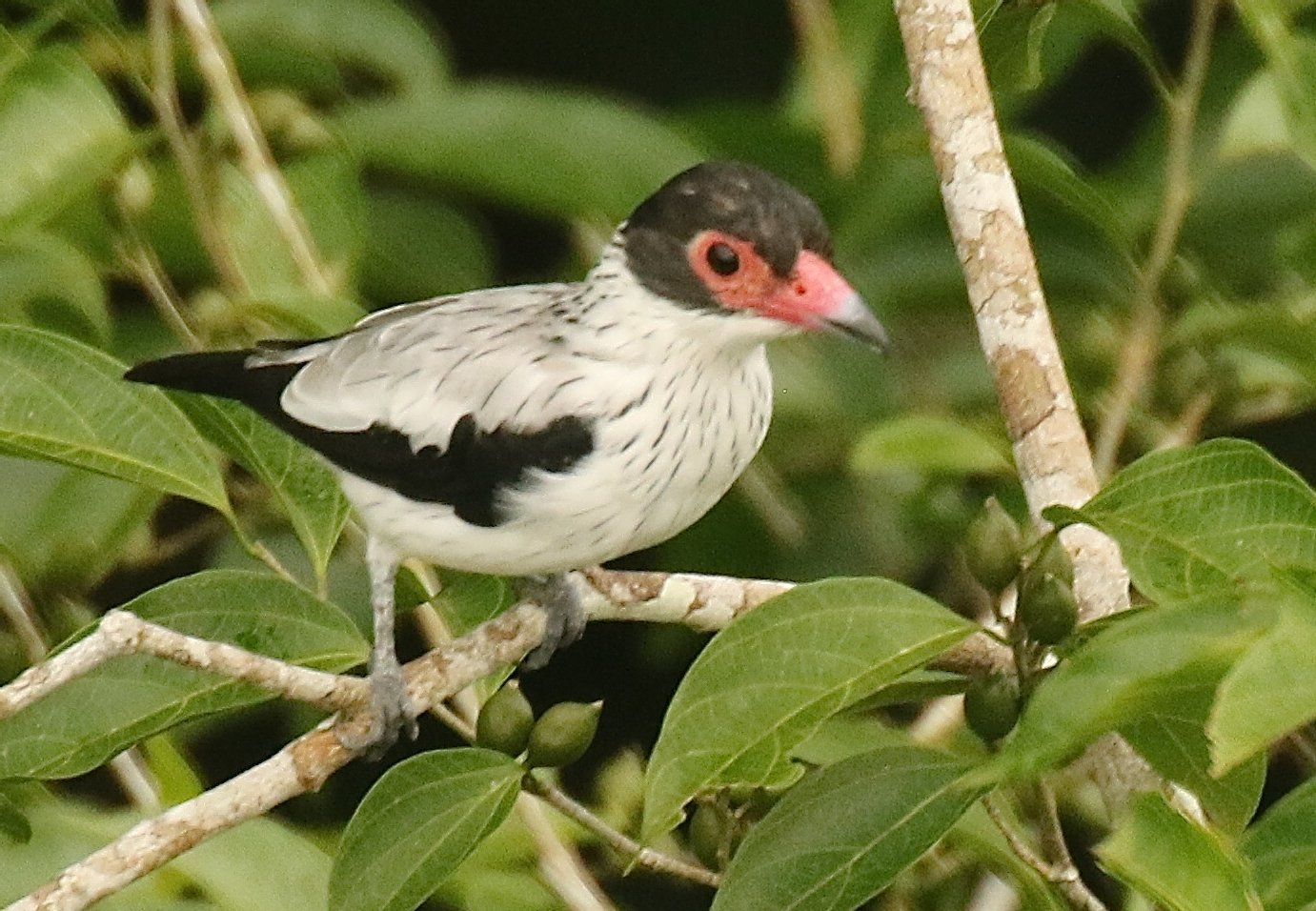
The Black-tailed Tityra is a stocky, largely white tree-dwelling bird of the tityra and becard family, which in the region occurs only on Trinidad. Pairs and small groups often perch in view on bare branches at the top of the canopy, at the forest edge or on a dead tree in a clearing, and are more often noticed by their grunting call than by any song.
Voice
Unmusical: short, nasal, buzzing or grunting calls such as ert, rek or wenk, often doubled or tripled and given most frequently in flight. They sound more like a frog or a toy horn than a songbird.
Recording: Jacob Wijpkema — CC BY-NC-SA 4.0 · shortened to the first 60 s, mono · xeno-canto
Identification
20–22 cm, with a large head, a heavy unhooked bill and a fairly short tail. The male is pale grey to silvery white above and white below, with a black cap reaching below the eye, black wings and an all-black tail. Around the eye is red bare skin; the bill is red with a black tip. The female has the same red eye-ring and bill but a dark brown cap, grey-brown upperparts, brownish-black wings and tail and whitish underparts. Juveniles resemble the female, with duller bare skin and bill.
Confusion species
No other tityra occurs on Trinidad. The male Bearded Bellbird Procnias averano is also largely white, but has a brown head, black wings with no red at eye or bill, and a tuft of black wattles on the throat; the female bellbird is green and streaked. White-winged Becard Pachyramphus polychopterus is much smaller and dark, with white wing bars.
Habitat
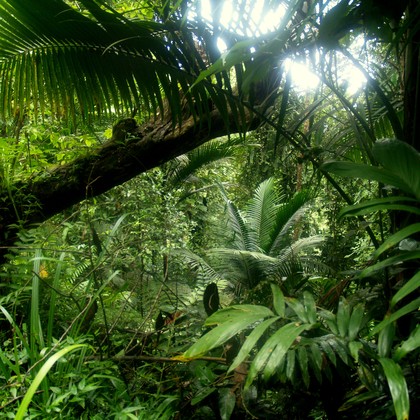
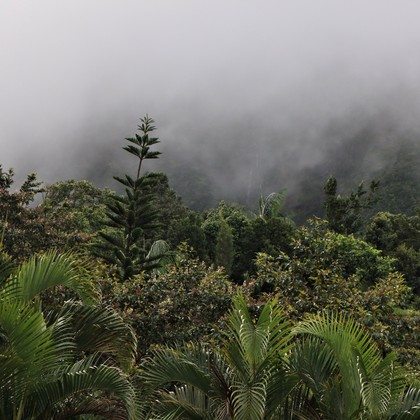
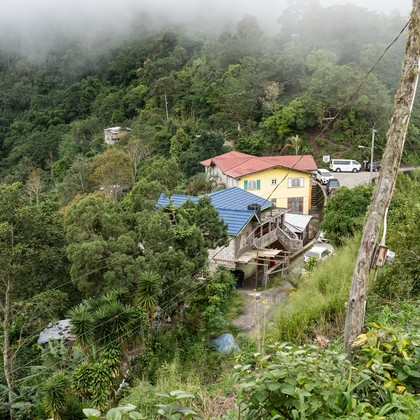
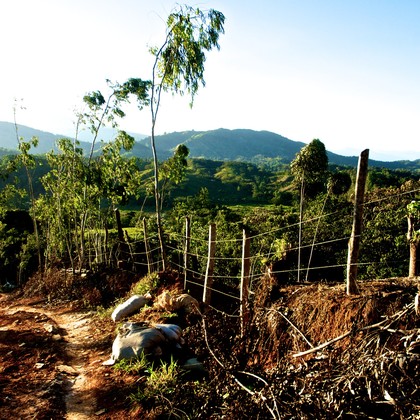
Forest edges, clearings and tall secondary forest, cacao and coffee plantations with shade trees, and semi-open country with scattered tall trees, mainly in the lowlands and lower hills. It feeds mostly on fruit, often plucked in a short sally from the perch, supplemented with large insects. It nests in a tree cavity, often an old woodpecker hole, several metres or more above the ground; the female incubates the eggs on a bed of dry leaves.
Where the bird is most at home, classified by the vegetation types of the Caribbean.

Range and movements
In the region only on Trinidad, where it is fairly common in the forested parts, including the Northern Range. It is absent from Tobago and the other islands. Outside the region from Venezuela and the Guianas through the Amazon basin to central and south-eastern Brazil, Bolivia and possibly north-eastern Argentina.
- Resident
- dark = core range, pale = thinly spread
How and when to look
Best found by scanning the tops of tall and dead trees along forest edges in the morning, when the birds sit there sunning or feeding on fruit. The nasal call often gives away a bird hidden in the canopy. Fruiting trees regularly attract them, together with tanagers and manakins.
Conservation status
Not threatened. The species has a very large range and tolerates forest edge, secondary forest and plantations with shade trees, though it depends on cavities in old or dead trees for nesting.
Scientific name
Tityra cayana | (Linnaeus, 1766)
Linnaeus described the species in 1766 as [Lanius] cayanus; because it was later moved to another genus, the author and year stand in brackets. The genus Tityra was introduced in 1816 by Vieillot. Tityra probably refers to the tituroi, the satyrs in the train of Pan and Bacchus, after the noisy, quarrelsome behaviour; the origin is not clear-cut. cayana refers to Cayenne in French Guiana, where the type specimen came from. The specimen the first description was based on came from Cayenne, French Guiana.