All species › Bustards › Bustards › Great Bustard
Great Bustard | Otis tarda
Grote trap | Avutarda común
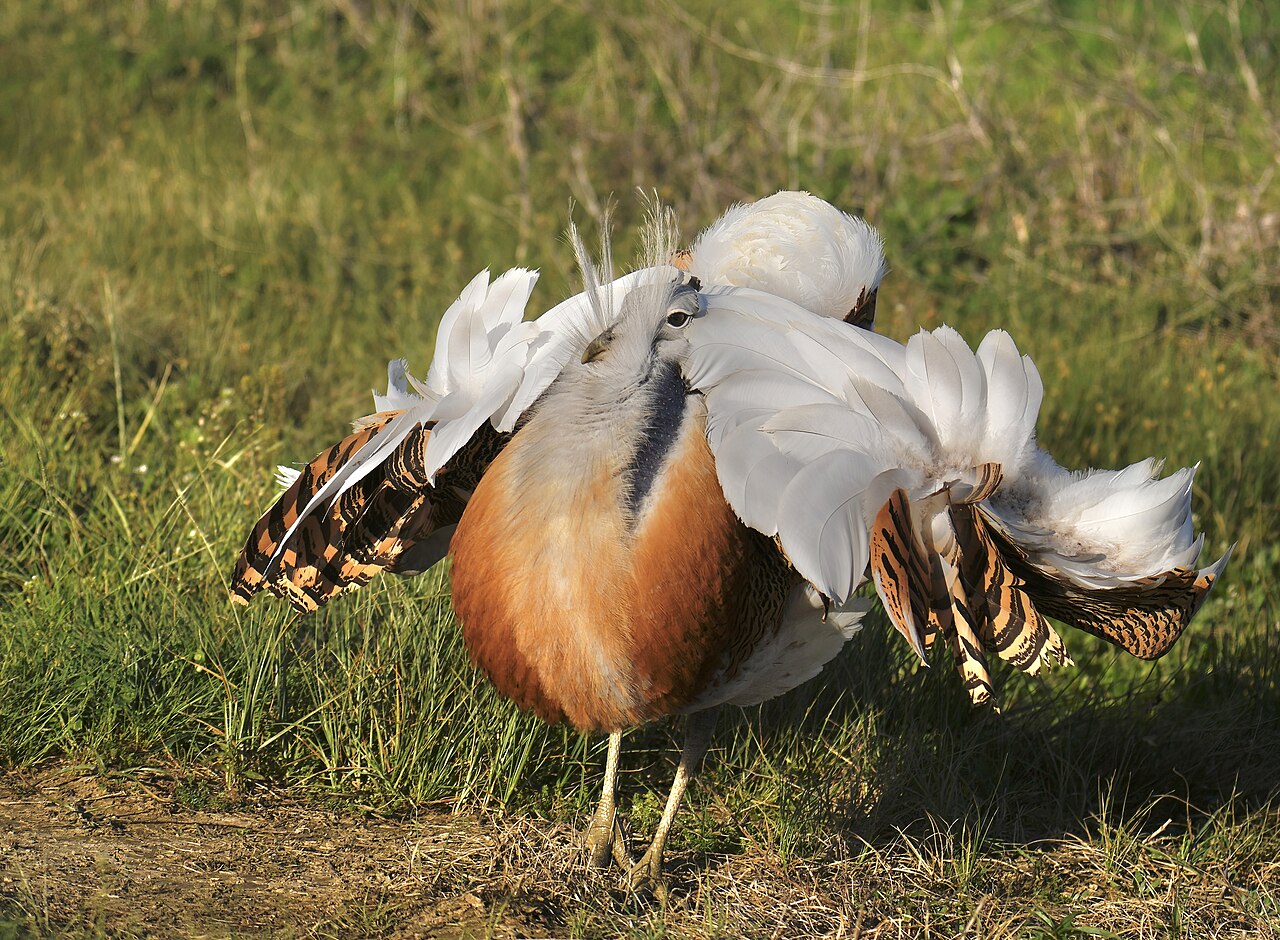
The heaviest bird in Europe still able to fly: an old male outweighs a White-Tailed Eagle and a Mute Swan combined. On a cereal plain in March the displaying males stand among the young wheat like upturned white parasols, visible from kilometres away.
Click a thumbnail to switch the photo above.
Voice
Effectively silent. Displaying males give a deep, muffled oomp that is hard to hear at a hundred metres and is usually lost to the wind; disturbed birds bark a short low chak. This is a bird to find by eye.
Recording: Esperanza Poveda — CC BY-NC-SA 4.0 · Wikimedia Commons
Identification
No European bird shows a wider gulf between the sexes. An old male is three to four times the weight of a female and almost a third longer, with a blue-grey head and neck, long white bristles either side of the bill and a broad rufous breast band that deepens with age. Females lack both the whiskers and the breast band and are simply sandy grey. Both sexes have a finely black-barred ochre back and a white belly. In flight the wing is enormous and largely white with black primaries and a black trailing edge, the beats slow and goose-like.
Confusion species
At range the real confusion is with livestock, boulders or straw bales rather than with another bird. Little Bustard is under a quarter the weight, flies with far quicker beats and shows an almost wholly white wing with no black trailing edge. A female Great Bustard in poor light can suggest a male Little Bustard: check the much longer neck and the heavy, deliberate walk.
Habitat
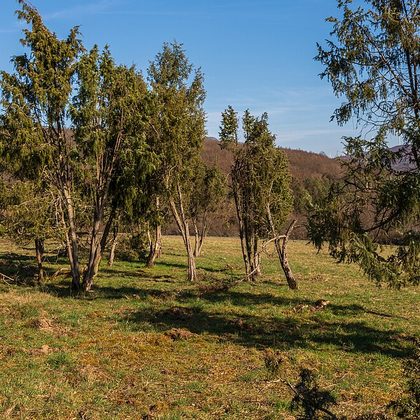
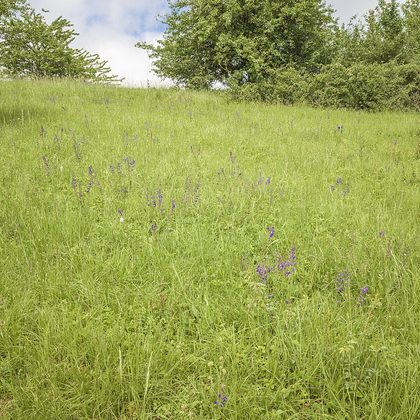
Large treeless cereal plains with a mosaic of fallow, alfalfa and pulses; in central Europe also hay meadows and oilseed rape. Great Bustards avoid power lines, roads and tall vegetation, and need plains of many hundreds of hectares with unobstructed views.
Where the bird is most at home, classified with EUNIS — the European standard for habitats.

Range and movements
The bulk of the world population is in Iberia; further groups live in central and eastern Europe, Anatolia and on the Iranian plateau. In the Mediterranean region the strongholds are the Iberian cereal plains: Villafáfila and Tierra de Campos, La Serena and the Llanos de Cáceres, the steppes around Madrid and La Mancha. In central Europe smaller groups remain, chiefly in the Pannonian Basin. In the British Isles the native birds were shot out by 1832; since 2004 birds of eastern European and Iberian stock have been released on Salisbury Plain, where a small free-flying population now breeds. Resident; it strays into north-west Europe only exceptionally, most recently in the hard winters of the late 1960s and 1970s, when parties from central Europe moved west.
- Resident
- Breeding (summer)
- Winter
- Passage
- dark = core range, pale = thinly spread
How and when to look
March and April, early in the morning, from the car on a cereal plain: Villafáfila in Zamora, where hundreds of birds come into view in a single April morning, La Serena and the Llanos de Cáceres in Extremadura, the Havelländisches Luch west of Berlin, where the birds display inside fox-proof fencing, or the March–Thaya floodplain and the steppes of Dévaványa and Kiskunság. On Salisbury Plain the released birds carry wing tags and are easiest in winter, when they gather in loose parties on the arable. Always stay in the vehicle: a bustard tolerates a car and will not tolerate a person on foot.
Conservation status
Uplisted from Vulnerable to Endangered in 2023. Collision with power lines is the chief cause of adult mortality, while the loss of fallow and fodder legumes, the switch from dry cereal to irrigation, early mowing and machinery disturbance destroy nests. Recovery programmes are under way west of Berlin and on Salisbury Plain; both populations derive from released birds and heavily guarded breeding areas.
Scientific name
Otis tarda | Linnaeus, 1758
Linnaeus described the species in 1758 and placed it straight away in the genus where it still stands. He introduced the genus Otis in that same work. Otis is Greek ōtis, the name Pliny and other classical authors used for the bustard. tarda is Latin for 'slow, deliberate', after the bird's measured walk; from avis tarda 'slow bird' came the English name bustard, by way of Old French. The specimen the first description was based on came from Poland.