All species › Birds of prey › Hawks, eagles and kites › Egyptian Vulture
Egyptian Vulture | Neophron percnopterus
Aasgier | Alimoche común
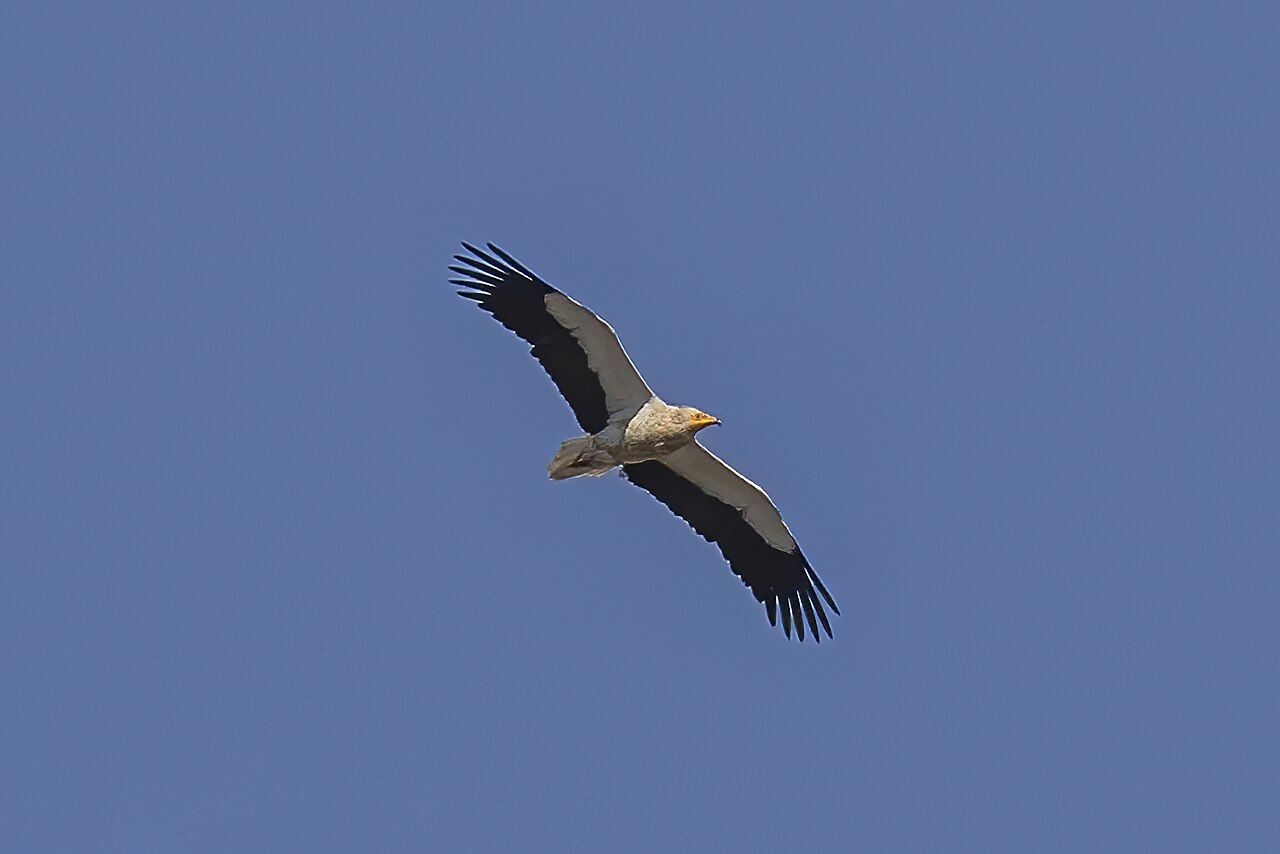
The Egyptian Vulture is Europe's smallest vulture and the only one that crosses the Sahara twice a year. White and black, with a bare yellow face and a wedge-tipped tail, in the air it suggests an agile stork more than a vulture. Well over half the European population breeds in Iberia.
Click a thumbnail to switch the photo above.
Voice
Almost always silent; away from the colony and the carcass you will hardly hear it. At the nest and in squabbles over food a hoarse growling, a hissing sseee and a nasal, mewing myaaa; young beg with a harsh, repeated chi-chi-chi. At the nest ledge a soft grunting sometimes passes between the pair, and otherwise there is silence.
Recording: Mischa Keijmel — CC BY-NC-SA 4.0 · Wikimedia Commons
Identification
A small, slender vulture, dirty white to cream with black flight feathers: the black-and-white flight pattern is unmistakable, the whole trailing edge of the wing dark. The tail is white and clearly wedge-shaped, with an angled tip, and projects well behind the wing. Head and throat are bare and bright yellow, and the long, bristly hind-neck feathers form a spiky mane. The bill is slender, yellow with a black tip. Soars on flat wings with the hands pushed slightly forward; the wing is narrow for a vulture. Juveniles are almost uniformly dark brown with a greyish face, becoming blotchily paler over four or five years.
Confusion species
The dark juvenile is the problem. A distant small Cinereous Vulture can be confused with it: Cinereous is huge, with far broader, straight wings and a short tail, while the young Egyptian has narrow wings and a long wedge-shaped tail — and the size gives itself away the moment it flies beside a Griffon. Confusion with Black Kite is more real: the kite has a forked or square-cut tail, never a wedge, flies on supple beats and constantly twists its tail, and shows a pale patch at the base of the primaries. The white adult can only be confused with a White Stork, which carries neck and legs outstretched and has a red bill, or with an adult Bearded Vulture, much larger, with long narrow wings and orange underparts without black.
Habitat
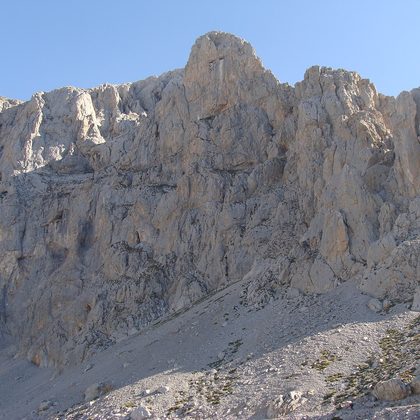
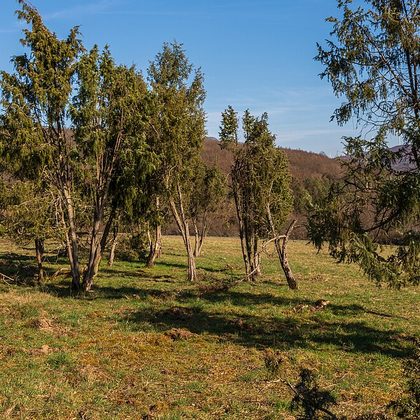
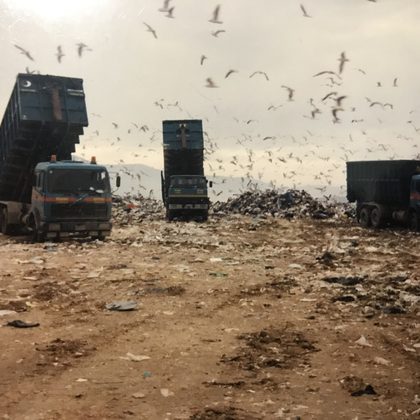
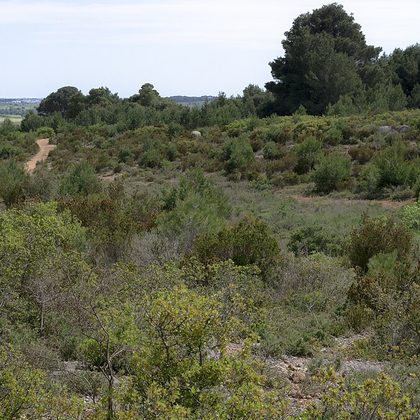
Breeds on cliffs and in river canyons, on ledges and in cavities of limestone or sandstone walls, often in smaller ravines than those used by the Griffon. Forages over cereal steppe, dehesa, poor pasture and garrigue with extensive livestock, and visits feeding stations, rubbish tips and farmyards faithfully, taking small scraps, afterbirths and insects. It also searches roadsides and dry riverbeds.
Where the bird is most at home, classified with EUNIS — the European standard for habitats.

Range and movements
Iberia is the stronghold, with 1,557 to 1,657 pairs in all, mainly in the Ebro valley, the Iberian System, Castile and León, Extremadura, Andalusia and the Pyrenees; on Fuerteventura and Lanzarote a resident island population, the guirre, of over four hundred birds. Elsewhere in the Mediterranean region some 130 pairs remain in all; the Balkan population shrinks year on year. It also breeds in Anatolia, the Caucasus, the Levant and North Africa. European birds winter in the Sahel.
- Resident
- Breeding (summer)
- Passage
- dark = core range, pale = thinly spread
How and when to look
March to September in the rock gorges of Iberia — the Duratón, the Riaza, the Ebro, Monfragüe — or all year on Fuerteventura and Lanzarote. Early in the morning pairs are still on the ledges of the cliff and can be watched at leisure; by mid-morning they leave to forage. An active feeding station, a livestock carcass dump, or a mountain pass where migrating raptors concentrate — the Strait of Gibraltar at Tarifa in August and September — offers the best chance.
Conservation status
IUCN: Endangered. It is the only European vulture in that category worldwide. The population collapsed through the twentieth century; in Europe the Iberian population is stable but the Balkan one keeps shrinking. Threats are illegal poison, veterinary medicines in livestock carcasses, electrocution and collision on power lines, wind turbines, nest robbery and, on migration and in the African wintering grounds, hunting and trade for traditional uses.
Scientific name
Neophron percnopterus | (Linnaeus, 1758)
Linnaeus described the species in 1758 as Vultur perenopterus; because it was later moved to another genus, the author and year stand in brackets. The genus Neophron was introduced in 1809 by De Savigny. Neophron is taken from Greek mythology: Neophron was turned into a vulture by Zeus. percnopterus is Greek, from perknos 'blue-black' and pteron 'wing': 'black-winged', after the black flight feathers in the otherwise white wing. The specimen the first description was based on came from Egypt.