All species › Passerines › Larks › Black Lark
Black Lark | Melanocorypha yeltoniensis
Zwarte leeuwerik | Calandria negra
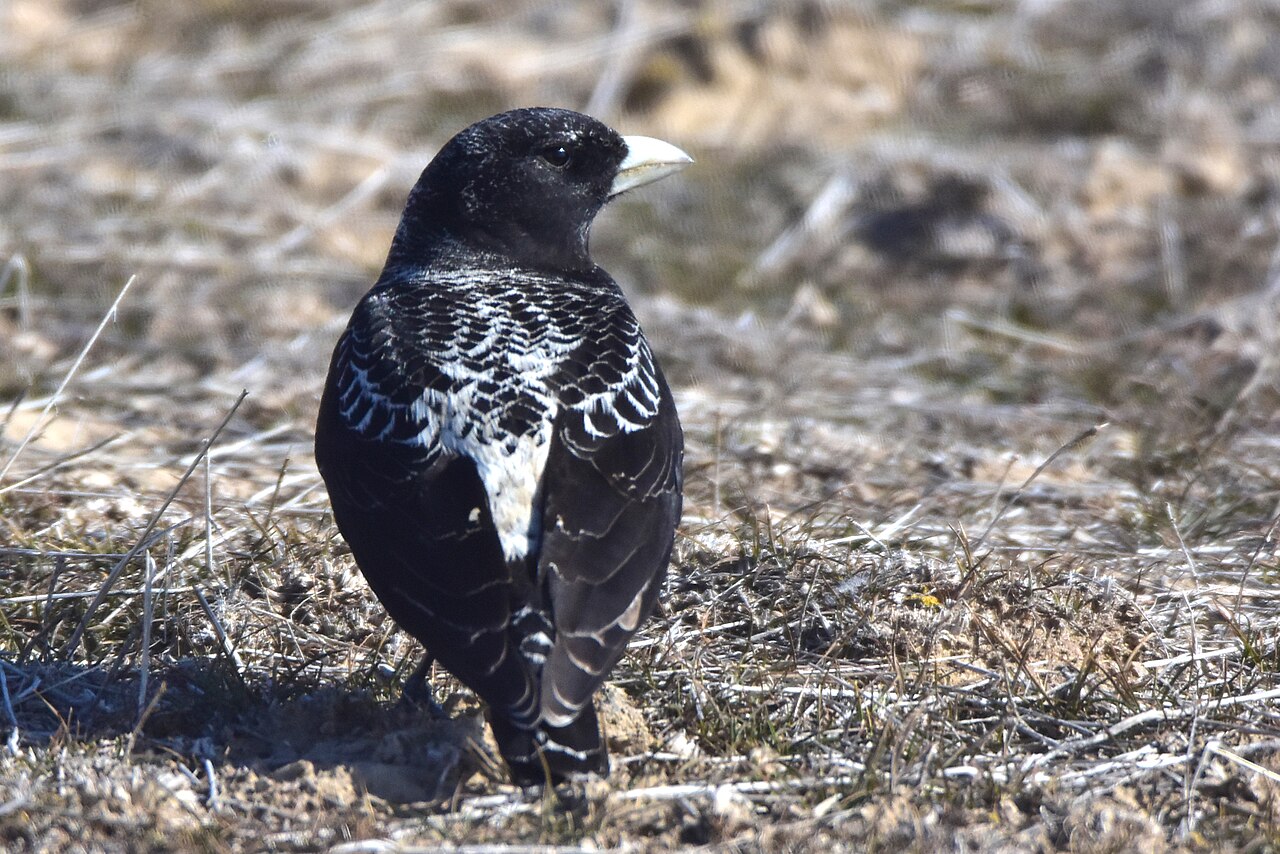
A sooty-black lark with an ivory bill — no other songbird in the region looks remotely like it. It belongs to the saline steppe of the Caspian lowland and the Kazakh steppe, where the males simply sit out the winter while the far plainer females move west in flocks.
Voice
The song recalls a Skylark's but has shorter phrases, a higher pitch and far more grating, buzzing and mimicked elements; it is delivered in bursts rather than in the minutes-long stream. In the song flight the male climbs on slow deep beats and then glides with the wings held in a high V, harrier-fashion, black against the sky. He also sings standing on an earth clod or a molehill. The call is a hard rolling chirp and a dry chrrt, deeper than a Skylark's. In spring the male carries lumps of dried dung and small stones to the nest and builds them into a low rampart on the windward side.
Recording: Steve Klasan — CC BY-NC-SA 4.0 · Wikimedia Commons
Identification
A large, very thickset lark with a broad head, a short tail and a heavy pale bill. In spring the male is entirely sooty black, underwing and undertail included, with black legs and a strikingly ivory to pale yellow bill. In fresh autumn plumage broad pale feather fringes cover all that, so the bird looks coarsely scaled; the fringes wear away through the winter and only by April is he uniform black. The female is clearly smaller and quite different: grey-brown, heavily mottled and streaked, with dark underwing coverts, dark legs and no white whatever in wing or tail. Her size and heavy bill give her away.
Confusion species
A black male can only be confused with a Starling, and that has a pointed yellow bill, a short tail and triangular wings — the lark is more compact, walks rather than bustles, and has a thick blunt bill. The problem is the female. Against a Skylark she is bulkier, bigger-headed and far thicker-billed, and she lacks the white outer tail feathers and the white trailing edge to the wing altogether; the underwing is dark, not pale. A female Calandra Lark shows black neck patches, a white trailing edge and white tail sides, and is thereby easily distinguished. White-Winged Lark, which shares the same steppe, always gives itself away with white secondaries and a chestnut shoulder.
Habitat
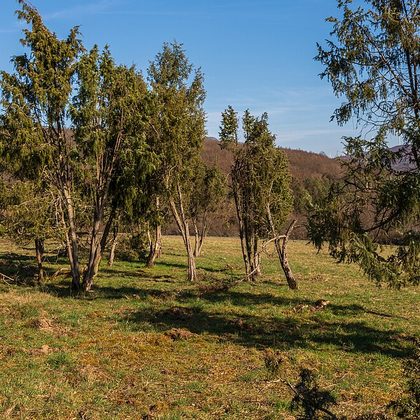
Flat, grassy and often saline steppe: solonetz and solonchak flats (two types of steppe salt soil) with wormwood and saltbush, hollows around steppe lakes, and short-grazed pasture. It prefers ground with water nearby where the sward stays low and patchily open. In winter the black males stay out on the snow-covered steppe, feeding on seed along stubbles and tracks and breaking the crust with the bill.
Where the bird is most at home, classified with EUNIS — the European standard for habitats.


Range and movements
Breeds on the steppes between the Don and the Volga — Rostov, Volgograd, Kalmykia, Astrakhan, Saratov and Orenburg — and eastwards across the whole Kazakh steppe to the foot of the Altai. The western part of that range lies inside the map area, but the bulk of it lies well beyond, on the Kazakh steppe. In winter mainly females and young birds wander west to the Pontic steppe and Crimea; in severe winters flocks push further into Europe. West of that it is an exceptional vagrant, with a few dozen records for Europe as a whole.
How and when to look
April and May on the steppe of Kalmykia, around the Manych lakes, or on the central Kazakh steppe. Drive slowly along a steppe track and look for black dots on the pale, half-snowy or newly green ground; they show up kilometres away. Then wait for the song flight with the wings in a V. In winter, work the same plains for flocks made up entirely of black males; the grey-brown females are hundreds of kilometres away by then.
Conservation status
Not threatened (LC): a huge range and still millions of birds. The history has been up and down, though. The wholesale ploughing of the steppe for grain in the 1950s and 1960s cost a great deal of breeding ground; after 1991 much of that arable fell fallow again and the species recovered. Pressure is now rising again through the recultivation of that fallow, irrigation and the drying of the saline hollows — and it is precisely the saline steppe that is its core habitat. Numbers are most sensitive along the western edge, on the Pontic and Caspian steppes.
Scientific name
Melanocorypha yeltoniensis | (Forster, 1768)
Forster described the species in 1768 as Alauda yeltoniensis; because it was later moved to another genus, the author and year stand in brackets. The genus Melanocorypha was introduced in 1828 by Boie. Melanocorypha is Greek, from melas 'black' and koruphos, a bird of classical authors that can no longer be identified, here confused with korudos 'lark'. yeltoniensis refers to Lake Yelton in the Volgograd region of Russia. The specimen the first description was based on came from Lake Elton, Russia.