All species › Passerines › New World warblers › Virginia's Warbler
Virginia's Warbler | Leiothlypis virginiae
Virginiazanger | Reinita de Virginia
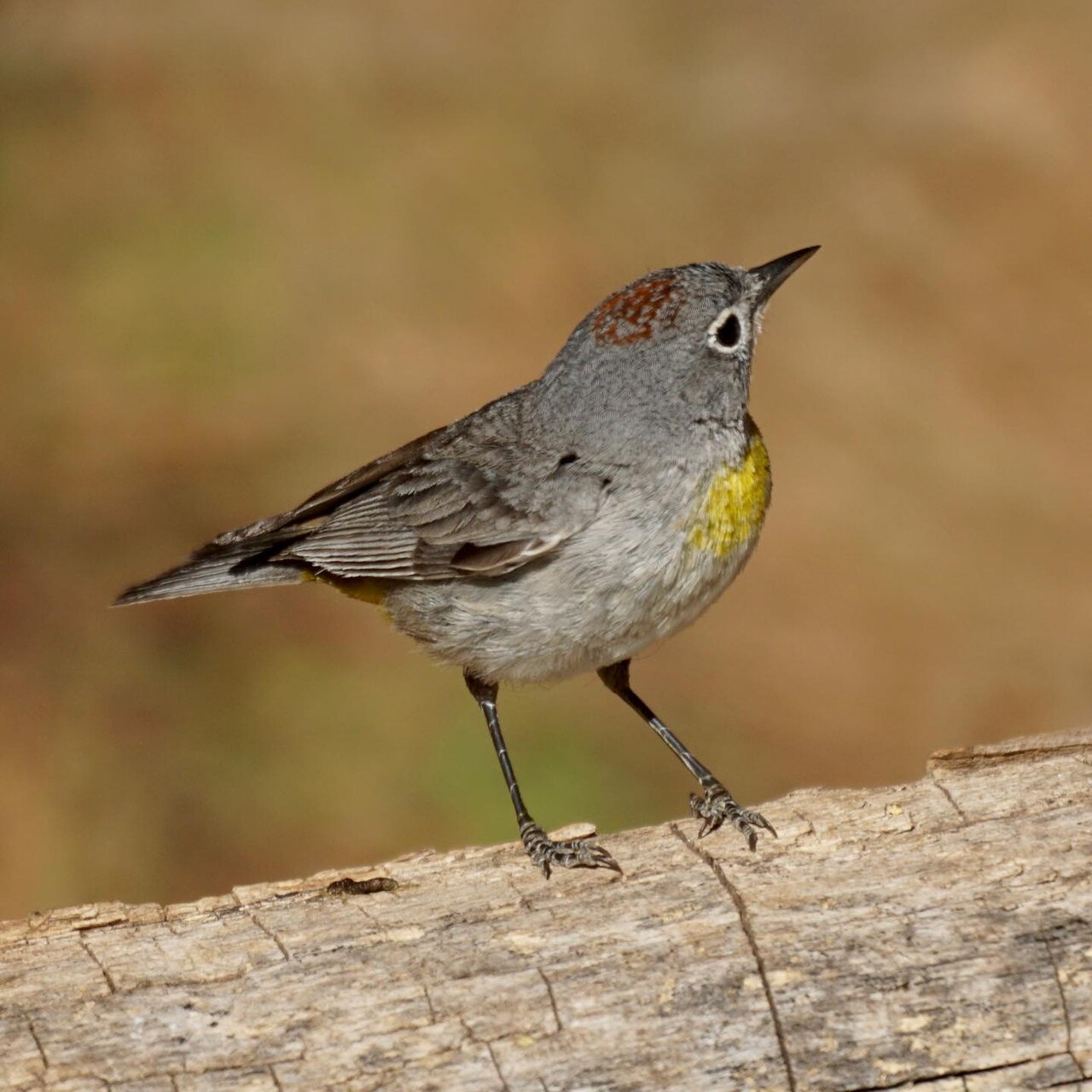
Virginia's Warbler is a largely grey warbler with a white eye-ring and yellow on the breast and undertail coverts, belonging to the pinyon (a low-growing pine of the dry southwestern foothills)-juniper woodland and oak scrub of the southern Rocky Mountains. Its breeding range is small and lies almost entirely in the mountains of the American Southwest.
Voice
The song is a loose, fast series of about ten thin chee-chee-chee notes that changes pitch halfway through and ends on a lower note; it sounds thinner and less clearly separated than a Nashville Warbler's. The call is a dry, high chik, often repeated from an oak bush. Males sing from late April into July, usually from a branch partway up a slope.
Recording: Sue Riffe — CC BY-NC-SA 4.0 · Jensen Memorial Park (Meeker), Rio Blanco Cty, Colorado, United States · xeno-canto
Identification
Plain grey above and below, with a bright white eye-ring in an otherwise unmarked grey face. Yellow is limited to a few places: a patch on the breast, the undertail coverts and a faint yellow wash on the rump. The male has a hidden chestnut crown patch. The tail is long for the size of the bird and is pumped up and down continuously while foraging — a behaviour that shows at a distance. Females and young birds have less yellow on the breast, or none.
Confusion species
Nashville Warbler has an olive-green back instead of a grey one and yellow running across the whole throat and breast. Lucy's Warbler is smaller and shorter-tailed, lacks yellow and has a cinnamon rump. Colima Warbler, which breeds in the United States only in the Chisos Mountains of Texas, is larger and browner on the flanks, with buff rather than white flanks and an orange-yellow rump. The grey form of Orange-crowned Warbler lacks the crisp eye-ring and has fine breast streaking.
Habitat
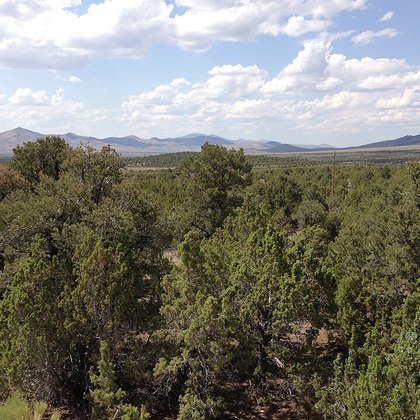
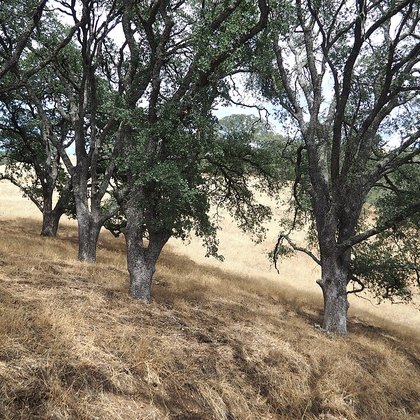
Open pinyon-juniper woodland, oak scrub and pine forest on steep slopes roughly between 1800 and 2750 metres, with a dense shrub layer of scrub oak, manzanita or mountain mahogany. Dry side canyons with brush and the shrubby margins of mountain streams are also occupied. The nest is on the ground, hidden under a tussock or dead leaves. On migration and in winter it occurs in dry tropical deciduous forest and scrub.
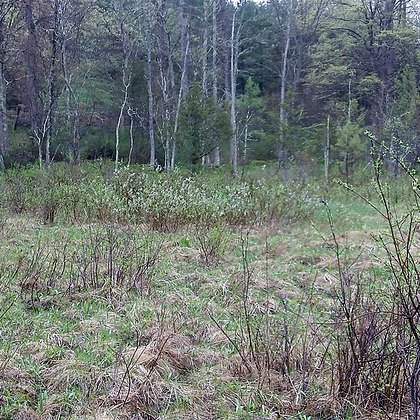
Where the bird is most often found, arranged by the USNVC — the vegetation classification of the United States and Canada — and CMECS for sea and coast.


Range and movements
It breeds in Colorado, Utah, Nevada, Arizona, New Mexico, southern Wyoming and West Texas, with the core in Colorado and New Mexico. It arrives in the second half of April and leaves in August and September along the mountains of northwestern Mexico. It winters in southwestern Mexico, in the states from Jalisco and Michoacán to Guerrero and Oaxaca; vagrants occasionally reach the east coast of the United States.
- Breeding (summer)
- Winter
- Passage
- dark = core range, pale = thinly spread
Where and when to look
Look for it in May and June on a dry oak slope in the mountains of northern New Mexico or southern Colorado; the song carries far, but the bird stays in the shrub layer. Watch for the tail pumping: with the white eye-ring and the yellow under the tail, that is the quickest confirmation.
Conservation
The species is listed as Least Concern (LC), with a world population of the order of half a million birds, virtually all of them within the guide area. The small, patchy range makes it sensitive to change in pinyon-juniper woodland: large-scale die-off from drought and bark beetles, removal of juniper for grazing and more intense wildfire all reduce the breeding area. Management that leaves the shrub layer under the pinyons keeps the habitat usable.
Scientific name
Leiothlypis virginiae | (Baird, 1860)
Spencer Fullerton Baird described the species in 1860 as Helminthophaga virginiae, from a specimen collected in 1858 by the army surgeon William Wallace Anderson at Fort Burgwin, Taos County, New Mexico; because it was later moved to another genus, author and year stand in parentheses. The species name refers not to the state of Virginia but to Virginia Anderson, the collector's wife. The genus Leiothlypis comes from Greek leios 'smooth, plain' and thlypis, a name for a small bird.