All species › Passerines › New World warblers › Connecticut Warbler
Connecticut Warbler | Oporornis agilis
Connecticutzanger | Reinita de Connecticut
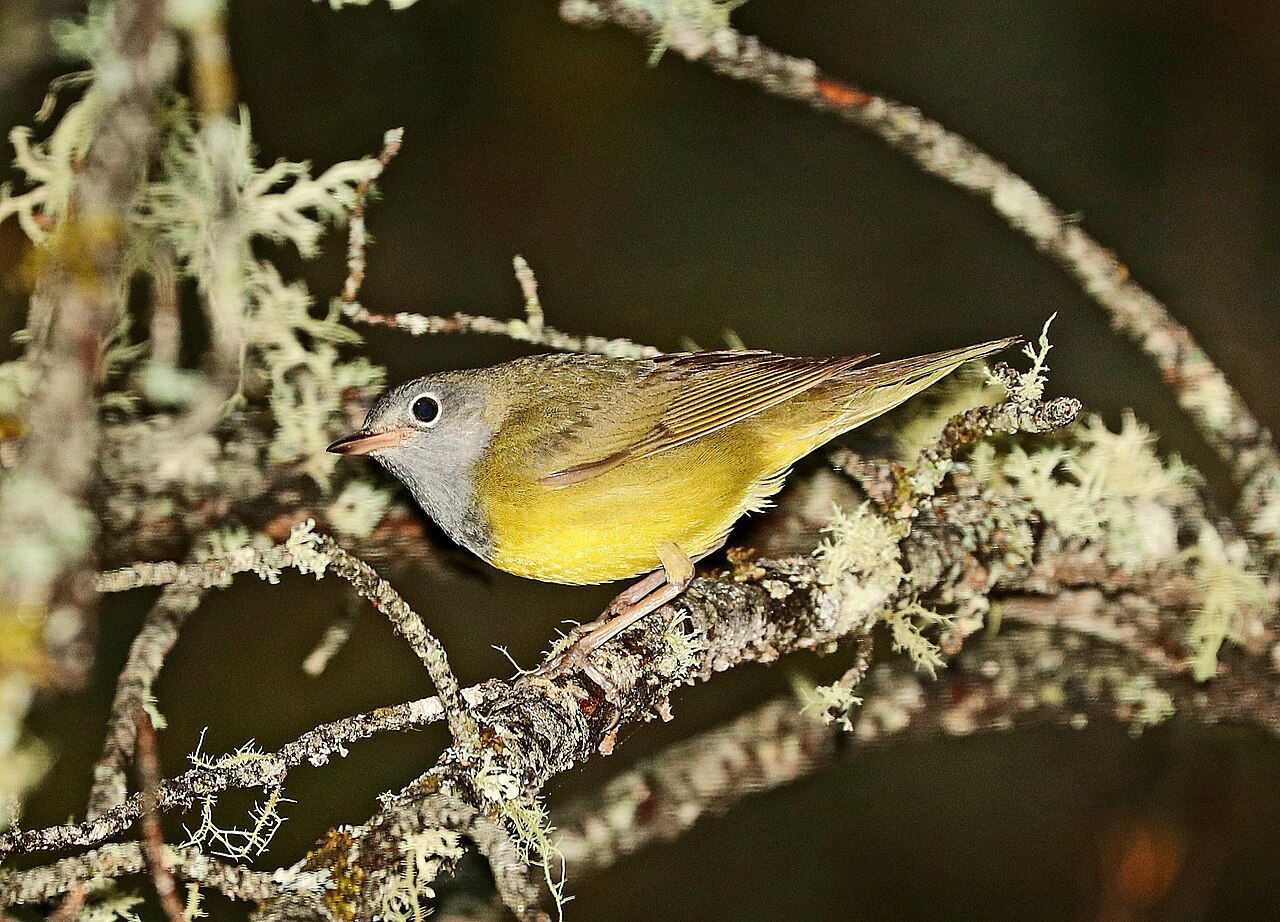
The Connecticut Warbler is a large, stocky warbler with a grey hood, a complete white eye-ring and yellow underparts, and it walks on the ground rather than flitting through the canopy. It breeds in remote bog and aspen woodland of central Canada and the Great Lakes, and is among the least studied songbirds in North America.
Voice
The song is a loud, ringing repetition of two-syllable motifs, often rendered cheepa-cheepa-cheepa-cheep, at a pitch recalling Ovenbird and Kentucky Warbler. The volume builds through the series and the sound carries hundreds of metres across open bog. The call is a dull, placeless chip that is almost never heard on migration: the species is largely silent when passing through.
Recording: Michael Collins — CC BY-NC-SA 4.0 · Kenora, Unorganized (near Lowther), Kenora District, Ontario, Canada · xeno-canto
Identification
Heavy and short-tailed in build, with long pink legs, a stout pointed bill and undertail coverts reaching almost to the tip of the tail — a proportion that separates it from the other hooded warblers. The male has an even grey hood over head, throat and upper breast, an olive-green back and a yellow belly. The white eye-ring is complete and of even width all the way round. Females and first-year birds have a browner, duller hood, but always that same unbroken ring. It walks through the understorey rather than hopping.
Confusion species
Mourning Warbler has no eye-ring or at most a broken one, a longer tail, shorter undertail coverts and, in the male, a black patch on the breast; it hops rather than walks. MacGillivray's Warbler has an eye-ring broken before and behind the eye, leaving two white arcs. Nashville Warbler is far smaller, with a yellow throat and an olive-green back. In first-year birds, the structure, the long undertail coverts and the way it moves remain the most reliable marks.
Habitat
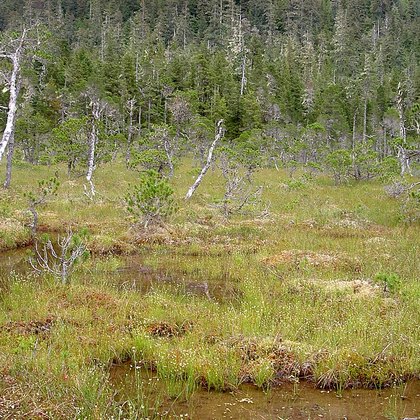
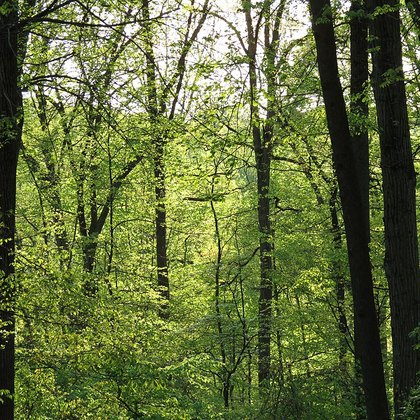
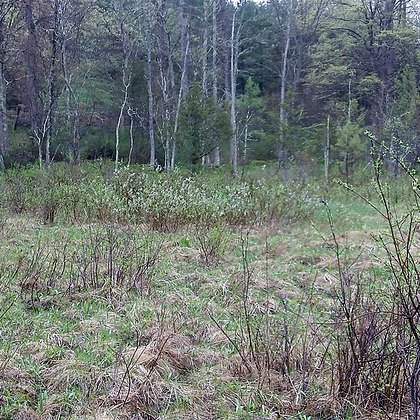
Open spruce and tamarack bog, muskeg (boggy peatland with spruce, typical of boreal Canada) with a wet moss floor, and drier aspen and poplar woodland with an open understorey in the north of the breeding range. The nest is well hidden in moss or in a grass tussock on the ground. On migration it uses dense herb layer and scrub along woodland edges, field margins and weedy fields, usually out of sight. In winter it keeps to the understorey of tropical lowland forest.
Where the bird is most often found, arranged by the USNVC — the vegetation classification of the United States and Canada — and CMECS for sea and coast.

Range and movements
The breeding range runs in a narrow band from northeastern British Columbia and the southwestern Northwest Territories east through Alberta, Saskatchewan, Manitoba and Ontario to central Quebec, and south to Minnesota, Wisconsin and Michigan. Migration follows an ellipse: in spring through the Midwest and across the Gulf coast, in autumn much more along the Atlantic seaboard. Tracking work has shown a two-day flight across the Caribbean to the Antilles. It winters in the Amazon basin, well outside the area of this guide.
- Breeding (summer)
- Passage
- dark = core range, pale = thinly spread
Where and when to look
The best chance is a singing male in June in a bog in northern Minnesota or Manitoba; on migration the species is largely silent and stays in cover. Then search the ground along a dense woodland edge early in the morning, and watch for a bird that walks rather than hops.
Conservation
The species is listed as of Least Concern (LC), but numbers are falling: migration counts and breeding bird surveys point to a long-term decline, and in Saskatchewan, Michigan, Minnesota and Wisconsin it appears on provincial or state lists of species of concern. Drainage of peatland, logging in aspen woodland and forest loss on the wintering grounds are cited as the pressures. Because the breeding grounds are thinly populated and hard to reach, the trend figures are less certain than for most warblers.
Scientific name
Oporornis agilis | (Wilson, 1812)
Alexander Wilson described the species in 1812 as Sylvia agilis, from a bird taken in Connecticut; because it was later moved to another genus, author and year stand in parentheses. The species name is Latin for 'nimble, quick'. The genus Oporornis comes from Greek opōra 'late summer, autumn' and ornis 'bird', after the season in which the species is seen in the east. The English and Dutch names refer to where the first specimen was found; in Connecticut itself the bird occurs only on passage.