All species › Passerines › New World warblers › Nashville Warbler
Nashville Warbler | Leiothlypis ruficapilla
Nashvillezanger | Reinita de Nashville
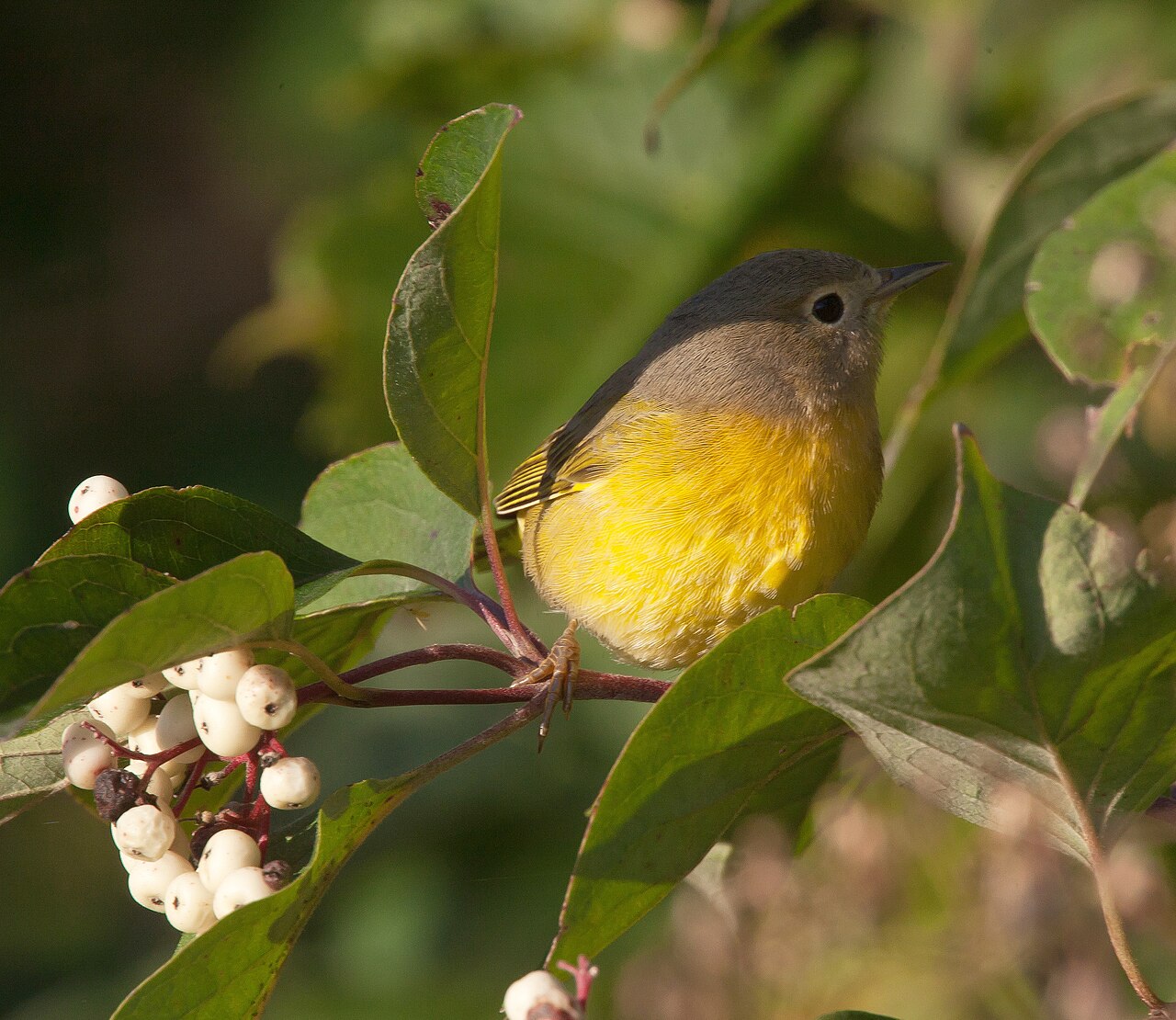
The Nashville Warbler is a small warbler with a grey head, a white eye-ring and yellow underparts that breeds in scrub and young regrowth at the edge of woodland. Its range falls into two separate halves: an eastern one in Canada and the northeastern United States, and a western one from British Columbia to California.
Voice
The song has two parts: first a series of clear, two-syllable see-wit see-wit see-wit notes, then a lower, faster trill ti-ti-ti-ti. Western birds sing slightly lower and richer than eastern ones. The call is a sharp, metallic chink, harder still in western birds; on migration a thin, high seet can be heard.
Recording: Ray Cooke — CC BY-NC 4.0 · Little River Road, First Bog East Corner, Albion Cross, Prince Edward Island, Canada · xeno-canto
Identification
A compact warbler with a plain grey head, an olive-green back and a yellow throat, breast and undertail coverts. Between the yellow breast and the yellow undertail coverts lies a white belly patch — a mark that separates it from many yellow warblers. The broad white eye-ring stands out sharply against the grey and is unbroken. The male has a rusty crown patch usually hidden under the grey. The bill is thin and pointed; the species forages at middle heights among twigs and leaves. Western birds pump the tail almost constantly, eastern birds rarely.
Confusion species
Virginia's Warbler is grey rather than green on the back and has yellow only on the breast and under the tail, not on the throat. Orange-crowned Warbler lacks the crisp white eye-ring and has a dull dark lore and fine breast streaking. Tennessee Warbler has white rather than yellow undertail coverts and a clear pale supercilium. Connecticut and Mourning Warblers are far larger, with a grey hood extending onto the breast and no yellow on the throat.
Habitat
Young regrowth, cutover, abandoned pasture grown to scrub, and the rough edges of open woodland. In the east it breeds in mixed forest, spruce and cedar bog and peatland with small spruces; in the west in oak scrub, brush on mountain slopes and open pine and fir forest. In every case these are places with a thick low shrub layer and a broken canopy; the nest is on the ground, hidden under moss or a grass tussock. On migration it uses almost any scrub, gardens and parks included.
Where the bird is most often found, arranged by the USNVC — the vegetation classification of the United States and Canada — and CMECS for sea and coast.





Range and movements
The eastern breeding range runs from Saskatchewan and Manitoba east to Quebec and the Maritimes, and south to Minnesota, Wisconsin, Michigan, New York and New England. The western one lies in British Columbia, Washington, Oregon, Idaho, western Montana and California. It winters largely in Mexico, from Sonora and Tamaulipas south to Chiapas and Yucatán, and on into Belize, Guatemala, Honduras and El Salvador; small numbers stay in South Texas and on the California coast. On migration it can be seen across almost the whole eastern half of the continent.
- Resident
- Breeding (summer)
- Winter
- Passage
- dark = core range, pale = thinly spread
Where and when to look
In May it turns up on migration in deciduous woodland and city parks; watch for the combination of grey head, white eye-ring and yellow throat, and do not forget the white belly patch. In autumn, when the plumage closely resembles that of other species, the eye-ring and the yellow undertail coverts remain the most usable marks.
Conservation
The species is listed as Least Concern (LC) and numerous; the world population is put at several tens of millions; over the last half century the trend is roughly stable, with local increases where forest is cut and grows back. Because it lives off young succession it depends on disturbance: logging, fire and abandoned farmland create breeding habitat, while mature forest removes it again. In the west drought and the loss of oak scrub are the main pressures.
Scientific name
Leiothlypis ruficapilla | (Wilson, 1811)
Alexander Wilson described the species in 1811 as Sylvia ruficapilla, from a bird he collected near Nashville, Tennessee; because it was later moved to another genus, author and year stand in parentheses. The species name comes from Latin rufus 'reddish' and capillus 'hair of the head' and refers to the rusty crown patch. The genus Leiothlypis is from Greek leios 'smooth, plain' and thlypis, a name for a small bird. The bird does not breed near Nashville; it passes through only on migration.