All species › Nightjars › Nightjars and nighthawks › Eastern Whip-poor-will
Eastern Whip-poor-will | Antrostomus vociferus
Whippoorwill | Chotacabras Cuerporruín Norteño
Eastern Whip-poor-will is the nightjar that repeats its own name without end on summer nights across eastern North American woods, often into early morning — a sound generations of Americans know without ever having seen the bird. By day it vanishes completely into the dead leaves of the forest floor.
Voice
The song is the three-syllable whip-poor-will, accented on the first and last syllable with a brief tremulous middle one, immediately followed by the next repetition — so the whole run sounds like a continuous, circling loop rather than separate calls. A male can repeat the phrase hundreds of times in a row, especially around sunset, under a full moon, and just before dawn. When disturbed near the nest it gives a short, sharp quirt, and sometimes a growl or a wing-clap.
Recording: Stanislas Wroza — CC BY-NC-SA 4.0 · La Haute-Côte-Nord (near Grandes-Bergeronnes), Côte-Nord, Québec, Canada · xeno-canto
Identification
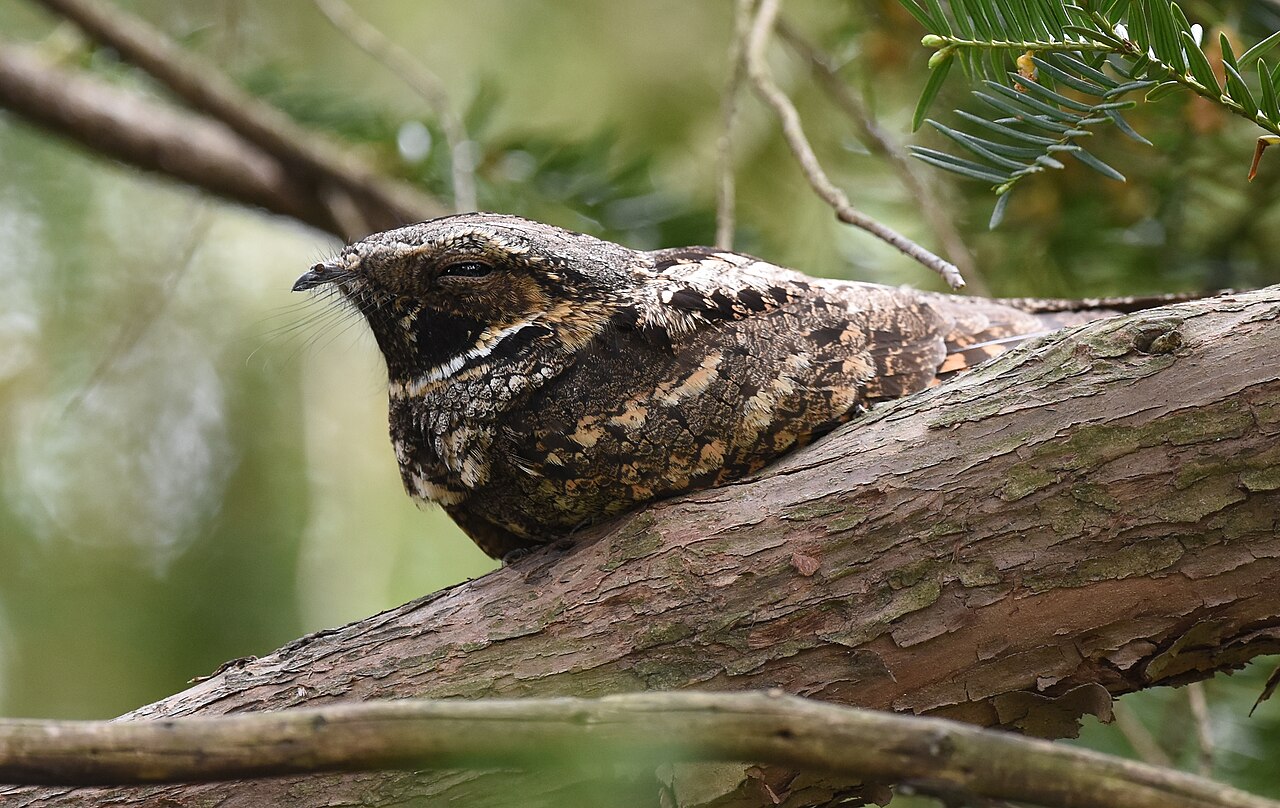
A medium-sized nightjar with a large, round head and a stout chest that tapers to long wings and tail, giving the bird a front-heavy, tapering silhouette. The plumage is a fine mosaic of grey, brown and black that blends seamlessly with dead leaves. The male shows broad, pure white corners to the outer tail feathers, flashing as two pale patches in flight; in the female those corners are narrower and buffy rather than white.
Confusion species
Mexican Whip-poor-will (Antrostomus arizonae) looks essentially identical and was treated as the same species until 2010; the most reliable distinctions are the song, which in Mexican Whip-poor-will is lower-pitched and burrier, lazier in delivery, and the range, which lies west and south of the Eastern's with almost no overlap. Chuck-will's-widow (Antrostomus carolinensis) is considerably larger, with buffy rather than white tail corners and a four-note rather than three-note call. Lesser Nighthawk (Chordeiles acutipennis) has long, pointed wings with a white bar and hunts on the wing rather than sallying from a perch.
Habitat
Dry deciduous or mixed forest with little undergrowth, preferably close to open ground: oak-pine woods, abandoned plantations, and scrubby forest with clearings. It avoids dense, unbroken forest without openings. On its wintering grounds it seeks out similarly open, low tropical and subtropical broadleaf forest.
Where the bird is most often found, arranged by the USNVC — the vegetation classification of the United States and Canada — and CMECS for sea and coast.




Range and movements
Breeds from southern Ontario and Quebec, with small populations reaching into the Maritime provinces, south through nearly the entire eastern third of the United States to Texas, the Gulf Coast and Georgia. In autumn it withdraws to the southeastern United States, eastern Mexico, Central America and the West Indies. The population has fallen by roughly two-thirds since 1966, mainly through the loss of open, low forest to urbanization, agriculture and the suppression of natural fire.
- Resident
- Breeding (summer)
- Winter
- Passage
- dark = core range, pale = thinly spread
Where and when to look
The best chance is a warm evening in May or June, just after sunset, along the edge of dry deciduous forest next to an open field or trail — wait for the first call, since once it begins it often continues unbroken for minutes. Around the full moon males also sing on deep into the night.
Conservation
The world population is estimated at 1.8 million birds, with a cumulative decline of 66 per cent since 1966 — the reason for its Near Threatened (NT) status. The main threat is the loss of open, low forest with a dry leaf-littered floor, exactly the terrain the species depends on for both hunting and breeding.
Scientific name
Antrostomus vociferus | (Wilson, 1812)
Wilson described the species in 1812 as Caprimulgus vociferus; it has since been moved to another genus, hence the parentheses around author and year. The species name vociferus is Latin for 'loudly calling', a direct reference to its relentless nocturnal song. The type locality is Pennsylvania. Until 2010 the western and southwestern population was treated as a subspecies of the same bird; since then it has stood as the separate Mexican Whip-poor-will, Antrostomus arizonae.