All species › Waders, gulls and terns › Skimmers, noddies, terns and gulls › Blue-billed White-Tern
Blue-billed White-Tern | Gygis candida
Blauwsnavelopaalstern | Charrán Blanco Pacífico
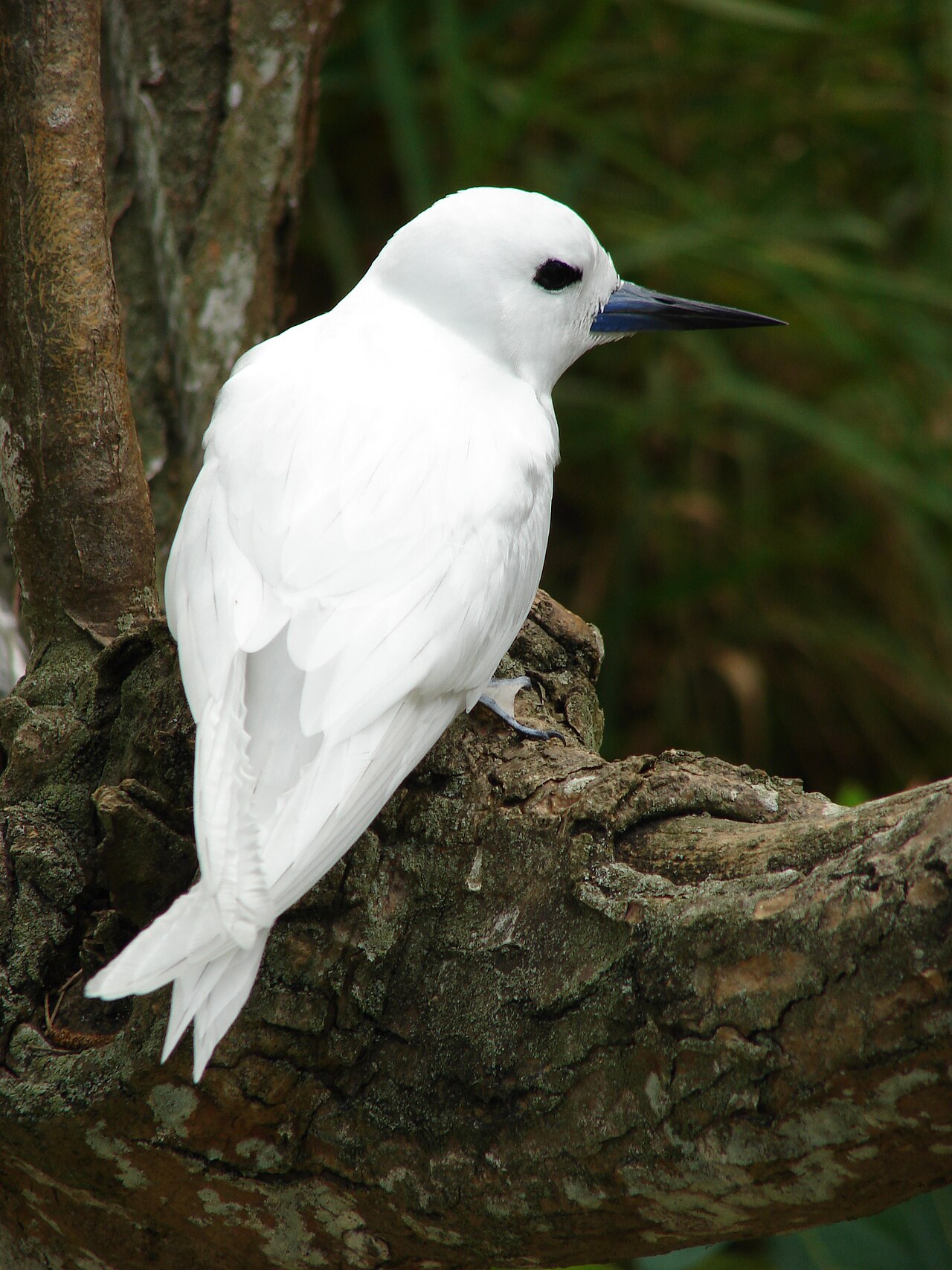
The Blue-billed White-Tern is the first tern in this guide: pure white from head to tail, with a heavy black eyering that makes the eye look larger, and a black bill with a blue base. It builds no nest, laying its single egg bare on a branch, a ledge or a roof edge, where it stays balanced. In North America it breeds only in Hawaii, and on Oʻahu it does so in the middle of Honolulu, in the street trees of the city.
Voice
It is not a noisy bird and is usually silent at the nest. In the air, and when the pair change over, it gives a low, throaty and slightly rasping heech-heech, repeated, quite unlike the screaming of other terns. At an intruder near the nest it hangs just above the branch with a buzzing, gurgling sound. Standing under a nest tree in Honolulu, you hear it before you see it.
No recording with a suitable Creative Commons licence has been found for this species yet; what to listen for is described below.
Identification
A medium-sized, wholly white tern with no marking in the plumage at all. The bill is straight and daggerlike, black with a blue-grey base, and a broad black ring around the dark eye gives the head a startled look at a distance. The tail is slightly forked and the legs are blue-grey with pale webs. Against the light the flight feathers and tail are translucent, so the bird reads as a patch of light rather than a body. Male and female look alike; juveniles have brown-fringed feathers above, a dark mark behind the eye and an entirely dark bill base. The flight is light and erratic, with sudden turns, low over the water or high around the treetops.
Confusion species
Within Hawaii confusion is barely possible: no other seabird is entirely white with a black bill and black eyering. Red-tailed Tropicbird (Phaethon rubricauda) is white too but far bigger and heavier, with a red bill and two thin red tail streamers. White-tailed Tropicbird (Phaethon lepturus) has black bars across the wings and long white streamers. Beyond this area there are two close relatives that do not occur here: Little White-Tern (Gygis microrhyncha) of the Marquesas is slightly smaller with an entirely black bill, and Atlantic White-Tern (Gygis alba) lives on the other side of the world. An odd white, pigment-less gull or tern can mislead at a distance, but lacks the heavy black bill and the translucent wing.
Habitat
It breeds on oceanic islands with trees or bushes: on the small, uninhabited islands of the northwestern Hawaiian chain in low scrub and on rock ledges, and on Oʻahu in tall city trees — kukui, monkeypod, mahogany, banyan and the flowering shower trees of Honolulu's streets and parks. What it needs is a branch with a fork or a shallow cup in it, high enough to stay out of reach of rats and cats. It feeds at sea, usually within a few tens of kilometres of the island, over clear tropical water. It makes no use of bare sand flats, marshes or the interior.
Where the bird is most often found, arranged by the USNVC — the vegetation classification of the United States and Canada — and CMECS for sea and coast.



Range and movements
The species breeds on tropical and subtropical islands of the Indian and Pacific Oceans, from the Seychelles into the South Pacific. Within North America it occurs only in Hawaii: numerous on the northwestern islands of the chain, and on the inhabited main islands practically only on Oʻahu. That city population is young — the first breeding pair was found at Koko Head in 1961, there were about seven hundred birds by 2003, and there are now more than two thousand. It does not migrate; birds stay by their island all year and breed in Hawaii in every month, with a peak between February and June.
- Resident
Where and when to look
Walk through central Honolulu on a weekday morning, past Kapiʻolani Park, the trees by Iolani Palace or the streets of Waikiki, and look up: the birds sit on thick horizontal branches, often with a chick beside them gripping the bark with strong claws. In the city a blue ribbon round a trunk marks an occupied nest. Binoculars are hardly needed — the birds let people stand right under the branch — but do watch the ground as well: fallen chicks are found and reported there.
Conservation
Worldwide the species is numerous and not threatened, but in Hawaii it is on the state list of threatened species. On the small islands introduced rats and cats are the main danger, and introduced big-headed ants attack eggs and newly hatched chicks. In the city tree work is the chief cause of loss: one pruning at the wrong moment costs an egg or a chick, which is why occupied trees are marked and reported. Overfishing of the tuna schools that drive small fish to the surface reaches it indirectly.
Scientific name
Gygis candida | (Gmelin, 1789)
Johann Friedrich Gmelin described the species in 1789 as Sterna candida; because it was later placed in Gygis, author and year stand in parentheses. The genus Gygis was introduced by Wagler in 1832 and goes back to Ancient Greek gugēs, the name of an unidentified waterbird; candida is Latin for 'shining white'. Until recently all white terns of this kind were counted under one name, Gygis alba; in 2024 and 2025 the major checklists separated them, and what breeds in Hawaii has since been called Gygis candida. The specimen first described came from Christmas Island in the Pacific, today's Kiritimati.