All species › Waders, gulls and terns › Skimmers, noddies, terns and gulls › Black Skimmer
Black Skimmer | Rynchops niger
Amerikaanse schaarbek | Rayador americano
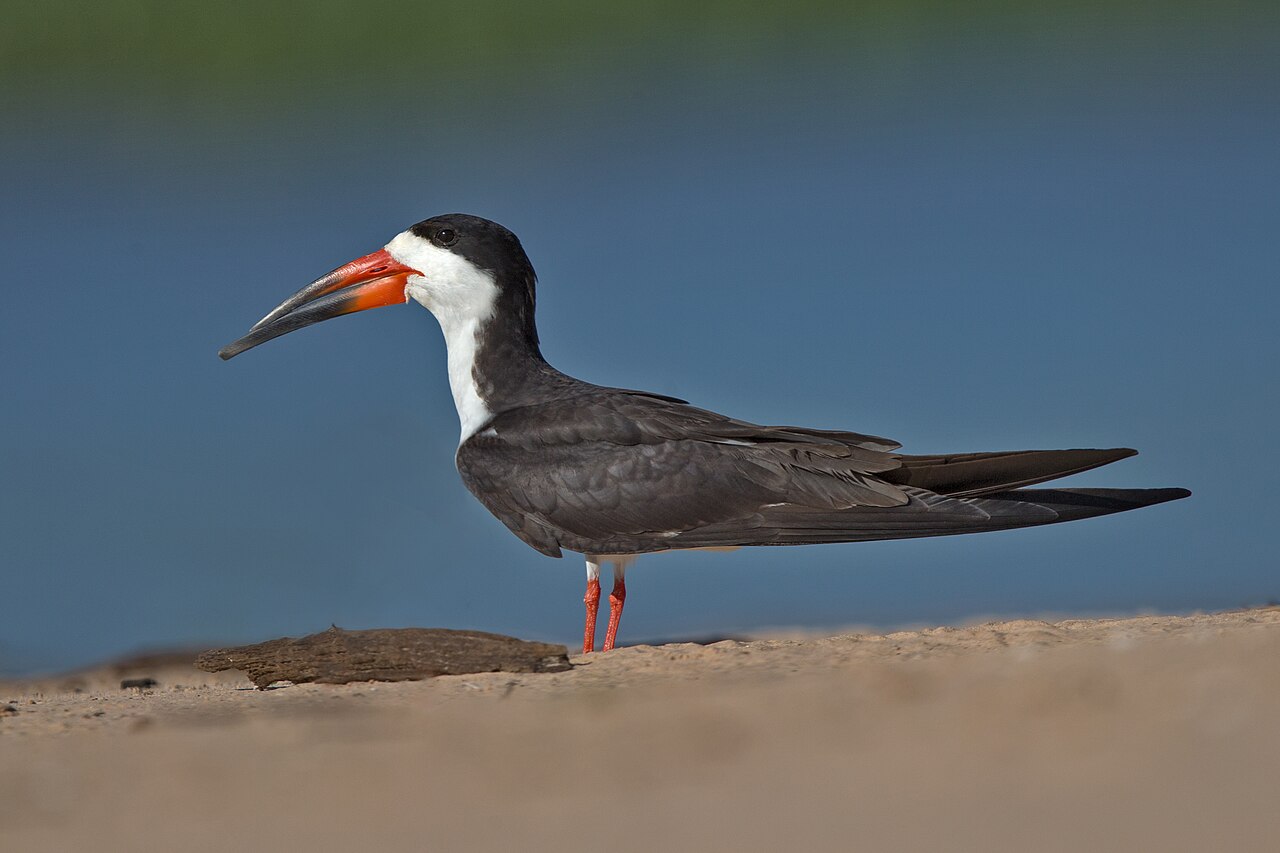
The Black Skimmer is the only bird in North America whose lower mandible is clearly longer than the upper. It fishes by flying low over smooth water with that lower mandible ploughing the surface, snapping the bill shut the instant it touches a fish — a way of hunting that needs no sight, and one it therefore also uses in the dark. It is also the only bird with a cat's pupil: a vertical slit, which cuts the glare thrown up off the water.
Voice
Not a screaming tern voice but a low, barking one, often likened to a dog yapping in the distance: kaup kaup kaup, with a nasal edge. In the colony it becomes a continuous barking from dozens of throats at once, above all at night, when the birds are busiest. Disturbed birds lift as one and pass low over the intruder with a hoarse, carrying call. Alarmed birds add a drawn-out, complaining kaaap.
Recording: Manuel Grosselet — CC BY-NC-SA 4.0 · Álvaro Obregón, Juchitán de Zaragoza, Oaxaca, Mexico · xeno-canto
Identification
A long, narrow black-and-white bird with long wings and short legs, which lies flat on its belly on the beach instead of standing. The upperparts are black, the underparts and forehead white; the bill is red at the base and black towards the tip, and the legs are orange-red. The bill itself is the mark: flattened sideways into a blade, with a lower mandible a third longer than the upper. Outside the breeding season a white collar shows in the black hindneck; juveniles are brown above with pale-fringed coverts and still have a nearly equal lower mandible, which only grows out over the first months. In flight it uses long upstrokes and short downstrokes, so the wingtip never touches the water.
Confusion species
Confusion is almost impossible in a good view, but at a distance and against the light a resting flock reads as terns. Royal Tern (Thalasseus maximus) has shorter wings, an entirely orange bill with mandibles of equal length, and a black cap rather than a black back. Laughing Gull (Leucophaeus atricilla), which often shares the same sandbar, has a grey back, a dark hood and stands upright on long legs. Juvenile skimmers are brown and less conspicuous, but the shape of the bill and the habit of lying flat on the sand give them away at once.
Habitat
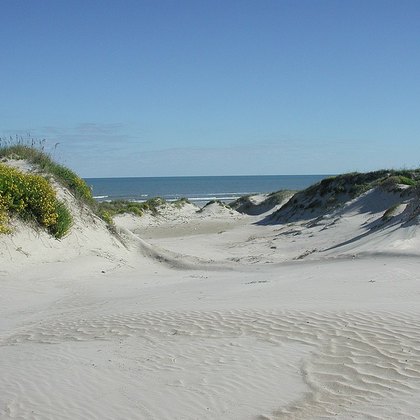
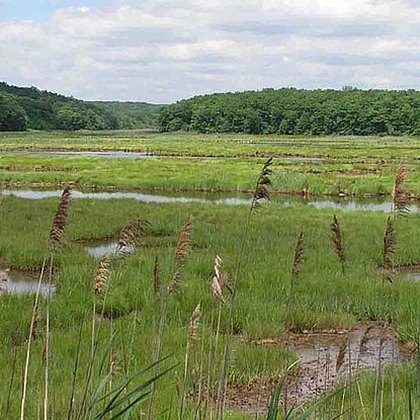
Calm, shallow water is the condition: lagoons, estuaries, tidal creeks behind the shore and sheltered bays, where the surface stays flat enough to skim. It nests on bare sand islands, shell banks and dredge-spoil flats with little vegetation, almost always beside a tern colony, whose birds react more strongly to predators. It avoids heavy surf and deep open water; in California, by contrast, it has settled on the saline inland sea of the Salton Sea and on the made islands of San Diego Bay. On tidal flats at low water the resting flocks gather through the day.
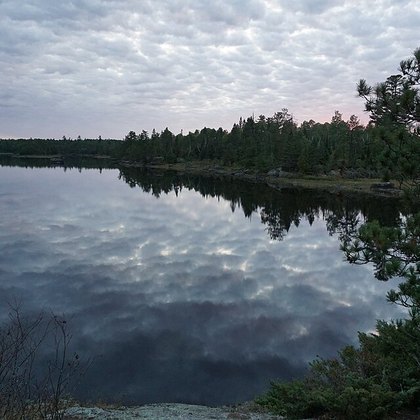
Where the bird is most often found, arranged by the USNVC — the vegetation classification of the United States and Canada — and CMECS for sea and coast.


Range and movements
It breeds along the Atlantic coast from New York and New Jersey south to Florida, along the whole Gulf coast to Texas and on into Mexico, and locally in California in the west. Northern birds withdraw for the winter: from North Carolina southwards it stays all year, while the mid-Atlantic colonies stand empty in winter. Outside the breeding season it spreads along both coasts of Mexico, to Cuba and Central America. Two related forms live in South America, following the great rivers of the interior; a few of those reach the northern coast of the Gulf of Mexico. In California it has bred only since the 1960s, an expansion less than a lifetime old.
- Resident
- Breeding (summer)
- Winter
- Passage
- dark = core range, pale = thinly spread
Where and when to look
Watch a sheltered lagoon or tidal creek in the last hour before sunset: the wind drops, the water turns to glass and the skimmers start their runs, often back and forth along the same strip. By day they lie in dense, motionless ranks on a sandbar, every head facing the same way; look then for the red bill base among the terns. Nickerson Beach on Long Island, the islands of Chincoteague in Virginia and the beaches of Florida and Texas give the best chance.
Conservation
The North American breeding population is put at some 65,000 to 70,000 birds and is falling steeply: an estimated nearly ninety per cent were lost between 1966 and 2015. Because it nests on open, low-lying sand the causes are plain to see: beach recreation, vehicles and loose dogs, and storm surges that wash out a whole colony in a night. Sea-level rise will in time make the lowest colony sites unusable, and the 2010 Gulf of Mexico oil spill cost hundreds of birds. Where colonies are roped off and wardened, the species holds its own.
Scientific name
Rynchops niger | Linnaeus, 1758
Linnaeus described the species in 1758 as Rynchops nigra; because he placed it at once in the genus where it still stands, author and year carry no parentheses. He introduced the genus Rynchops in the same work, from Ancient Greek rhunkhos, 'bill', and ops, 'face'; strictly it is a slip for Rhynchops, but the faulty spelling is the valid one. The ending later changed from nigra to niger because the genus name is treated as masculine; niger means black. Linnaeus gave only 'America' as the origin, after a plate by Catesby; that was later fixed on the coast of South Carolina.