All species › Waders, gulls and terns › Skimmers, noddies, terns and gulls › Brown Noddy
Brown Noddy | Anous stolidus
Noddy | Tiñosa común
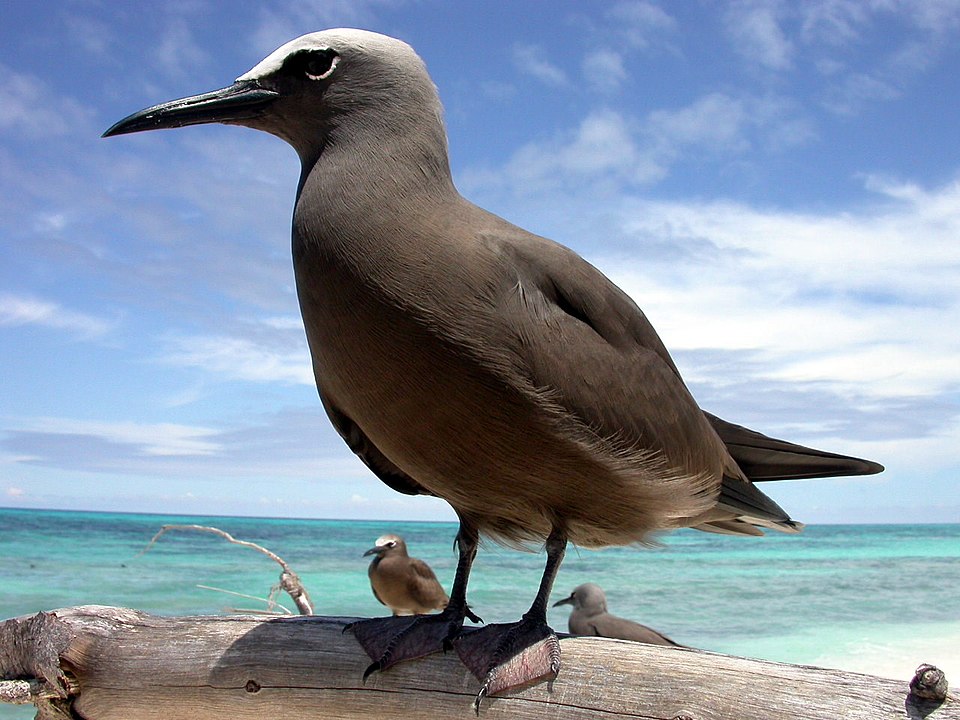
The Brown Noddy is a large, chocolate-brown tropical tern with a pale grey to white cap — the reverse of the usual tern pattern, in which the cap is black and the body white. It does not plunge-dive but picks its fish from the surface in flight, often over a school of tuna driving small prey upwards. In North America it breeds in the Caribbean, on the islets of Mexico and in Hawaii, and at one place in the United States outside Hawaii: the Dry Tortugas off Florida.
Voice
The voice is low and flat, far darker than that of other terns: a hoarse, crow-like kaah that recalls a young American Crow. In the colony this becomes a continuous rattling and chattering from hundreds of birds at once, with no high note in it anywhere. At the nest the partners exchange a soft, rattling krrr. Lying near a colony at night you hear a steady low rumble that only swells as the light comes.
Recording: Alexander Schlatmann — CC BY-NC-SA 4.0 · Cousin Island Special Reserve, Seychelles · xeno-canto
Identification
A big, dark tern with long narrow wings and a long wedge-shaped tail notched in the middle. The whole plumage is warm chocolate brown, a little paler on the forewing and darker towards the wingtip, with a white to pale grey cap that is sharpest on the forehead and grades gradually into the brown of the nape. The bill is long, straight and black; a small white crescent sits below the eye and a thin white line above it. Male and female look alike; juveniles have a more sharply bounded but smaller and whiter forehead patch, without the grey of the adult. The flight is slow and heavy for a tern, on deep beats, low over the swell and often without ever settling on the water.
Confusion species
Black Noddy (Anous minutus) is smaller and much blacker, with a thinner and longer bill, a shorter tail and a snow-white cap sharply set off against the black; in the main Hawaiian Islands, though, that species is browner and orange-legged and so harder to separate. Sooty Tern (Onychoprion fuscatus), which breeds on the same islets, is black above and white below with a deeply forked tail; only its young are wholly dark, and they show white spotting on the back and their own forked tail. Bridled Tern (Onychoprion anaethetus) is grey-brown with a white forehead, a white nape band and a forked tail. Rule of thumb: wedge-shaped tail and pale cap means noddy.
Habitat
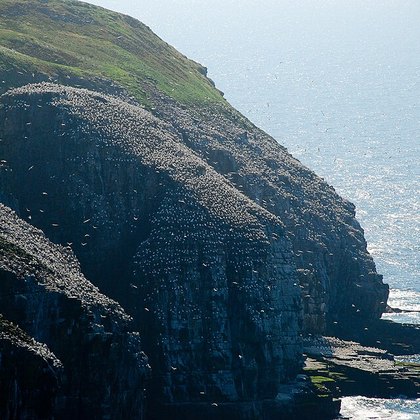
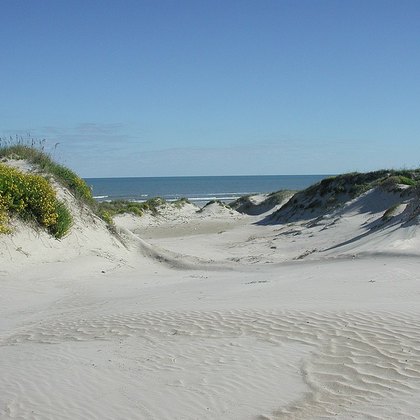
It lives on warm, clear seas and comes ashore only to breed, on uninhabited coral islets, rock islands and sandy keys with bushes. The nest is a platform of twigs, weed and coral rubble in a low shrub, on a rock ledge or simply on the ground, usually in the middle of a dense colony. It feeds over open water within a few tens to well over a hundred kilometres of the colony, by preference where large predatory fish drive small fish and squid to the surface. It avoids mainland shores, river mouths and fresh water; on the land of an inhabited island it is rarely seen.
Where the bird is most often found, arranged by the USNVC — the vegetation classification of the United States and Canada — and CMECS for sea and coast.

Range and movements
The species is spread across all tropical oceans. Within the area of this guide it breeds in the Bahamas, Cuba, Jamaica, the Cayman Islands, Hispaniola and Puerto Rico, on the reefs and cays of Belize and Honduras, along both coasts of Mexico, in Hawaii — where it is called noio koha and breeds throughout the chain — and on Bush Key in the Dry Tortugas, the only site in the United States outside Hawaii. That Florida colony is occupied from January into October and stands empty for the rest of the year. Beyond that it does not truly migrate: outside the breeding season it spreads over the sea, usually within a few hundred kilometres of the islands. Only hurricanes sometimes carry it far inland or up to the Gulf Coast.
- Resident
- Breeding (summer)
- Winter
- Passage
- dark = core range, pale = thinly spread
Where and when to look
The surest place in the United States is a boat or seaplane trip to the Dry Tortugas between March and June: from the wall of Fort Jefferson you look out over Bush Key, where thousands of noddies and Sooty Terns sit together and birds are always skimming past along the shore. In Hawaii, look for it from a headland or from a boat to the smaller islands. On the way over open water, watch for flocks above a boiling patch of sea: where tuna are hunting, the noddy hangs above them.
Conservation
Worldwide the species is numerous and stable, and it is listed as Least Concern (LC). The weak point is on the breeding islands: introduced rats and cats can empty a colony in a few years, and on low keys a hurricane washes nests and chicks away. In Florida the Dry Tortugas colony is smaller than it was a century ago but has been stable for decades, protected by the closure of the island to visitors during the breeding season. Overfishing of the large predatory fish whose hunting grounds it borrows is a risk that will only show over time.
Scientific name
Anous stolidus | (Linnaeus, 1758)
Linnaeus described the species in 1758 as Sterna stolida, among the terns; because it was later placed in Anous, author and year stand in parentheses. The genus Anous was introduced by Stephens in 1826 and is Ancient Greek for 'without sense'; stolidus means the same in Latin. Both names come from seafaring: the birds let themselves be picked off the nest and so passed for stupid. The Dutch and English name 'noddy' belongs to the same idea — an old word for a fool, and at the same time a reference to the nodding with which the birds greet one another. As type locality Linnaeus gave 'Americae pelago', the sea of America, later taken to mean the West Indies.