All species › Frogmouths › Frogmouths › Marbled Frogmouth
Marbled Frogmouth | Podargus ocellatus
Gemarmerde uilnachtzwaluw | Podargo ocelado
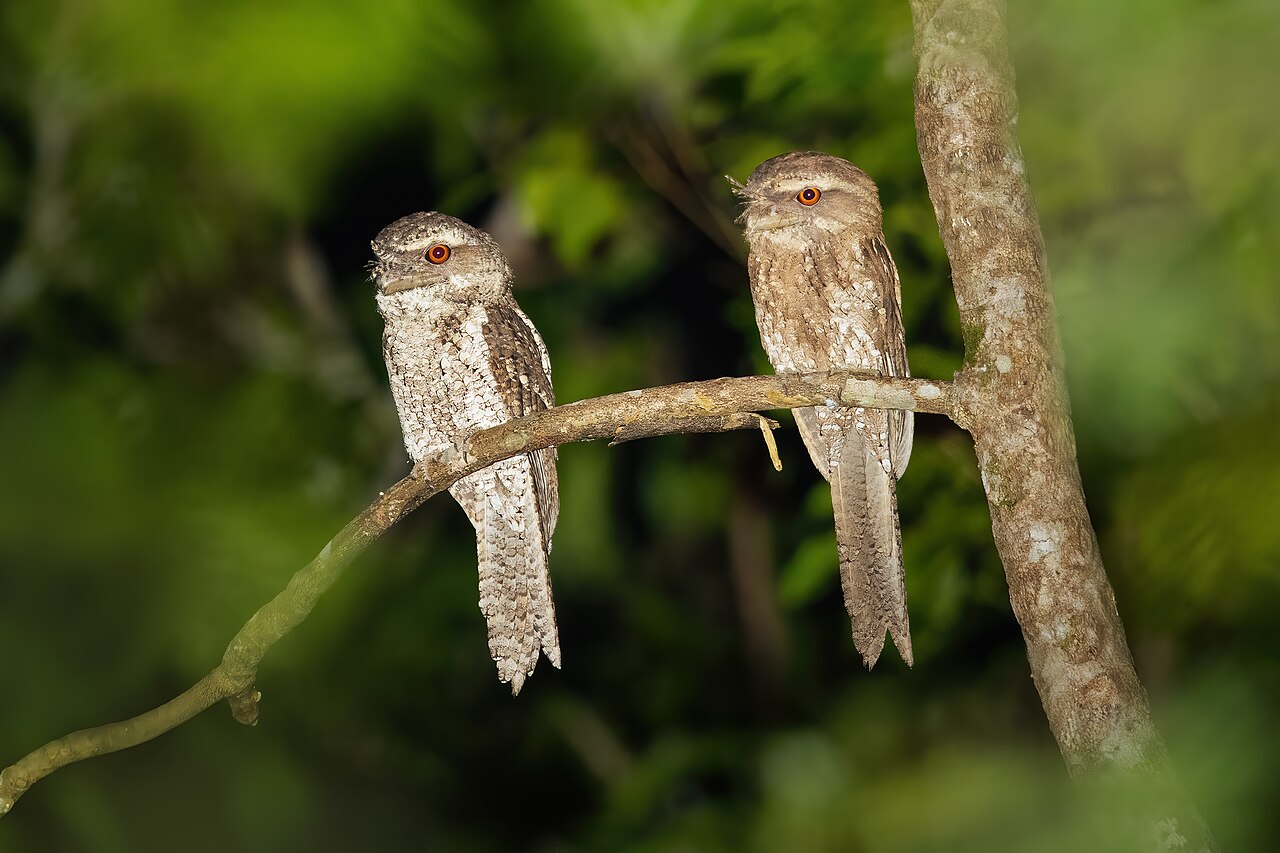
The Marbled Frogmouth is the smallest and by far the least often seen of Australia's frogmouths: a slim, long-tailed bird of dense rainforest that spends the day pressed against a branch like a broken twig. It lives in two small, widely separated areas — the tip of Cape York and the rainforests of south-east Queensland — and in the field it is mostly a voice in the dark.
Voice
In the dark the voice settles everything. Southern birds of the Conondale and Blackall Ranges give a run of low clucking notes that come faster and faster and rise or fall in pitch, a turkey-like gobble-gobble-gobble-gobble that stops abruptly — the sound this population is surveyed by. Alongside it comes a liquid, questioning koor-loo, koo-loo, koo-look, which pairs trade in turn so that the answer arrives a moment later from another tree. When disturbed it puffs, hisses and claps the bill. It calls mainly in the first hours after dark and again shortly before dawn, and most of all between August and December.
Recording: Greg McLachlan — CC BY-NC-SA 4.0 · Maleny, Sunshine Coast Regional, Queensland, Australia · xeno-canto
Identification
A frogmouth of thirty-seven to forty-eight centimetres — noticeably smaller and slimmer than the region's other two species — with a proportionally long tail, long stiff bristles above the bill and a broad flat head. The plumage is finely marbled and streaked, from grey through brown to rufous; males are usually silvery grey with brown-grey scalloping, females more rufous to almost uniformly dark brown, with white spots and flecks especially below. The iris is orange, ranging from yellow to reddish-brown — the quickest separation from the other two species. Bill and legs are grey. At rest it presses itself obliquely upward against a thin branch and disappears entirely into the outline of the wood.
Confusion species
Papuan Frogmouth (Podargus papuensis) is the main pitfall on Cape York, where both sit in the same forest: at fifty to sixty centimetres it is considerably larger and heavier, has a far more massive bill and a red iris rather than orange, and hunts more often along forest edges, creeks and mangroves. Tawny Frogmouth (Podargus strigoides) has a yellow iris, a short tail and a much heavier bill, and sits in dry eucalypt forest, gardens and roadsides — precisely the opposite habitat. Anyone seeing only a silhouette should go by tail length: that of the Marbled Frogmouth projects strikingly far beyond the branch.
Habitat
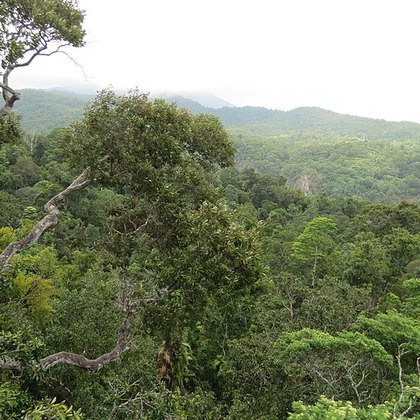
Dense, closed rainforest and vine thicket in the lowlands and on the ranges, especially along creeks and in moist gullies with plenty of vines and a thick herb layer. Southern birds sit between about fifty and eight hundred metres in subtropical rainforest with palms and lianas along streams; northern birds in tropical rainforest and monsoon forest of the coastal plain. It scarcely ventures out of closed forest and, unlike the Tawny Frogmouth, never into gardens or open woodland.
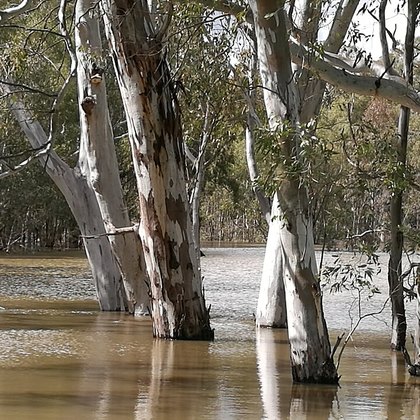
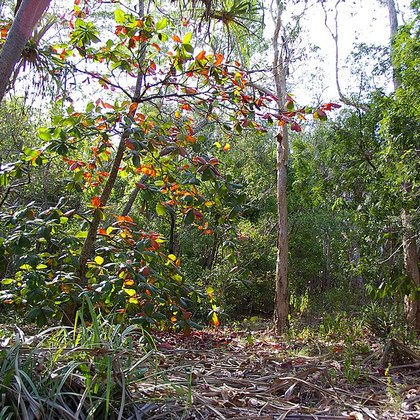
Where the bird is most often found, arranged by main group and formation.
Range and movements
Two widely separated Australian areas, both small. In the north the subspecies marmoratus at the tip of Cape York and along a narrow coastal strip from Iron Range to the Yarraden district. In the south the subspecies plumiferus, the Plumed Frogmouth, on the eastern flank of the Great Dividing Range from Great Sandy National Park in Queensland — with the Conondale and Blackall Ranges as its core — south to the Ballina and Lismore district in north-east New South Wales. A thousand kilometres without the species lies between them. Outside Australia it occurs in New Guinea and the Aru Islands. It does not occur in New Zealand.
- Resident
- dark = core range, pale = thinly spread
Where and when to look
Look for the southern birds in the Conondale Range: walk a forest track along a creek after dark and stop where the rainforest is thickest; the turkey-like gobbling carries down the gully and is usually the only sign you will get. Take a strong torch and sweep it along thin, obliquely rising branches three to eight metres up — the bird often stays put and the orange eyeshine betrays it. Go in winter and early spring, when it calls most, and leave playback alone in an area where the species is protected.
Conservation
Least Concern (LC) on the world list, but that verdict rests on the large New Guinean population. In Australia matters stand differently: both populations are small and wholly dependent on closed rainforest, and the species is listed as vulnerable in Queensland. Clearing and fragmentation of rainforest is the heaviest pressure, together with the loss of the dense creekside growth it hunts in and the vulnerability of a bird that lays a single egg and holds a small, fixed territory. Southern birds were surveyed by playback in the 1980s and 1990s and proved to number some hundreds of pairs in the Conondale Range.
Scientific name
Podargus ocellatus | Quoy & Gaimard, 1832
Quoy and Gaimard described the species in 1832 as Podargus ocellatus, and it has stayed in that genus, so author and year carry no parentheses. The genus Podargus was introduced by Vieillot in 1818, after Greek podargos, 'swift-footed' — an odd choice for a bird that hardly walks. ocellatus means 'with little eyes', from Latin ocellus, the diminutive of oculus, 'eye', for the round white spots in the plumage; the Dutch and English names sum up the same pattern as 'marbled'. The type locality is Dorey harbour, present-day Manokwari in New Guinea, where the Astrolabe expedition put in.