All species › Frogmouths › Frogmouths › Papuan Frogmouth
Papuan Frogmouth | Podargus papuensis
Reuzenuilnachtzwaluw | Podargo papú
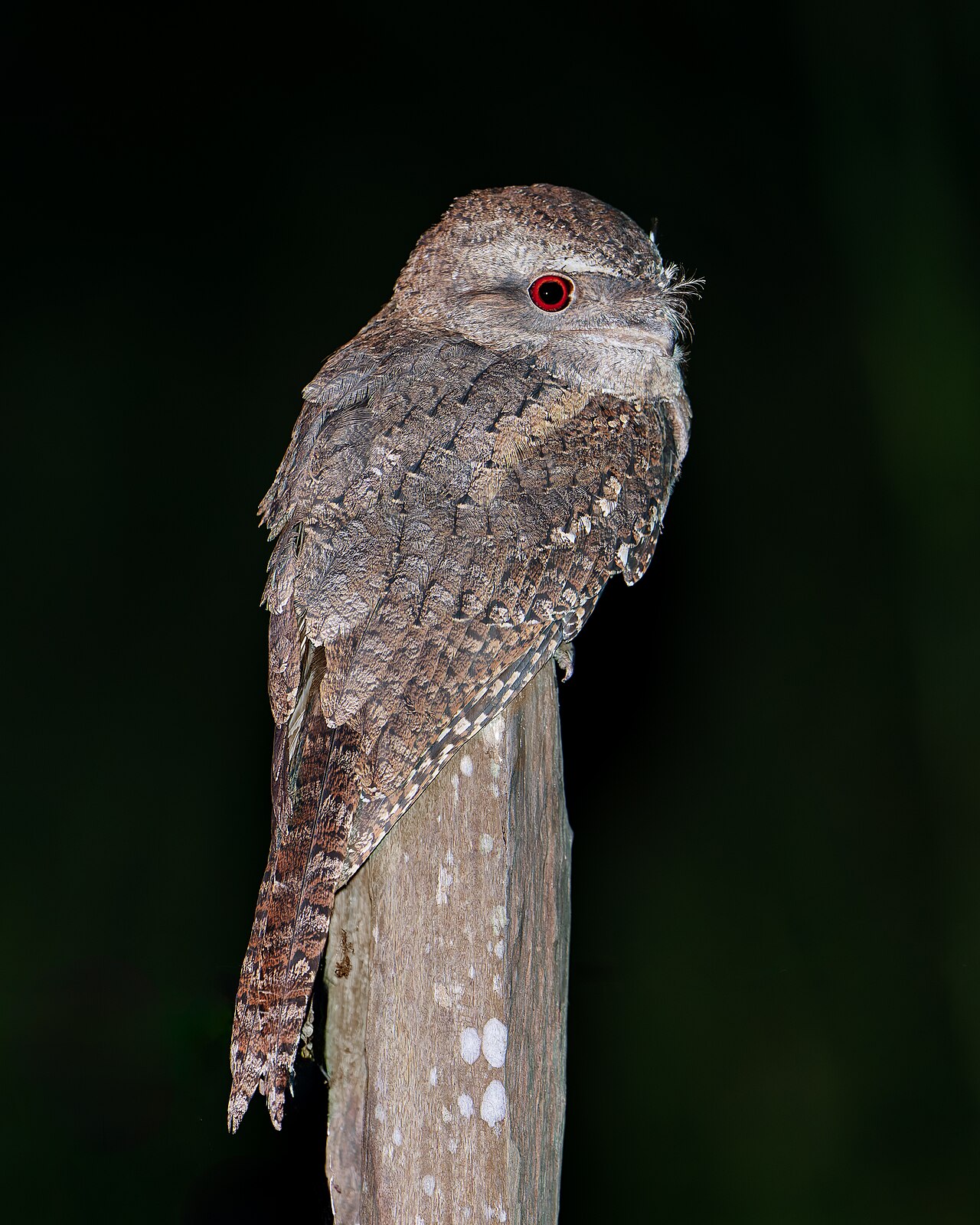
The Papuan Frogmouth is the largest frogmouth in the world: a bird of half a metre to six tenths with an enormous, frog-like bill, a long tail and a bright red iris that glows like an ember in torchlight. In Australia it occurs only in the far north-east, along creeks and mangroves in the tropical rainforest of Cape York and the Queensland Wet Tropics.
Voice
At night the voice is the most useful character. The territorial sound is a deep, resonating oom ... oom ... oom, slower and fuller than the Tawny Frogmouth's booming and felt in the chest more than heard. Alongside it comes a run of laughing, descending hoots and an unexpectedly loud, wailing scream that suggests a mammal rather than a bird in the dark — the sound that wakes many a camper at Iron Range. It calls mainly in the first hours after sunset and again shortly before light, and when disturbed it hisses and claps the heavy bill.
Recording: GABRIEL LEITE — CC BY-NC-SA 4.0 · Afore Rural LLG (near Ondoro), Ijivitari District, Northern Province, Papua New Guinea · xeno-canto
Identification
A huge, elongated night bird of fifty to sixty centimetres, a good share of it tail, with a broad flat head and a heavy bulbous bill with an enormous gape and long stiff bristles above it. The iris is red — the quickest and surest mark in torchlight — with a cream eyebrow above. The plumage is grey-brown, finely marbled and streaked; males are darker and more marbled, females more rufous. The wings are dark and relatively short and broad, and the flight is silent and low. At rest it sits upright along a branch with bill raised and eyes narrowed to slits.
Confusion species
Tawny Frogmouth (Podargus strigoides) is the species it is most often confused with where their ranges meet in the Wet Tropics: smaller and stockier, with a yellow iris rather than red, a shorter tail and a greyer, more silvery plumage, and it sits in dry eucalypt forest, gardens and roadsides instead of rainforest. Marbled Frogmouth (Podargus ocellatus) shares the same forest on Cape York but at thirty-seven to forty-eight centimetres is clearly smaller and far slimmer in build, with an orange iris and a lighter bill; the size difference really does show in the field, since the Papuan weighs well over twice as much. A true owl such as the Australian Boobook (Ninox boobook) has forward-facing eyes, a short hooked bill and talons, and takes its prey on the wing.
Habitat
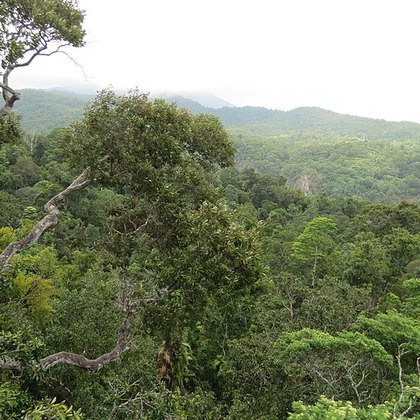
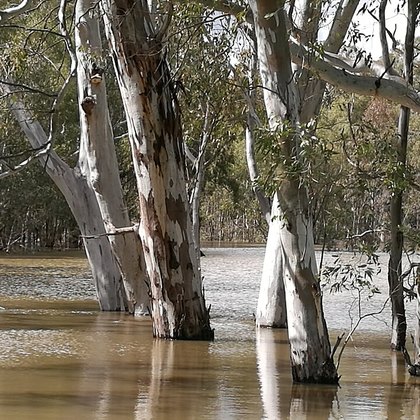
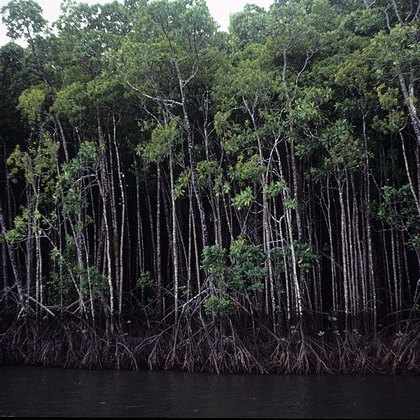
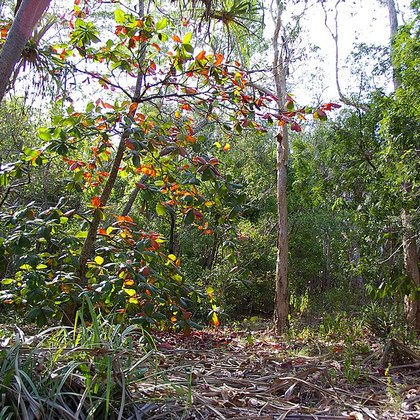
Tropical rainforest and its edges, riverine forest and dense growth along creeks, mangrove and the fringe behind it, monsoon forest and vine thicket, and beyond that open forest and woodland close to water. It is more tied to water than the other two species and likes to hunt from a low branch over a creek or a mangrove channel, watching for large insects, frogs, lizards and even small mammals and birds. Dry interior country and closed forest far from water it passes over.
Where the bird is most often found, arranged by main group and formation.
Range and movements
Within the map window of this guide, only the far north-east of Australia: Cape York Peninsula and the coastal belt of the Queensland Wet Tropics south to about Ingham and Townsville, with Iron Range and the Daintree as its best-known places. It does not migrate and holds the same territory, often the same roost branch, for years. Outside Australia it is widespread in New Guinea and on the Raja Ampat and Aru Islands; that population is much larger than the Australian one. It does not occur in New Zealand.
- Resident
- dark = core range, pale = thinly spread
Where and when to look
Stand by a creek or a mangrove channel in the Wet Tropics in the early evening and sweep a torch slowly along the lowest heavy branches over the water; the red eyeshine shows at tens of metres and gives the bird away before you make out its shape. Reliable places such as the Iron Range campground, the banks of the Daintree and the riverine forest near Cairns produce the same birds year after year. By day a large motionless lump on a horizontal branch above the track sometimes betrays it; then look at the tail, which projects much further than a Tawny Frogmouth's.
Conservation
Least Concern (LC), with a large range centred on New Guinea and showing no rapid decline. In Australia the population is small and confined to the north-eastern coastal country, so there it depends on the keeping of rainforest, mangrove and creekside vegetation. Collisions at dusk are the most visible loss, because it hunts from posts and low branches beside roads; beyond that the loss of old trees with solid horizontal branches counts, since without such a branch there is no roost and no nest.
Scientific name
Podargus papuensis | Quoy & Gaimard, 1832
Quoy and Gaimard described the species in 1832 as Podargus papuensis, and it has stayed in that genus, so author and year carry no parentheses. The genus Podargus was introduced by Vieillot in 1818, after Greek podargos, 'swift-footed'. papuensis simply means 'from Papua', after the type locality: Dorey harbour, present-day Manokwari in New Guinea, where the Astrolabe under d'Urville put in during 1827 — the same voyage and the same harbour that produced the Marbled Frogmouth. The Dutch name goes not for the origin but for the size, since this is the largest species in the family.