All species › Lamiales › Bladderwort family › Pinguicula reichenbachiana
Pinguicula reichenbachiana
Behind the coast at Nice, the Vésubie and the Roya cut deep into the limestone mountains. In those two valleys, and in adjoining Liguria, grows Pinguicula reichenbachiana — an early-flowering butterwort with a conspicuously long spur, and one of the few European species to have been given a regional action plan of its own.
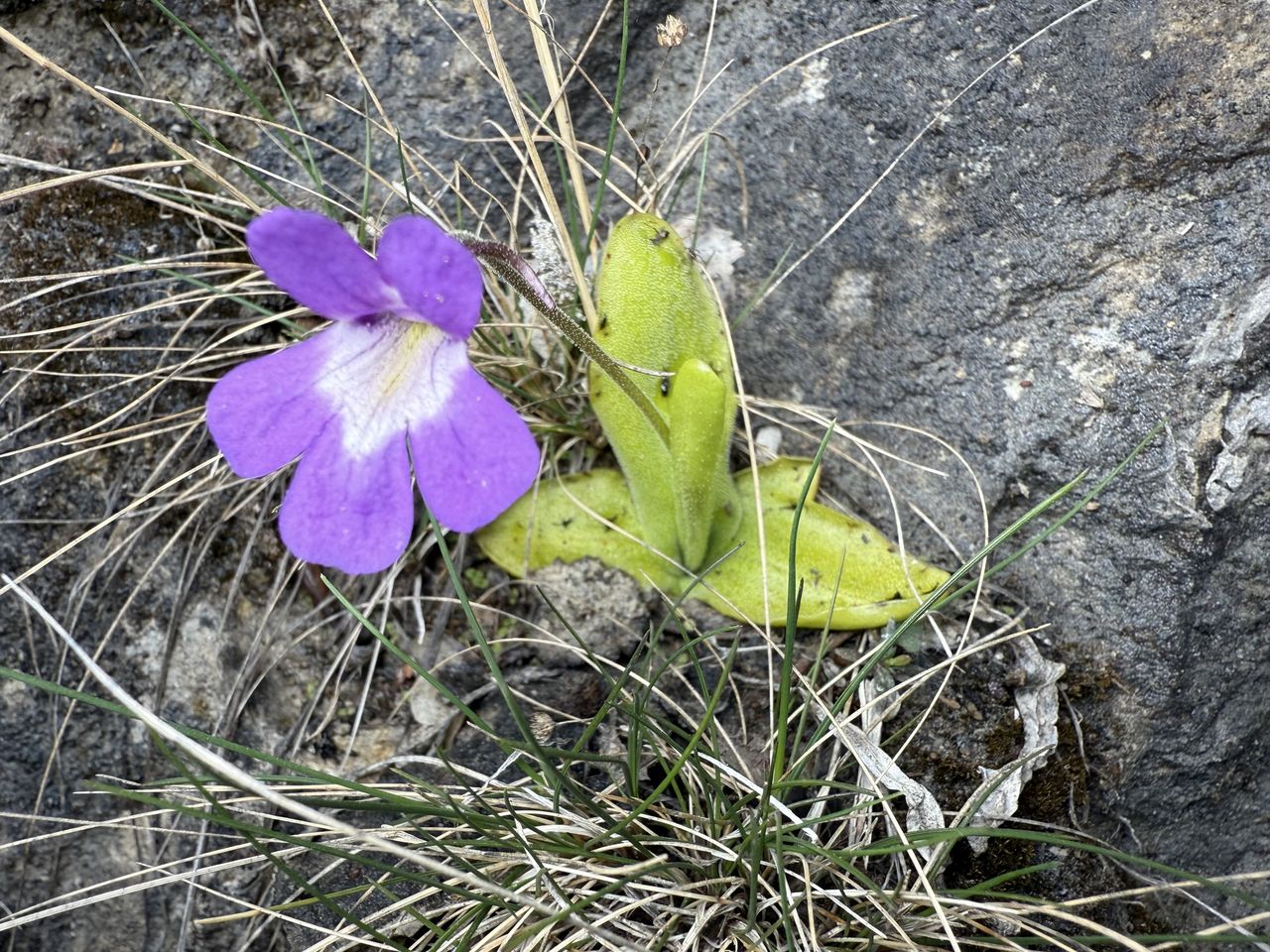
Identification
A rosette whose outer leaves lie flat against the rock while the inner ones stand slightly up; the margins are inrolled, giving the plant a ribbed look. In flower it reaches five to fifteen centimetres. The flower is bicoloured and ten to fifteen millimetres across, with an exceptionally long spur that marks the species at once. Flowering is early — March to May — well before any Alpine species: while the mountain pastures are still bare, this plant is in full flower on the gorge walls. Longer summer leaves follow.
Similar species
The species belongs to the group around Pinguicula longifolia, which also includes P. caussensis of the Causses; that grows hundreds of kilometres to the west, so field confusion does not arise. Within the Alps the distinction from P. vulgaris and P. leptoceras is simple: those flower only from June to August, grow higher in the mountains and have short to moderately long spurs. A butterwort flowering in March on a limestone wall in the Roya can be no other species.
The trap and how it works
A flypaper trap in a permanently humid, shaded setting. The leaf bears stalked glands with an adhesive droplet and, between them, sessile glands that deliver digestive enzymes only once prey is lying on them. At these low sites, which warm early in the year, midges and gnats emerge in March, exactly when the plant is flowering and growing. The leaf margin rolls over the prey so the digestive fluid stands in a shallow dish — on a vertical limestone wall that is indispensable. The limestone itself gives the plant next to nothing.
Habitat and ecology
Wet, mostly north-facing limestone walls in the gorges of the Vésubie and the Roya: dripping rock, tufa deposits, the damp zone beside small waterfalls and springs. The sites lie strikingly low for an 'Alpine' species, between roughly four hundred and eight hundred metres, in the belt where Mediterranean and montane floras meet. There the plant forms a vegetation type of its own together with maidenhair fern and other moisture-loving species of dripping limestone; that combination has been described as a distinct plant community in the French literature.
Distribution and elevation
The south-western Alps: the valleys of the Vésubie and the Roya in the French department of Alpes-Maritimes, with adjoining occurrences on the Italian side in Liguria. The range is small and sharply bounded; in France the species is very rare and confined to these two valleys. Our own species list names 'south-western Alps: France and Italy', which is correct, but the elevation here is low: this is a plant of foothill gorge walls, not of the high mountains.
- Recorded (one-degree cells)
Forms and variation
No wild varieties are recognised. The taxonomic history is confusing, though: the plant has been treated in turn as a species of its own, as a subspecies of P. longifolia, and again as a species, and both views coexist in the literature and in databases. Within populations it is mainly plant size that varies, from five to fifteen centimetres according to the moisture and shelter of the site; the long spur, by contrast, is constant and the most reliable character.
Where and when to see it
April is the month. Search the gorges of the Vésubie and the Roya on the wet, north-facing walls, recognisable by their dark sheen and by the ferns growing in tufts alongside. Look up from the path or road and use binoculars — the rosettes usually hang well above eye level and the walls are loose and steep. In France the species is legally protected in the region and may not be picked or dug up; photographing it and recording the site is what there is to do.
Conservation status
The species is listed as Vulnerable. The grounds are its very small range: two valleys in France plus adjoining Ligurian ground, with a limited number of walls on which the plant grows. The population is described as stable, and in the French region of Provence-Alpes-Côte d'Azur the species is legally protected, with picking and destruction prohibited; a regional action plan for 2016-2026 has moreover been drawn up. The threats are road building and works on the gorge walls, water abstraction and changes in spring discharge, and recreational pressure from climbing and canyoning. CITES does not apply.
Scientific name
Pinguicula reichenbachiana | Schindler, 1908
Described by Anton Karl Schindler in 1908. The species occurs in the Maritime Alps, on the border of France and Italy. The name honours a botanist named Reichenbach; which of the several botanists with that name is meant exactly (possibly Heinrich Gottlieb Ludwig Reichenbach, who also described Pinguicula leptoceras, or his son Heinrich Gustav Reichenbach) could not be established with certainty.
World Checklist of Vascular Plants (WCVP), via Plants of the World Online (POWO), Royal Botanic Gardens, Kew.