All species › Lamiales › Bladderwort family › Pinguicula moctezumae
Pinguicula moctezumae
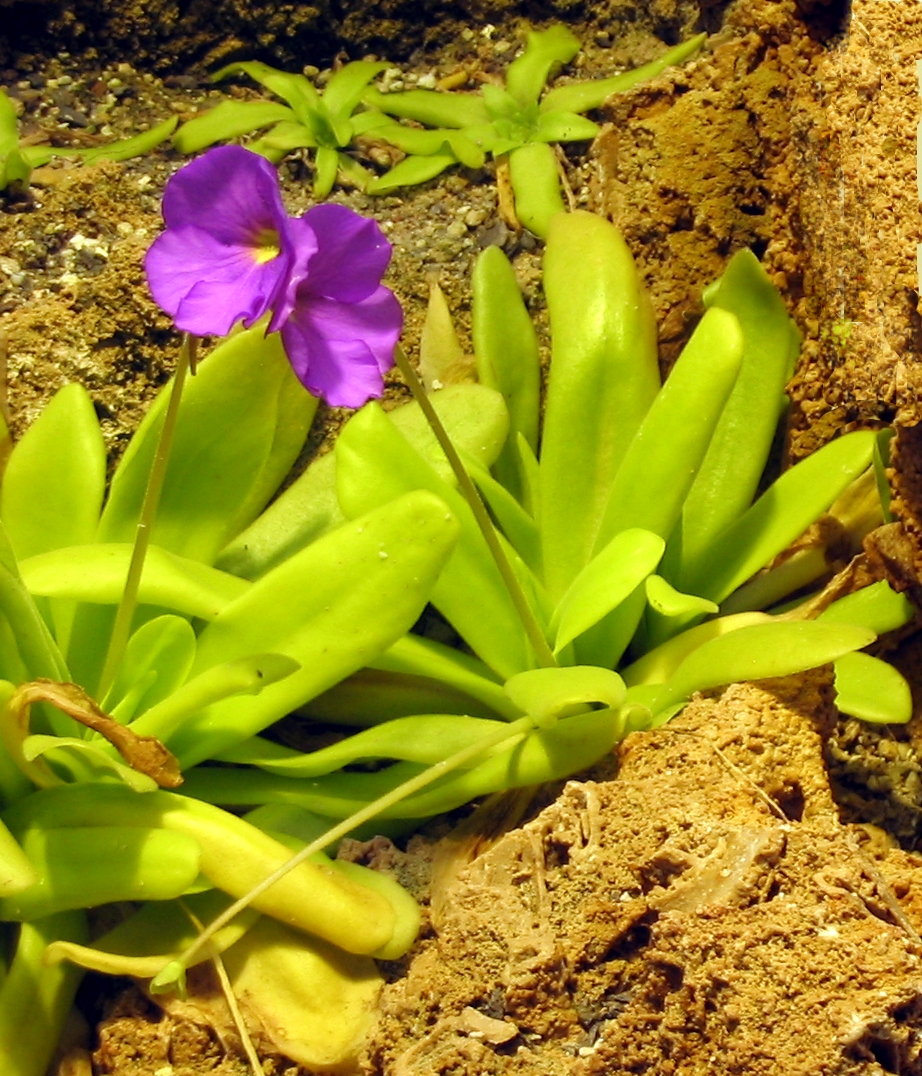
A butterwort with leaves like narrow green tongues and a flower that seems almost too large for the plant beneath it. Pinguicula moctezumae was only described in 1994, from the deep canyon of the Río Moctezuma on the border of Querétaro and Hidalgo, and belongs to the run of Mexican species that have emerged one by one from the Sierra Gorda in recent decades.


Identification
In the dry season there is a small winter rosette of elliptic to oblong leaflets 5 to 30 mm long and 3 to 7 mm wide, fleshy and with few glands. In summer the plant makes something quite different: lanceolate to linear leaves 60 to 100 mm, sometimes to 130 mm long, and only 5 to 8 mm wide at the base, hanging down the rock face like narrow tongues. The scape carries a single flower 45 to 55 mm long including the spur. The corolla is pink to violet-purple, with a two-lobed upper lip 10 to 13 mm and a three-lobed lower lip 10 to 15 mm; behind sits a cylindrical-tubular, violet-purple spur 28 to 35 mm long, occasionally 25 to 38 mm. That very long spur is the handiest field character.
Similar species
Pinguicula elizabethiae grows in the same canyon country; it has a broader, more oval summer leaf and a deeper red-purple flower with a shorter spur. P. agnata, also from the Sierra Gorda, is separated at once by its spur of only a few millimetres. Outside Mexico no butterwort combines strap-shaped leaves with a spur of over three centimetres. Where both canyon species grow together hybrids are possible, and plants with intermediate leaf width and spur length need careful treatment.
The trap and how it works
The long narrow leaf hangs obliquely to almost vertically down the wall, which makes the flypaper trap work differently than on a flat rosette. Stalked glands hold the prey and sessile glands handle digestion, but instead of rolling the margin over the animal the leaf folds a little along its length, so the fluid stays in the channel. On a hanging leaf, loss of digestive fluid is otherwise a real cost. The catch is mostly midges and small flies out of the humid canyon air; in the dry season, with its glandless winter rosette, the plant catches next to nothing.
Habitat and ecology
Limestone walls in a warm, deeply incised river canyon at nine hundred to eleven hundred metres. The plants sit on calcium carbonate concretions, in the stream bed itself and on walls with water draining over them, that is, wherever the limestone is permanently or periodically wet (R1, R2). It is a semi-dry, warm environment with a marked rainy season; outside it the plant leans on the water that keeps emerging from the rock and on the humidity in the gorge. Soil hardly comes into it: the roots sit in moss, in lime crust and in narrow crevices.
Distribution and elevation
Known from the canyon of the Río Moctezuma between Querétaro and Hidalgo, around San Joaquín in the municipality of Cadereyta. Our species list gives Mexico, Hidalgo and Querétaro, which matches the published sites. The range is small and follows the course of the river and its side gorges. The species is a Mexican endemic and belongs to the core of butterworts that make the Sierra Gorda one of the richest areas for the genus.
- Recorded (one-degree cells)
Forms and variation
No wild varieties have been described. Variation within the species concerns mainly leaf length and flower colour: plants on wetter walls make longer summer leaves, and the corolla runs from fairly pale pink to dark violet-purple. In the wild the flower shows no sharply bounded forms, rather a continuous series. Because the species occurs alongside other butterworts in the canyon, conspicuous deviations should first be considered natural hybrids rather than new forms. Cultivated clones are left out of the picture here.
Where and when to see it
The rainy season, roughly July to October, is the best moment: the long summer leaves then hang down the wall and the large pink flowers stand out from them. Search along the banks of the river and its side streams, on wet limestone blocks and in overhanging parts of the wall, watching for places where water runs in a thin film over the rock. The flower is visible from tens of metres away; the leaves, by contrast, all but vanish among moss and ferns. Stay on the existing paths — the walls are wet, slick and steep.
Conservation status
Not assessed for the global IUCN Red List, and not listed in CITES. What is known: the species was only described in 1994, comes from a limited number of walls in one river system, and has since become unusually popular in cultivation, which can put collecting pressure on the wild populations. Water abstraction and road building in the canyon are named as further risks. No published population figures exist. Since the plant is very easily propagated and widely available in cultivation, there is no reason whatever to collect wild plants; a formal assessment would be the main missing piece here.
Scientific name
Pinguicula moctezumae | Zamudio & Ortega, 1994
Described by Sergio Zamudio and Ricardo Zirahuén Ortega in 1994, in the article "Una nueva especie de Pinguicula (Lentibulariaceae) de los estados de Querétaro e Hidalgo, México", Acta Botánica Mexicana 28: 57–62. The type locality lies in the canyon of the Moctezuma river, on the border of the states of Querétaro and Hidalgo, near San Joaquín in the municipality of Cadereyta, Mexico. The name refers to the locality: the canyon of the Moctezuma river (Rio Moctezuma), not directly to the Aztec ruler Moctezuma.
World Checklist of Vascular Plants (WCVP), via Plants of the World Online (POWO), Royal Botanic Gardens, Kew.