All species › Lamiales › Bladderwort family › Pinguicula agnata
Pinguicula agnata
A butterwort whose flower hardly suggests the genus: broad, flat, often nearly white, with a spur so short it is easily missed. Pinguicula agnata grows on limestone rocks in the canyons of Hidalgo and Querétaro and is one of the first Mexican species to receive a name of its own after Casper's revision of the genus in the 1960s.
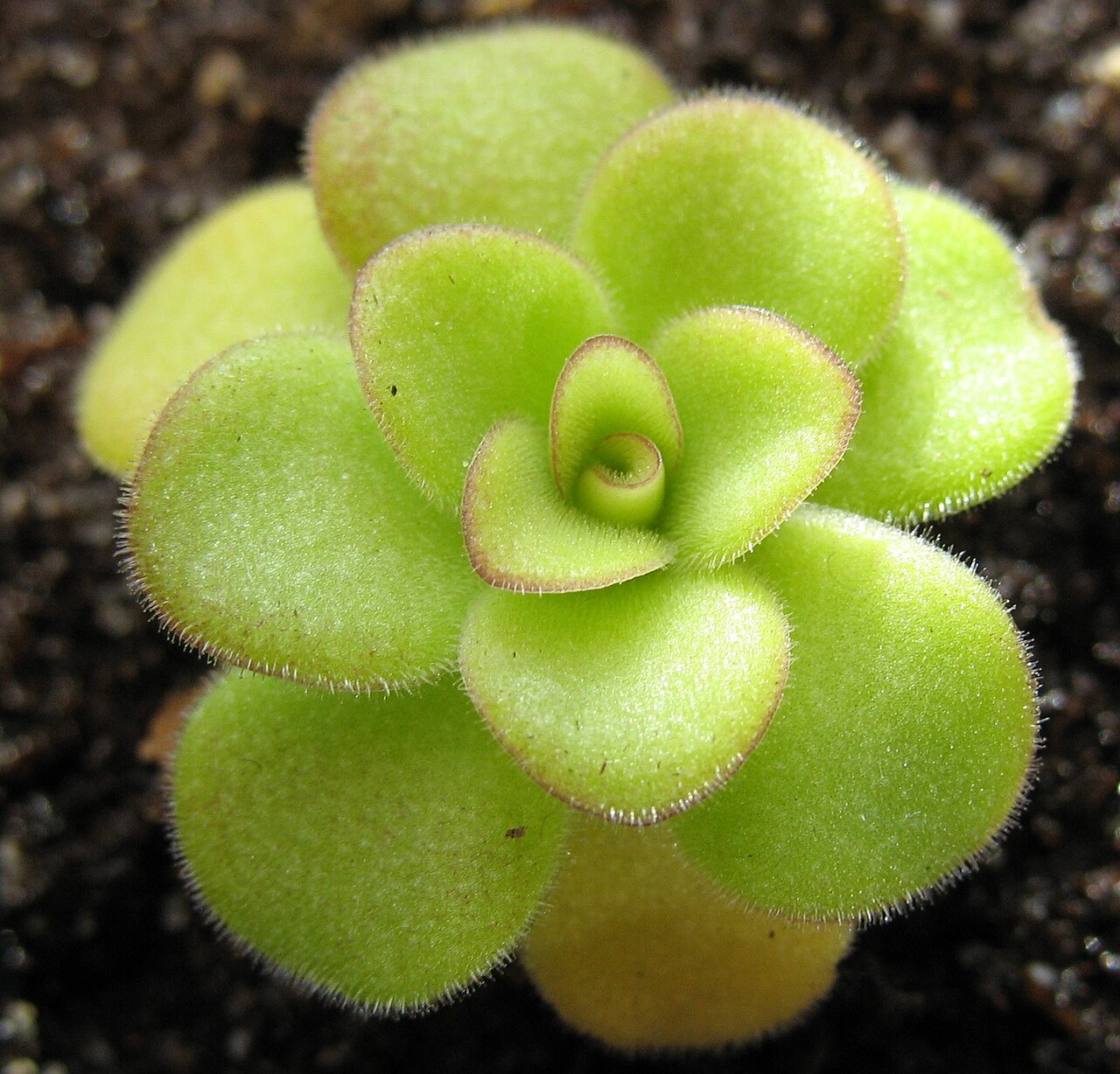


Identification
The rosette consists of spathulate to obovate-oblong leaves (25) 35 to 55 (70) mm long and (7) 10 to 15 (20) mm wide, thick and firm, light green, with the margin turned upward. The upper surface is densely glandular and shines greasily. The scape stands 5 to 12 cm tall and usually carries a single flower. That flower is 18 to 22 mm long including the spur and has broad, partly overlapping lobes, which makes it look flat and round; the colour is white to pale blue-violet, often with a violet edge along the lobes or violet veins in the throat. The spur is strikingly short, (2) 3 to 4 (5) mm. In the dry season the plant forms a rosette of smaller, less sticky leaves rather than a true bud.
Similar species
The short spur separates the species from virtually all its Mexican relatives, which almost without exception have a spur over a centimetre long. Pinguicula moctezumae and P. elizabethiae from the same region are recognised by this at once. Comparison with several white-flowered forms in north-eastern Mexico is harder; there the thick firm leaf and broad flat flower help. Where P. agnata grows with relatives, hybrids are known, with a somewhat longer spur and a paler violet flower.
The trap and how it works
A classic flypaper trap, with a dense glandular coating on a firm flat leaf. The stalked glands each carry a droplet of sticky mucilage; the sessile glands, lying between the stalks on the leaf surface, release enzymes only once prey makes contact. The leaf answers with a slow curving of the margin over the prey, creating a shallow bowl in which the fluid stands. In this limestone setting the catch is varied: midges, small flies, ants, aphids and whatever is swirled up along a rock face. Older leaves lie covered with the dark remains of digested insects.
Habitat and ecology
Nearly vertical limestone walls, preferably facing north, on dry rocky slopes and in the canyons of the Sierra Gorda and its surroundings (R1, R2). The plants sit in crevices and on ledges where water seeps down the wall or where a thin layer of moss and humus has gathered. The climate is warm and markedly seasonal, with summer rains and a long dry period; the limestone wall still gives off water in that dry time, and that is the difference between surviving and drying out. The accompanying vegetation is usually open scrub with agaves, hechtias and drought herbs.
Distribution and elevation
Known from Hidalgo, with the type from the district of Zimapán, and from adjoining parts of Querétaro; that is, north-eastern central Mexico, in and around the Sierra Gorda. Our species list says only 'Mexico'; the literature places the species in that smaller area. Elevation runs roughly from eight hundred and fifty to well over fifteen hundred metres, depending on how deeply the canyon is cut. The species is endemic to Mexico.
- Recorded (one-degree cells)
Forms and variation
In the wild, populations differ mainly in how far the flower is flushed violet: from nearly pure white to distinctly blue-violet with dark edges. That variation is gradual and no varieties are distinguished. Leaf thickness also varies with exposure: plants on an open wall have thicker, stiffer leaves than those in shade. Hybrids with other butterworts from the same area occur in the wild; those plants have a spur longer than in P. agnata but shorter than in the other parent, and belong with the parents in this guide.
Where and when to see it
Search from May to August, when the species flowers and the glandular coating is at its densest. Look at the wall, not at the ground: the plants sit on ledges and in crevices, often above eye level, and are found best on north and north-east faces where the wall stays damp longer. From a distance the white flower gives itself away as a pale dot against grey limestone. In the dry months the plant withdraws into smaller leaves and is practically unfindable without binoculars.
Conservation status
The species has not been assessed for the global IUCN Red List and is not listed in CITES. What is known: the range is confined to part of the Sierra Gorda and adjoining limestone country, but within it the species is not rare on suitable walls. Limestone quarrying, road building and the clearing of cliff vegetation are named as pressures, along with the collecting of plants; that last pressure is mainly historical, since P. agnata has been one of the most widespread butterworts in cultivation for decades. Published population figures are lacking, so an assessment would above all require further fieldwork.
Scientific name
Pinguicula agnata | Casper, 1963
Described by Siegfried Jost Casper in 1963, in Feddes Repertorium Specierum Novarum Regni Vegetabilis 67(1–3): 14. The type area lies in the Zimapán district of the Mexican state of Hidalgo, at the Barranca de Tolimán, on wet limestone rock at around 1524 metres elevation. The species name agnata is Latin for "related, akin" and likely refers to this species' resemblance to other Mexican Pinguicula species.
World Checklist of Vascular Plants (WCVP), via Plants of the World Online (POWO), Royal Botanic Gardens, Kew.