All species › Lamiales › Bladderwort family › Pinguicula martinezii
Pinguicula martinezii
A white-flowered butterwort of the limestone faces in the cloud forest of the Sierra Madre Oriental, described only in 2005 and named for the Mexican botanist Maximino Martínez. Pinguicula martinezii is the high-altitude, small-flowered counterpart of the familiar P. agnata: the same narrow pale green leaves, but a more compact winter rosette, smaller flowers, and a habitat that begins a thousand metres higher up.
Identification
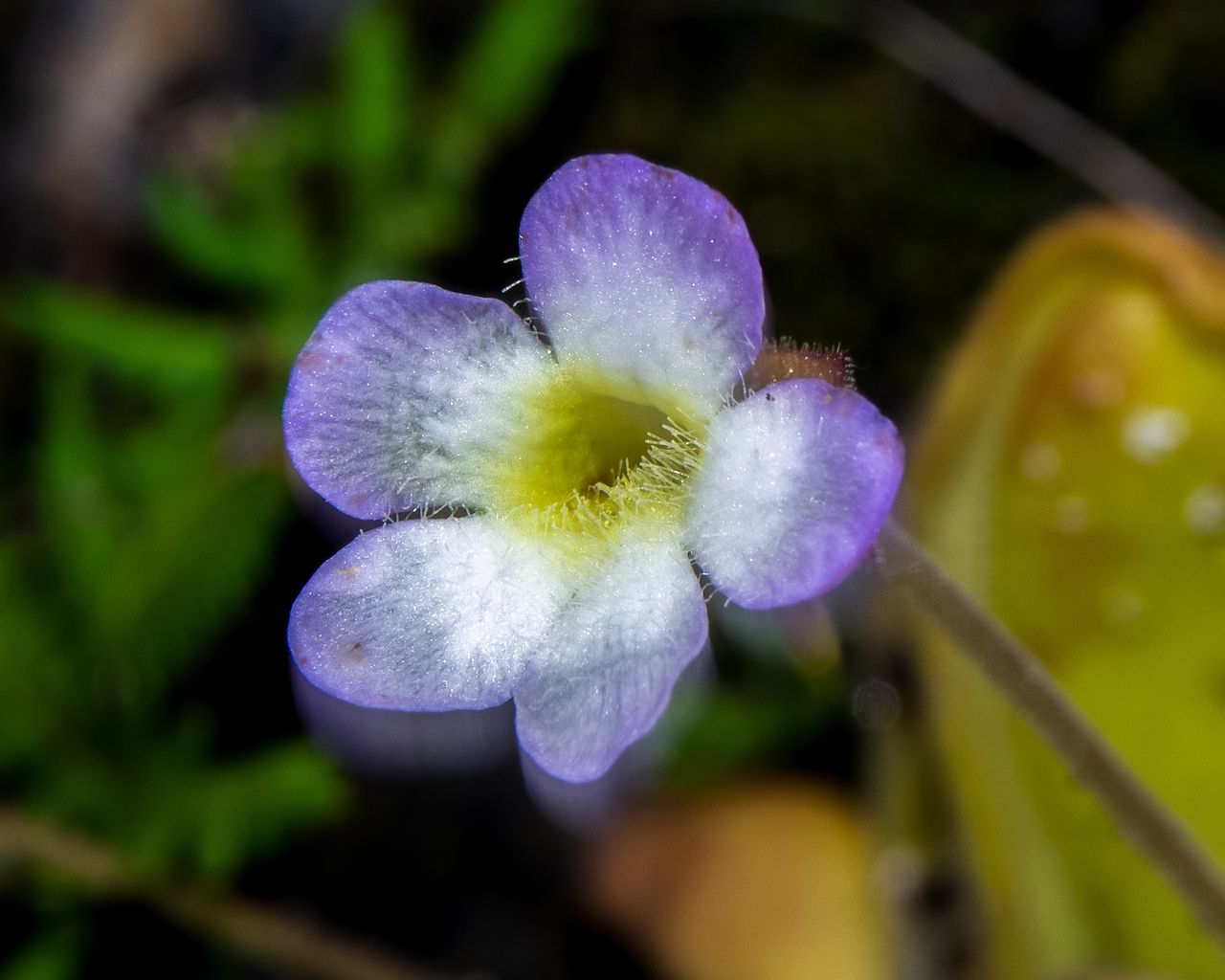
A species with two guises. The summer rosette consists of (6)8 to 14 thin, narrowly spathulate leaves 50 to 100 mm long and 13 to 25 mm wide, with a slightly inrolled margin and an upper surface glistening with glandular droplets. The winter rosette is compact and squat and counts (16)20 to 38 fleshy, spathulate to oblong-spathulate leaves 8 to 30(40) mm long and 3.5 to 15 mm wide. The scapes are 60 to 115 mm tall. The flower is white with a violet-flushed margin and measures 13 to 25(30) mm including the spur; that spur is short, 2.5 to 5 mm. Flowering falls between February and early April, at the end of the dry season and thus before the summer leaves are fully out.
Similar species
The species to weigh it against is Pinguicula agnata, which inhabits the same range. Three differences work in the field: the winter rosette of P. martinezii is compact with 16 to 38 leaves, where that of P. agnata is looser; the summer leaves are narrower (50 to 100 mm long against 35 to 110 mm in P. agnata, but distinctly less broad); and the flower is smaller, 13 to 25 mm against 20 to 34 mm. Altitude is a strong pointer too: P. martinezii grows between 2000 and 2370 m, P. agnata from 350 to around 2000 m. Large-flowered long-spurred species such as P. moranensis are excluded at once.
The trap and how it works
The narrow summer leaves form the trap. Stalked glands carrying a clear sticky droplet cover the whole upper surface, and between them sit sessile glands that release digestive enzymes only on contact with prey. A fly landing on the glistening blade sticks fast; struggling brings it against more and more droplets and at the same time starts a slow growth response in which the leaf margin bends a few millimetres over the prey and holds the digestive fluid. On a damp limestone face in cloud forest the catch consists of midges, small flies and flying ants. The winter rosette does not feed: those leaves are thick and virtually glandless and serve to see the plant through the dry months.
Habitat and ecology
Limestone cliffs in the bosque mesófilo de montaña between 2000 and 2370 m. The plants sit on ledges and in crevices of steep limestone faces (R2) over which water seeps in the wet months and which are kept damp by mist for the rest of the year (R1), usually in half shade beneath the canopy (B1). It is a habitat with almost no soil: a film of moss and weathered grit on bare rock, where little but mosses, small ferns and a few epiphytes persists. That is exactly where carnivory pays, because the seeping water carries every nutrient away.
Distribution and elevation
Endemic to the Sierra Madre Oriental of Mexico. The species was described from Llano Chiquito in the state of Querétaro, making it one of many butterworts whose only known site lies in the Querétaro-Hidalgo block of the range. The guide's species list gives merely 'Mexico' for this species — the protologue narrows that to Querétaro, and that is the statement we follow. The known range is small and consists of a few limestone massifs; given the inaccessibility of the country and the late date of description, nearby populations may exist that have not been recorded.
- Recorded (one-degree cells)
Forms and variation
No wild varieties have been described. The species is known from a limited number of closely spaced limestone faces within a single altitudinal belt, which leaves little scope for divergent forms. Observed variation concerns chiefly the amount of violet in the flower margin, running from almost pure white to a clearly violet-edged corolla, and the number of scapes per plant. Within section Agnata natural hybrids between related species are known where ranges meet, but none are reported for this species; the altitude at which it grows keeps it apart from P. agnata.
Where and when to see it
March is the moment: the species is then at peak flowering while the cloud forest is still in the dry season and the tracks are passable. Search along limestone faces and road cuts at two thousand metres and above, in half shade, and concentrate on the lowest two metres of the face and on overhanging ledges where the water runs down. The white of the flower shows up well against dark wet rock; the rosette itself is pale green and disappears into the moss. Keep off the face and do not climb it: the plants root in a thin skin of moss that peels away at a touch.
Conservation status
The species has not been assessed for the global IUCN Red List and is not listed in CITES. What is known amounts to little: a few populations on limestone faces in one part of the Sierra Madre Oriental, with a total known range of at most a few tens of square kilometres. The threats are those of the Querétaro and Hidalgo cloud forest generally — logging, conversion to pasture and coffee, and road works that strike exactly the damp rock faces the species occupies. On top of that, recently described Mexican butterworts are systematically collected from the wild for the trade. The absence of a category here means the species has never been examined, not that there is no cause for concern.
Scientific name
Pinguicula martinezii | Zamudio, 2004
Described by Sergio Zamudio in 2004 (formally published 2005), in Acta Botánica Mexicana 70: 76. The species occurs in the Mexican state of Querétaro. Who exactly is honoured by this species name could not be established with certainty.
World Checklist of Vascular Plants (WCVP), via Plants of the World Online (POWO), Royal Botanic Gardens, Kew.