All species › Lamiales › Bladderwort family › Pinguicula calderoniae
Pinguicula calderoniae
Pinguicula calderoniae belongs to the high grasslands of the Sierra Madre Oriental, on the border of the Mexican states of Querétaro and San Luis Potosí. The species was described in 2001 by Sergio Zamudio and named for the Mexican botanist Graciela Calderón. It is a plant of open, damp patches between cypress and oak woodland, on karstic limestone, at over two thousand metres.
Identification
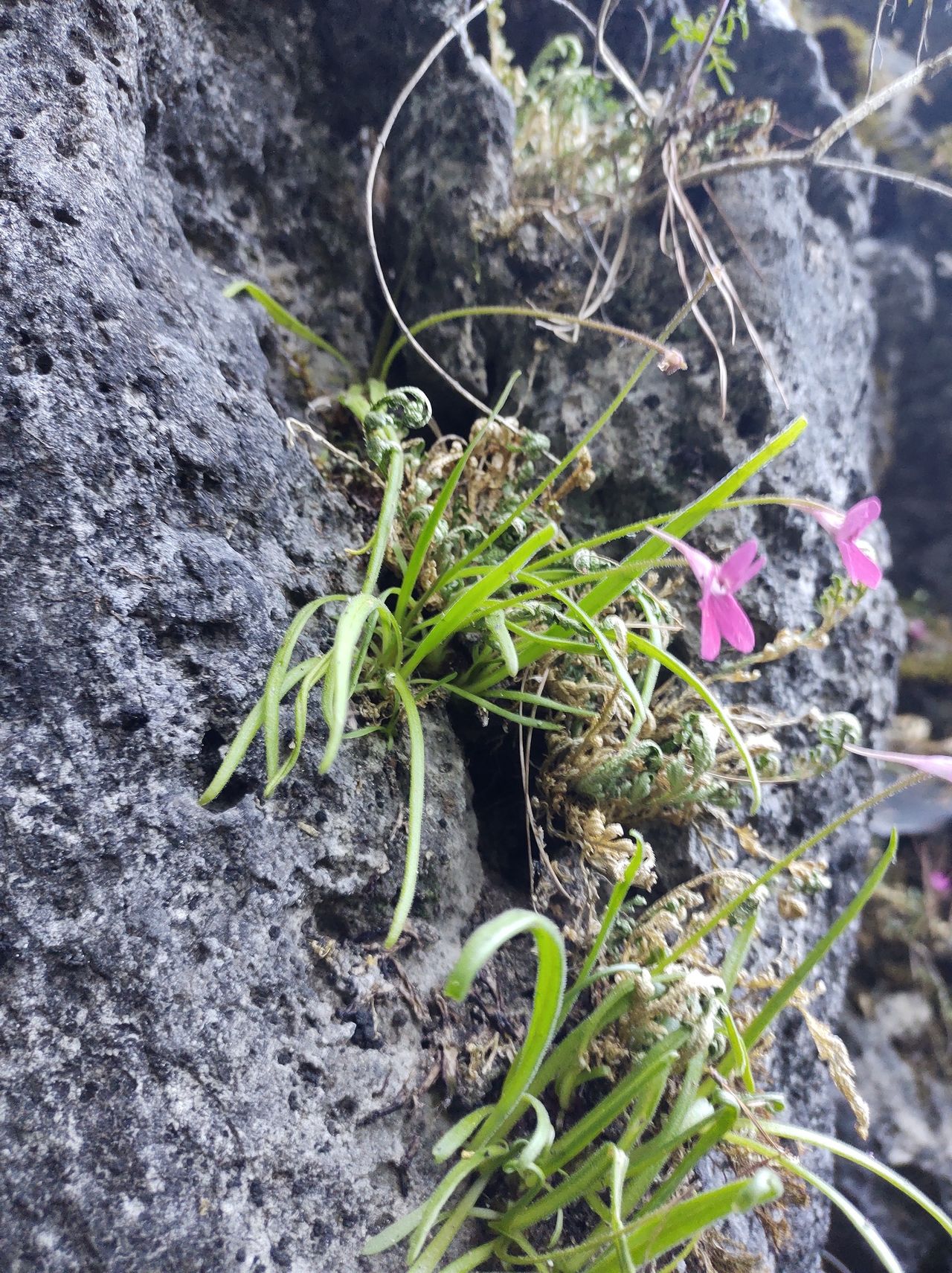
A flat rosette of entire, fleshy leaves with the glandular coat typical of butterworts, which makes the blade look wet in raking light and feel greasy. Slender, glandular-hairy scapes rise from the centre, each with a single two-lipped, spurred flower. Reliable, verifiable measurements of rosette and flower were not found for this guide; the original description appears in a Mexican botanical journal of 2001 that is not publicly accessible. In the field you therefore recognise the plant mainly by genus, situation and altitude, and the species name should be checked afterwards when in doubt.
Similar species
The Sierra Madre Oriental is the richest butterwort region in Mexico, and several species occur within reach in this part of it. The main distinctions run through the flower — colour, the ratio of corolla tube to spur, the shape of the lower lip — and those characters cannot be read without the descriptions. Practical advice: record altitude, soil type and surrounding vegetation, photograph the flower from the front and the side, and capture the whole rosette. In this company a well-documented observation is worth more than a quick name.
The trap and how it works
The trap is the standard butterwort one: stalked glands with a sticky droplet, sessile glands that release digestive enzymes only once prey rests on them, and a leaf skin that reabsorbs the dissolved food; the margin often rolls slowly towards the prey. At over two thousand metres, in grassland with cold nights and a marked wet and dry season, catching is largely a matter of the warm hours and of the rains. The insects available are small: midges, flies and whatever walks over the ground. In such grassland the rosette also faces something that plays no part on wet rock: grass growing up and taking the light, and dead plant material falling on the glandular coat and putting it out of action. Short, open patches are therefore a requirement.
Habitat and ecology
Open, damp grassy patches embedded in cypress and oak woodland, and in the transition to cloud forest, on karstic limestone slopes. The type labels describe exactly that combination: grassland between cypress-and-oak woodland and cloud forest, on calcareous karstic slopes. Limestone karst here means water that sinks away quickly and thin soils, and the open grassy patches sit precisely where that water stays at the surface — small wet openings in an otherwise dry landscape.
Distribution and elevation
Endemic to east-central Mexico: the Sierra Madre Oriental on the border of Querétaro and San Luis Potosí, with localities such as Llano Chiquito in Landa de Matamoros municipality and Llano del Conejo near Xilitla. The known range covers a handful of high grassy patches at about two thousand one hundred to two thousand three hundred metres. It is therefore a local endemic of one mountain belt, not of a whole country. The two known areas, Llano Chiquito and Llano del Conejo, are not far apart as the crow flies and belong to the same karst landscape; the picture is therefore of one cluster of populations rather than two separate ranges.
- Recorded (one-degree cells)
Forms and variation
No wild subspecies or varieties are recognised. In a species known from two adjacent areas the breadth of variation has not been adequately mapped; what differs on the labels is mainly the accompanying vegetation and the exact altitude. Mexican butterworts as a group are still very much in motion — dozens of new species have been described in recent decades — and it is not out of the question that new work will also draw distinctions within this one.
Where and when to see it
Search the small, wet grassy patches between the cypress and oak woodland rather than the woodland itself: open, short vegetation with seeping water is where butterworts stand in this landscape. The rainy season is the time to go, when the patches are actually damp. Kneel and use raking light; the rosette is small and vanishes into the grass. Record everything you see — the species is poorly documented, and a good observation with photographs is a real contribution here.
Conservation status
The species has not been assessed for the global IUCN Red List and is not listed in CITES. What is known: a Mexican endemic of a few high grassy patches in the Sierra Madre Oriental, spread over two adjacent states. Such small, wet openings in a wooded mountain landscape are vulnerable to grazing, conversion to pasture, water abstraction and changes in rainfall. The number of documented localities is small and recent records are few; an assessment is missing, and here that is above all a call for fieldwork. As long as the description is not freely accessible, fieldwork too remains hampered: you can find the plant, but can confirm the name only with literature not everyone can consult.
Scientific name
Pinguicula calderoniae | Zamudio, 2001
Described by Sergio Zamudio in 2001, in Boletín de la Sociedad Botánica Mexicana 68: 85. The type area lies at two sites in Mexico: near Llano Chiquito in Landa municipality (Querétaro) and near Llano del Cornejo in Xilitla municipality (San Luis Potosí). The species name calderoniae honours the Mexican botanist Graciela Calderón de Rzedowski.
World Checklist of Vascular Plants (WCVP), via Plants of the World Online (POWO), Royal Botanic Gardens, Kew.