All species › Lamiales › Bladderwort family › Pinguicula ionantha
Pinguicula ionantha
Godfrey's butterwort is a plant of six counties: all of Pinguicula ionantha fits into a strip of the central Florida panhandle, and more than half the known sites lie within a single forest, the Apalachicola National Forest. That makes it one of the most site-bound carnivorous plants in North America, and one of the few with federal protection.
Identification
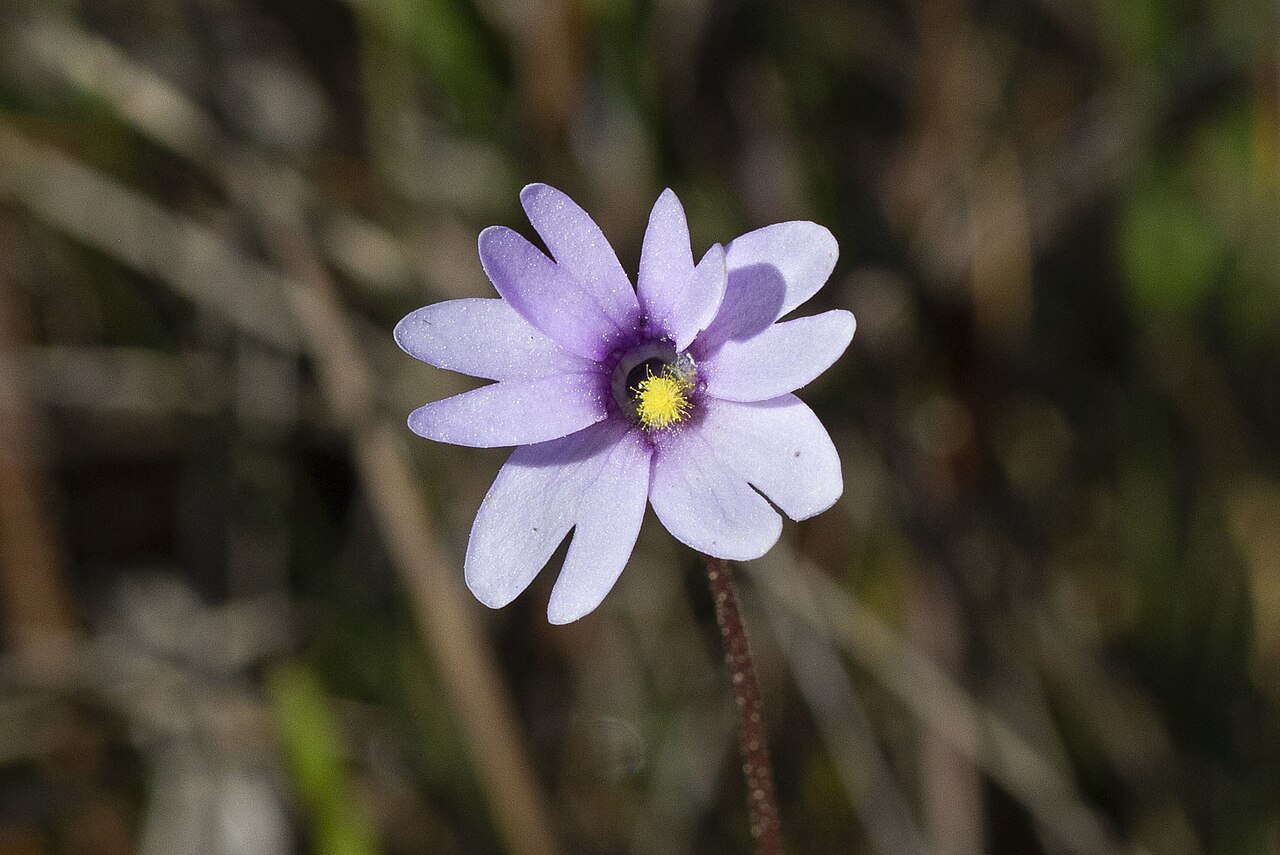
A fleshy rosette up to about fifteen centimetres across, with oblong leaves that feel sticky and are densely set with glandular hairs. Slender scapes rise from the centre, each with a single flower. That flower is pale purple to white and measures nearly two and a half centimetres when fully open; characteristically the yellow palate protrudes clearly forward from the throat, giving the flower an open, almost startled expression. Five spreading, notched corolla lobes complete the picture. The scape, as in all butterworts, itself carries glandular hairs. After flowering a small capsule of dust-fine seed remains — in this species with notably few viable grains.
Similar species
Four relatives share the small range: Pinguicula planifolia has broader, reddish, flat leaves; P. primuliflora has a pale ring above the throat and sits on shaded creek banks; P. caerulea has a large, deep violet, strongly veined flower and P. lutea a yellow one — and both prefer better-drained ground. The distinguishing character of this species is the combination of a pale purple to white corolla with that forward-jutting palate. It helps too that the species do not flower in exact step: the primrose butterwort usually starts in January, while this one only gets going towards the end of February. Looking at several sites in the same week therefore already separates them in part before a single flower has been examined closely.
The trap and how it works
The rosette is a flypaper trap: stalked glands produce a sticky droplet, sessile glands release digestive enzymes once prey lies on them, and the leaf margin rolls slowly towards the prey so the fluid pools in a shallow depression. The catch is small flying insects of the wet savanna. Work on this species and several relatives shows that they are self-compatible but hardly ever self-pollinate spontaneously: seed set needs pollinators, which makes the populations more fragile than their numbers suggest.
Habitat and ecology
Seepage slopes, bogs, the transition zone between wet flatwoods or wet prairie and cypress stringers, roadside ditches and depressions in wet pine flatwoods. The common feature is permanently wet, acid, nutrient-poor soil in full sun. As everywhere in this coastal plain fire drives the system: without regular burning the scrub closes in and the species goes. Roadside ditches play a double role — they offer replacement habitat, but are also vulnerable to maintenance and widening. Seepage slopes are the most distinctive habitat in this landscape: places where groundwater emerges at the foot of a sand ridge and maintains permanently wet, acid ground. They are small, scattered and barely recover from excavation or trampling.
Distribution and elevation
Endemic to the central Florida panhandle and known from six counties. More than half the known populations lie in the Apalachicola National Forest, which means the fate of the species depends largely on the management of one federal forest. Outside that strip it has never been found anywhere in the world; it is thus among the most geographically restricted species in this book.
- Recorded (one-degree cells)
Forms and variation
No wild subspecies or varieties are recognised. What varies is flower colour, running from pale lavender to virtually pure white, and rosette size according to how wet and open the site is. A practical problem in this species is seed quality: the seed has a strikingly low viability, which matters when judging population renewal. On top of that the species depends in nature mainly on cross-pollination, so genetic variation within a population depends heavily on how many plants flower at once and on the presence of pollinators.
Where and when to see it
Finding it stands or falls with flowering: the flowers show from late February into April, and outside that window the species is very hard to name in the field. Search seepage slopes and the transition from wet prairie to cypress stringers, and check roadside ditches along forest tracks in the Apalachicola National Forest. Stay off the sward and collect nothing: this species is federally protected, and even walking on a seepage slope can do damage.
Conservation status
The species has not been assessed for the global IUCN Red List and is not listed in CITES — but here that certainly does not mean there is nothing to worry about. Nationally the plant is protected under the United States Endangered Species Act as threatened, and in Florida at state level as well; Florida's natural areas ranking places it in the second-highest rarity class. The causes are the familiar ones: drainage, fire exclusion, works in roadside ditches and the very limited range. The absence of a global category is a good example of a gap that says nothing about the real situation.
Scientific name
Pinguicula ionantha | Godfrey, 1961
Described by Robert Kenneth Godfrey in 1961. The species occurs only in the central Florida Panhandle, in six counties between Tallahassee and Panama City. The species name ionantha is Greek for "violet-flowered" (ion, "violet" + anthos, "flower") and refers to the violet flower colour; the English common name "Godfrey's butterwort" honours the describer.
World Checklist of Vascular Plants (WCVP), via Plants of the World Online (POWO), Royal Botanic Gardens, Kew.