All species › Lamiales › Bladderwort family › Pinguicula planifolia
Pinguicula planifolia
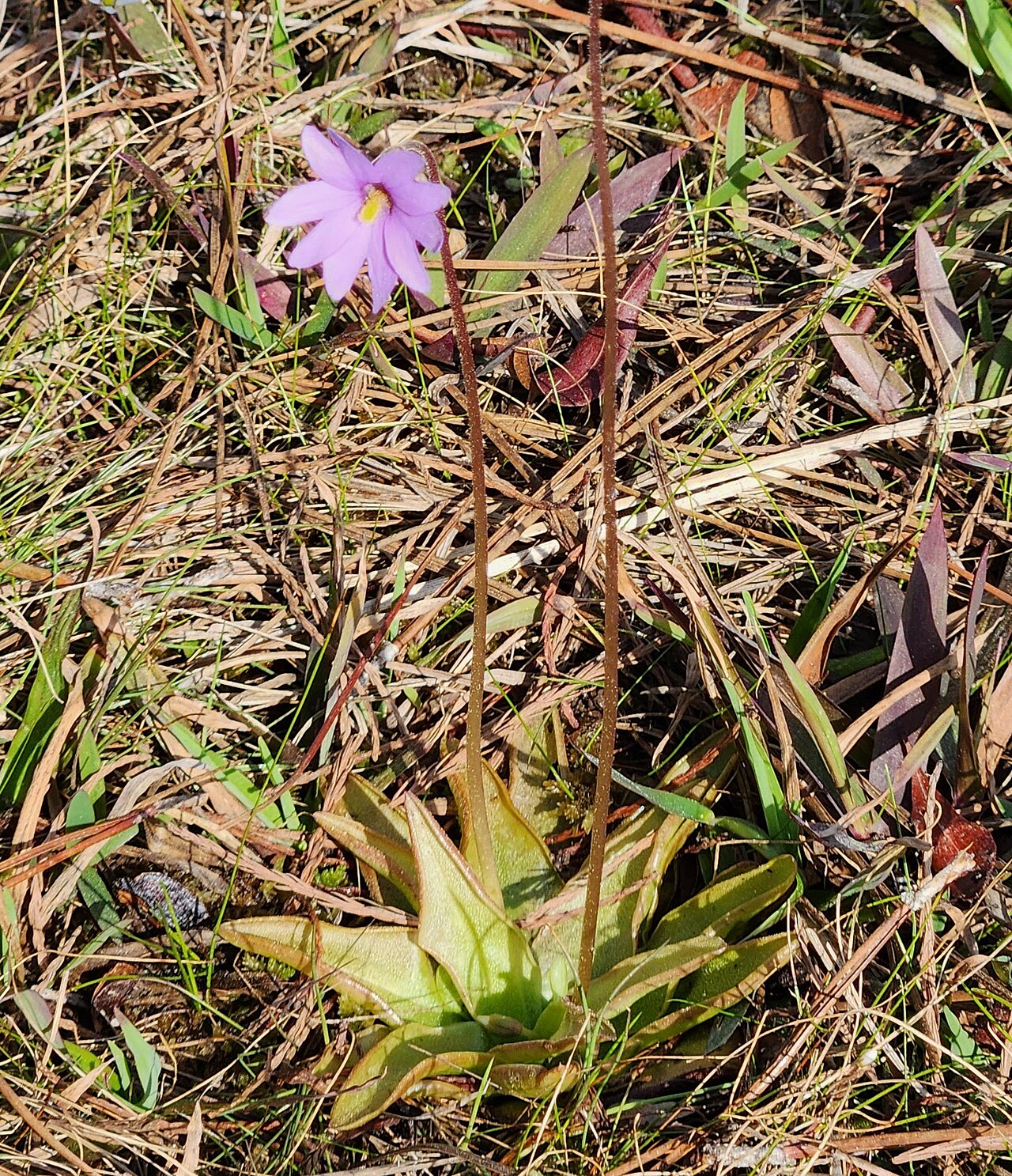
Chapman's butterwort is the wettest of the company. Where the other butterworts of the south-eastern United States stand in damp savanna, Pinguicula planifolia lies on muddy flats that are under water for much of the year — sometimes with the whole rosette below the surface. The reddish, entirely flat leaves are the best recognition point, even without flowers.
Identification
A rosette of narrow to oblong leaves lying completely flat on the mud, without the inrolled margin most relatives have; in many plants they are distinctly red to bronze, especially in sunny open spots. The scape is slender and can reach about twenty-five centimetres. The flower is light purple to pink or nearly white, with notched corolla lobes and a darker purple, tubular throat. The whole stands strikingly high above the flat rosette, which is what gives the plant away in the field. The scape is, as in all butterworts, itself set with glandular hairs. After flowering a small capsule of dust-fine seed remains, splitting only once the ground has dried out.
Similar species
The flat, often reddish leaves separate this species from all other butterworts in the area: Pinguicula caerulea and P. lutea have clearly inrolled margins and grow drier; P. primuliflora has a pale ring above the throat and sits on shaded creek banks; P. ionantha has a paler flower with a conspicuously protruding palate. Where two species grow together the situation is often decisive on its own — this one is invariably in the wettest part.
The trap and how it works
Catching proceeds as in all butterworts through two gland types: stalked glands with a sticky droplet and sessile glands releasing digestive enzymes. Because the blade here stays flat and the margin hardly curls, the strategy differs slightly: the leaf forms a broad, flat adhesive surface rather than a shallow dish. That suits a site where the leaf is often under water; part of what is caught is therefore what moves on and in the water, alongside the usual small midges and flies above it.
Habitat and ecology
Very wet, muddy and sometimes flooded ground: depressions in wet pine flatwoods and wet prairies, cypress domes, swamp edges and roadside ditches, on acid, nutrient-poor soil in full sun. Observers describe plants standing entirely submerged in the wet season and emerging only in the dry. As with the other butterworts of this coastal plain, open, fire-maintained ground is a condition; shrub encroachment ends a site. Living under water is not obvious for a carnivorous plant: the glandular coat works best in air, so growth and flowering must be concentrated in the period when the level falls. That explains why flowering falls so sharply in late winter and early spring.
Distribution and elevation
Confined to the south-eastern coastal plain of the United States: the Florida panhandle and adjacent southern Alabama and Mississippi, with Florida localities from Escambia County in the west to Wakulla County in the east. It is therefore a species of a narrow lowland strip around the northern Gulf coast. The range is small, but within it the species can be locally numerous where conditions suit.
- Recorded (quarter-degree cells)
Forms and variation
No wild subspecies or varieties are recognised. The most conspicuous variation is leaf colour, running from fresh green in shade to deep red in full sun, and so a response to light rather than a fixed property. Flower colour and the degree of notching of the corolla lobes also vary; observers additionally report plants free of red pigments, with pale flowers and green leaves. Cultivated selections fall outside this account. Where the rosettes stand submerged for long periods the leaves also stay thinner and longer than in plants sitting merely on wet mud; that too depends on the site and is no character to identify by.
Where and when to see it
Go between January and April and search the wettest part of the site: muddy hollows, the edges of cypress domes and flooded prairies. Boots are not a luxury. The flowers stand high above the flat rosettes and are visible from a distance; the rosettes themselves you only find close up, by looking deliberately for red, flat leaves. Check roadside ditches along tracks through wet flatwoods too — these are often the most accessible colonies. A waterproof torch is surprisingly useful in shallow, turbid water: the rosettes often lie just below the surface and can be picked out from above in raking light.
Conservation status
The species has not been assessed for the global IUCN Red List and is not listed in CITES. In Florida it is protected as threatened at state level. The threats named are drought, drainage, habitat loss and illegal collection — a combination that bears exactly on what this species needs: prolonged shallow water on poor, open ground. Because the range is small and the habitat is under pressure across the northern Gulf coastal plain, the absence of a global assessment here reflects a shortage of attention rather than a sign that all is well. Anyone meeting the species in the field helps most by reporting the site and collecting nothing.
Scientific name
Pinguicula planifolia | Chapman, 1897
Described by Alvan Wentworth Chapman in 1897, in Flora of the Southern United States, 3rd edition: 303. The species occurs in the southeastern United States: southern Mississippi and Alabama, the Florida panhandle, and the extreme southeastern tip of Louisiana. The name "planifolia" is Latin for "flat-leaved" (planus, flat + folium, leaf) and refers to this species' thin, flat leaves.
World Checklist of Vascular Plants (WCVP), via Plants of the World Online (POWO), Royal Botanic Gardens, Kew.