All species › Lamiales › Bladderwort family › Pinguicula heterophylla
Pinguicula heterophylla
The epithet means 'with different leaves', and that is exactly what this plant does: within one rosette, and between the seasons, Pinguicula heterophylla makes leaves of entirely different shape, from thread-thin to long and strap-like. It is a species of pine and oak woodland in the mountains of southern Mexico, and one of the few butterworts growing not on rock but in ordinary woodland soil.
Identification
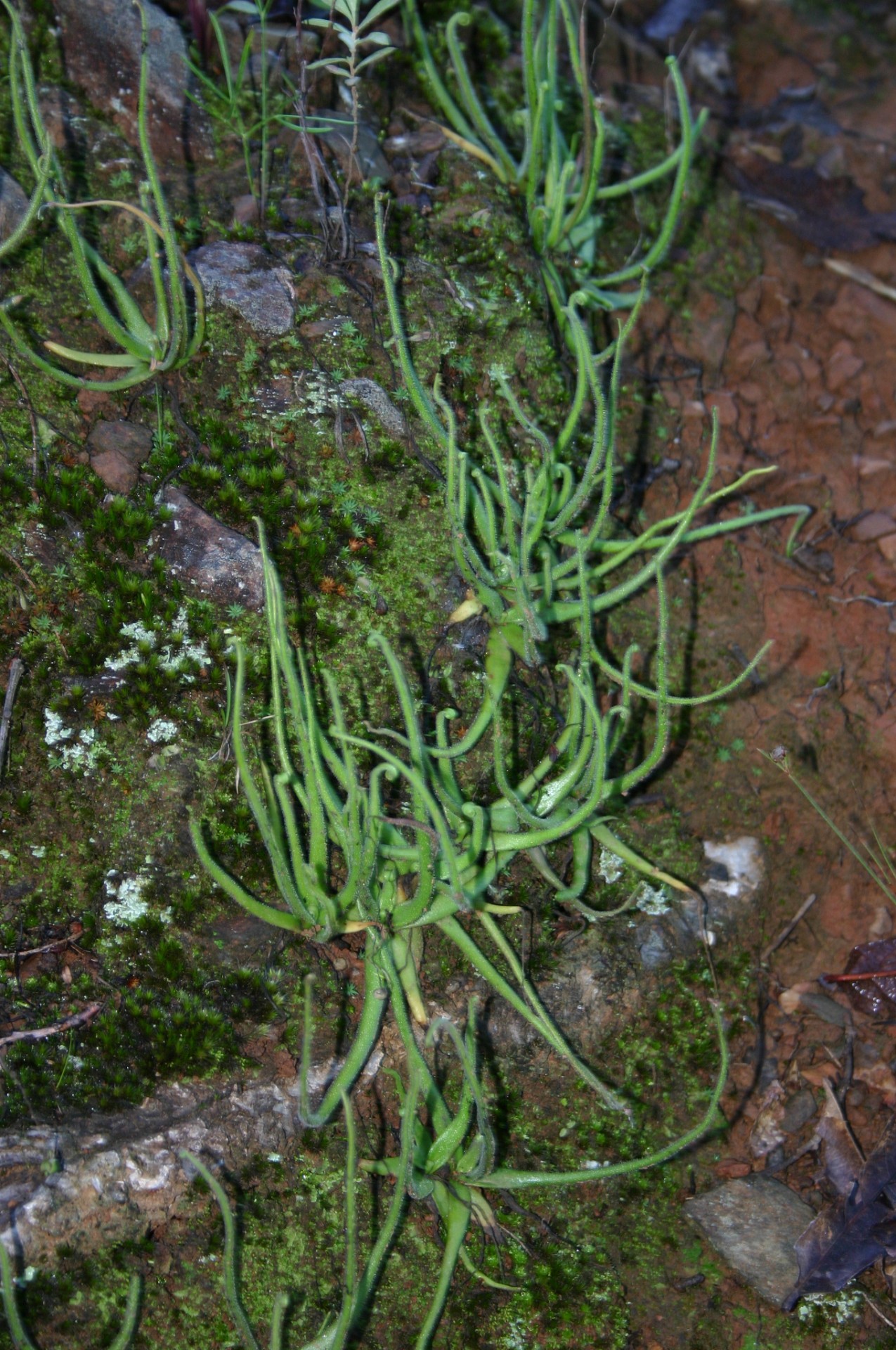
The winter rosette has outer leaves 10 to 25 mm long and 1 to 3 mm wide, and within them almost filiform leaflets to 25 mm long and only 0.2 mm wide — a form found in no other Mexican species to this degree. The summer rosette makes outer leaves 15 to 25 mm and inner leaves reaching 150 mm long and 4 to 5 mm wide at the base: long limp straps lying over the ground. One to four erect scapes 10 to 15 cm tall, sometimes 23 cm, rise per plant, each with one flower. The flower is 20 to 24 mm including the short spur of 4 to 5 mm, and violet, purple, pinkish-white or white in colour, with a yellow-green mark in the throat. Flowering May to June. The plant forms a true underground bud for the dry season.
Similar species
The filiform inner leaves of the winter rosette are unique and make the species recognisable even out of flower. In flower, confusion is possible with Pinguicula acuminata and other species with a short spur and pale flower, but those have broad spathulate leaves without the strap-like summer foliage. P. macrophylla, partly sharing the same mountains, has very broad leaves and a much longer spur. In doubt: carefully part the centre of the rosette and see whether filiform leaflets sit among the rest.
The trap and how it works
A flypaper trap, but with a striking division of labour between leaf types. The broad summer leaves carry the full glandular coating and do most of the catching; the filiform leaflets catch hardly anything and probably serve mainly to see the plant through the dry season. On the catching leaves, stalked glands hold the prey and sessile glands release enzymes on contact, while the margin of the long leaf bends slowly inward. Prey consists mainly of small flies and ants from the woodland floor layer.
Habitat and ecology
Oak woodland, pine woodland and mixed woodland on reddish-brown to brown soils derived from andesite or metamorphic rocks (B5, D4). This is therefore neither a lime plant nor a rock dweller: P. heterophylla grows in plain woodland soil, among litter, moss and grass, where the humus layer is thin and dries out completely in the dry season. Its elevation range is wide, from fifteen hundred to three thousand metres, which means it can stand both in warm oak woodland and in cold conifer forest. The underground bud lets it survive fire and long drought.
Distribution and elevation
Endemic to Mexico, with sites in Oaxaca, Guerrero and Michoacán. Our species list says only 'Mexico'; the literature is more precise and points to those three states in the south and south-west. It is not a continuous range but a series of mountain populations in different massifs, separated by hot dry valleys. Because the species grows in woodland soil and is not tied to rock or gypsum, it can be spread over large areas within a suitable wood.
- Recorded (quarter-degree cells)
Forms and variation
Flower colour is notably variable in this species — violet, purple, pinkish-white and white all occur, sometimes within one population — but no wild varieties are distinguished. The leaf variation the species is named for is not a matter of forms but of season and position within the rosette, and is present in every plant. The size of the summer leaves depends strongly on summer rainfall; in dry years the straps stay considerably shorter. No natural hybrids have been published.
Where and when to see it
May and June are the months: the species flowers then and the pale blooms show above the woodland grass while the long summer leaves have barely emerged. Search open spots in oak and pine woodland, along paths and where the litter is thin; not on rock. The rosette lies flat and vanishes entirely among grass and needles, so let the flower do the work. Do not sweep litter aside or dig: the underground bud sits just below the surface and is easily damaged.
Conservation status
Not assessed for the global IUCN Red List and not listed in CITES. What is known looks less precarious than for its rock-dwelling relatives: the species has a wide elevation belt, a distribution across three states, and grows in a widespread woodland type. Against that, pine and oak woodland in southern Mexico is being converted to farmland fast, and overgrazing and too-frequent fires damage the herb layer. Published population data are lacking. An assessment here would above all have to establish how much of the known range still holds suitable woodland.
Scientific name
Pinguicula heterophylla | Bentham, 1839
Described by George Bentham in 1839, in Plantae Hartwegianae 1: 70. The species occurs in Mexico, in the states of Oaxaca (Sierra de San Felipe), Guerrero (north-east of Chilpancingo) and Michoacán (near Coalcomán). The species name heterophylla is Greek for "with different leaves" and refers to this species' two strongly differing rosette forms: a compact, bulb-like winter rosette and an erect, carnivorous summer rosette.
World Checklist of Vascular Plants (WCVP), via Plants of the World Online (POWO), Royal Botanic Gardens, Kew.