All species › Lamiales › Bladderwort family › Pinguicula cyclosecta
Pinguicula cyclosecta
A small butterwort with a large, deep violet flower, from cool north-facing limestone walls high in the Sierra Madre Oriental. Pinguicula cyclosecta was described by Casper in 1963 from material collected in Nuevo León in 1948, and belongs to the group of small fleshy Mexican species that spend most of the year as a hard little bud.


Identification
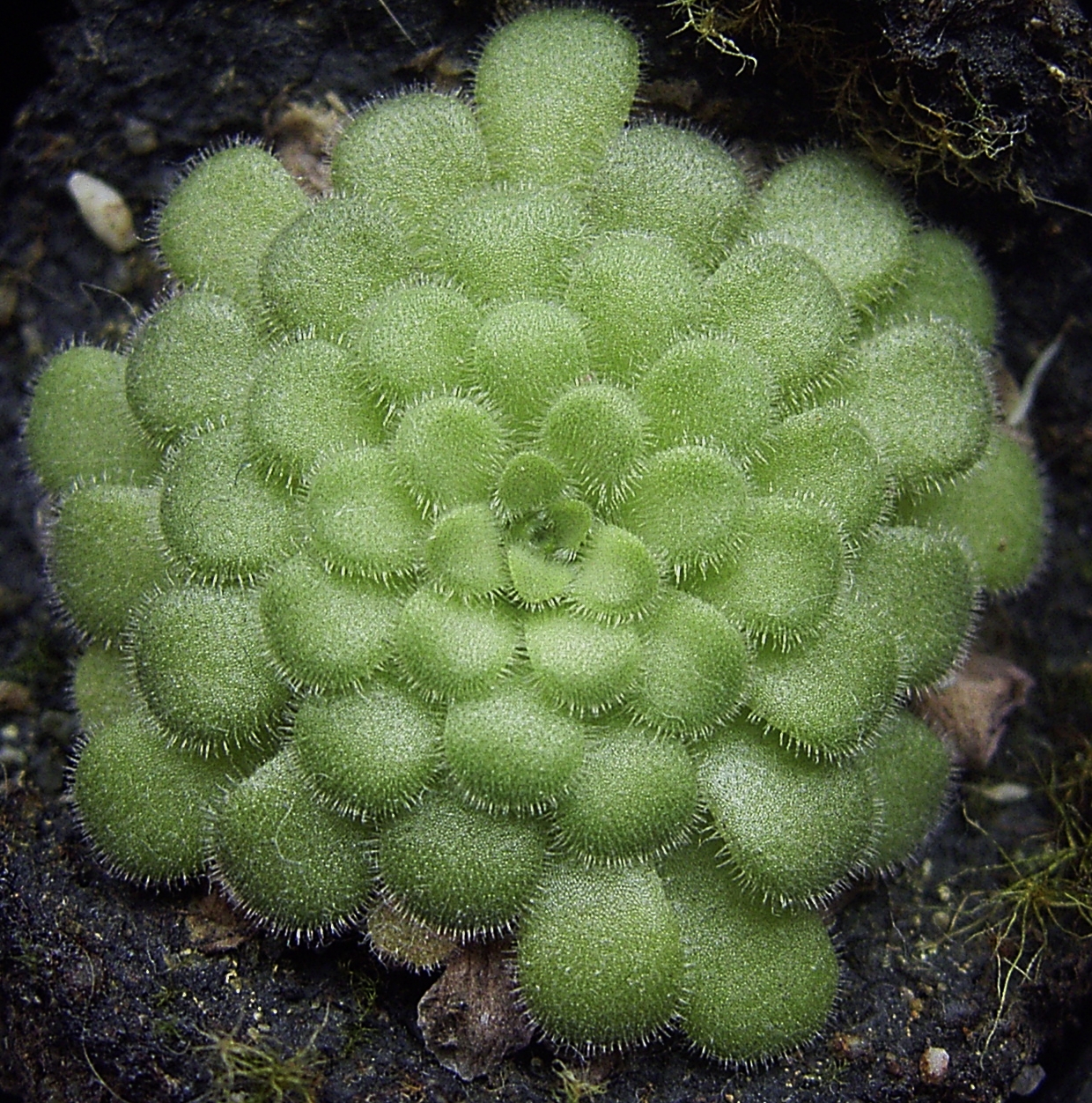
Two very different rosettes. The winter rosette consists of very small, narrow, fleshy leaflets 3 to 10 mm long and 0.75 to 2.5 mm wide, packed tightly into a bud barely larger than a pea. The summer rosette makes broader, flat leaves 15 to 35 mm long and 5 to 12 mm wide with a glandular coating; the leaf margin is often bent upward so the rosette forms a shallow dish. The scape stays low, 3 to 5 cm, but the flower is large: 25 to 35 mm including the slender spur of 15 to 22 mm, and intense violet in colour. That proportion — small plant, substantial flower on a short scape — is characteristic in the field.
Similar species
Other small butterworts of the north-east, such as Pinguicula immaculata and P. rotundiflora, have a considerably smaller flower with a shorter spur and grow by preference on gypsum. P. esseriana and relatives from San Luis Potosí look strikingly alike in the winter rosette but lie further south and generally have broader winter leaflets. The combination of very narrow winter leaflets, a short scape and a deep violet flower over two centimetres long with a long spur is the most reliable for this species.
The trap and how it works
A flypaper trap on a small but slightly dished leaf. The stalked glands hold the prey; the sessile glands between them release digestive enzymes on contact, and the already raised leaf margin keeps the fluid around the prey without much movement being needed. On the winter rosette the leaflets are fleshy and almost glandless; the plant then catches nothing and lives on reserves. The catch is correspondingly small: springtails, midges and small flies hanging about in the lee of the wall.
Habitat and ecology
North-facing vertical limestone walls rising above woodland of Abies and oak (R1, R2, B5). The air there is cool and windy; the rosettes sit on small carpets of moss together with Selaginella and ferns, or in narrow crevices and on ledges in the shade beneath agaves and hechtias. Water comes from seepage down the wall and from the humid mountain air; in the dry months that supply falls sharply and the plant withdraws into its winter bud. Soil hardly exists here — moss, grit and a thin layer of humus in a crack.
Distribution and elevation
Endemic to Mexico and known from Nuevo León, in the highlands of the Sierra Madre Oriental. Our species list names Tamaulipas; the published origin of the type material and later records, however, point to Nuevo León. We follow Nuevo León here. The number of known sites is small, and given how hard the walls it grows on are to reach, the real distribution is probably somewhat wider than the map suggests.
- Recorded (one-degree cells)
Forms and variation
No wild varieties are distinguished. Between populations what mainly differs is the saturation of the flower colour, from clear violet to nearly blue-violet, and how far the winter rosette flushes purple. The latter relates strongly to how sunlit the wall is. The summer leaves are noticeably larger on wet ledges than on dry ones; that too is site-dependent and not a fixed character. No natural hybrids have been published with certainty for this species, partly because other butterworts rarely occur on its walls.
Where and when to see it
Go in summer, when the summer rosettes are open and the violet flowers appear on their short scapes; in the dry season the plant is a bud you will not find. Search north-facing walls above the conifer woodland, along ledges and in the shade under overhanging rock. The flower is large relative to the plant and the first thing to catch the eye: look for violet dots on the grey limestone. Do not climb; the walls are high and loose, and the species is perfectly viewable from a path with binoculars.
Conservation status
Not assessed for the global IUCN Red List, and not listed in CITES. What is known: a small number of sites in one state, on a habitat fairly well protected by its steepness from grazing and trampling. Logging in the woodland below, fires and the opening of walls during road building are named as pressures, along with collecting, since the species is sought after by enthusiasts. Population figures do not exist. The plant is widely available in cultivation and easily propagated from leaves, so taking wild plants is pointless.
Scientific name
Pinguicula cyclosecta | Casper, 1963
Described by Siegfried Jost Casper in 1963, in Feddes Repertorium Specierum Novarum Regni Vegetabilis 67(1–3): 11–12. The type area lies in the Mexican state of Nuevo León; the type material was collected by F.G. Meyer and D.J. Rogers in 1948. The species name cyclosecta combines the Greek kyklos ("circle") and the Latin secta ("cut") and refers to the circular arrangement of the leaves in a rosette.
World Checklist of Vascular Plants (WCVP), via Plants of the World Online (POWO), Royal Botanic Gardens, Kew.