All species › Lamiales › Bladderwort family › Pinguicula benedicta
Pinguicula benedicta
A small blue-flowered butterwort growing where almost nothing else can: on the red, iron- and nickel-rich laterite soils along the fast rivers of eastern Cuba. Pinguicula benedicta was collected in 1910 and only described ten years later, and it has had a reputation for being hard to find ever since. Walk along the water in the Moa-Baracoa country and you see it as a narrow band of green rosettes tracing the bank like a drawn line.
Identification
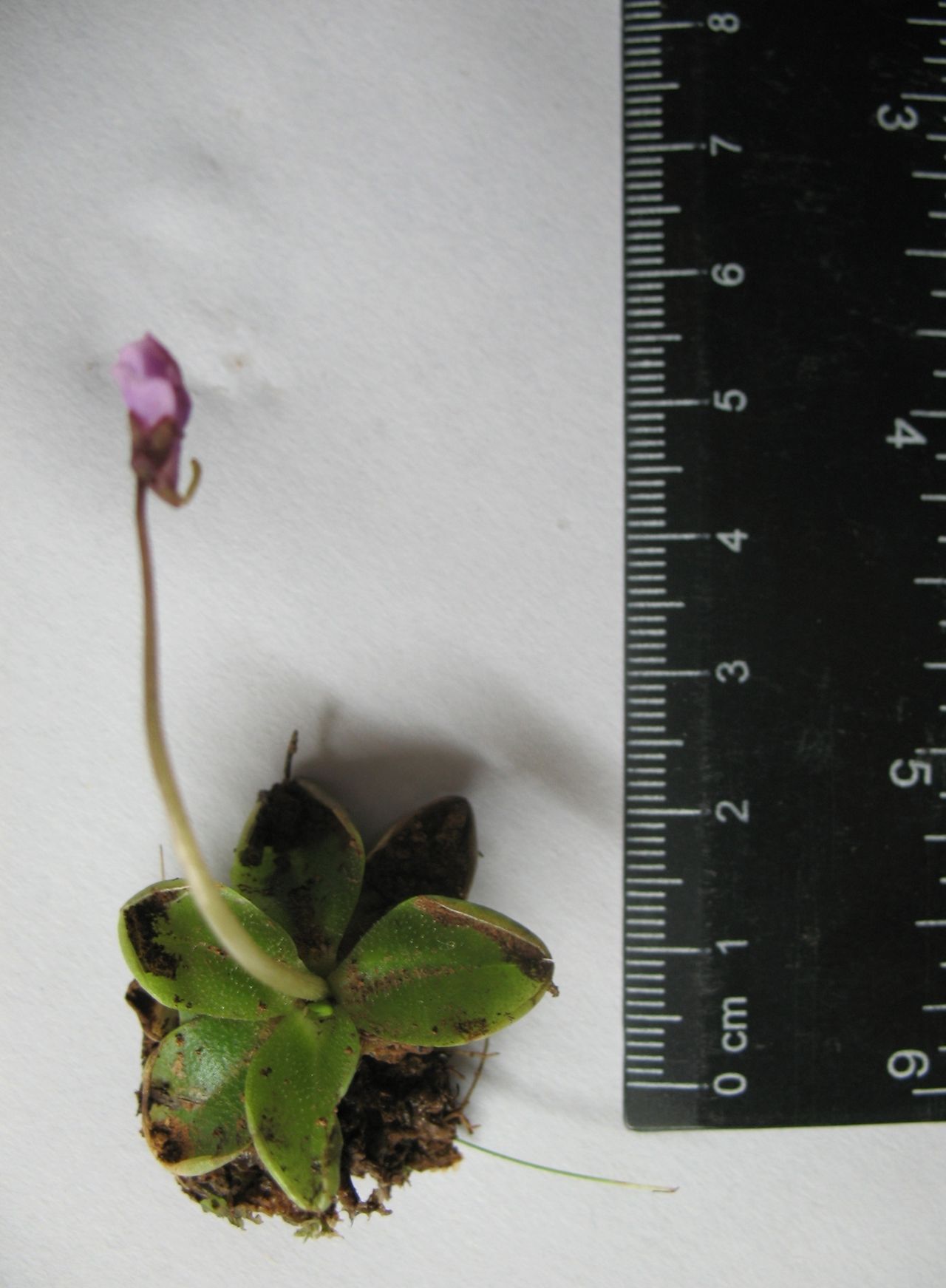
A compact, flat rosette of fairly small entire leaves 10 to 15 mm long and 5 to 8 mm wide, set so closely that the rosette forms a closed disc. The leaf surface is covered with glandular hairs and looks permanently wet; the margin stands slightly proud. Slender erect scapes rise from the centre, each carrying a single flower. The flower is bluish and clearly two-lipped: the upper lip has two rounded lobes, the lower lip is markedly larger and three-lobed. Behind it sits a cylindrical spur 4 to 6 mm long, held at very nearly a right angle to the corolla tube — a useful character in the field, because several related Caribbean species carry the spur more nearly in line with the tube. Flowering runs from September to May, with the odd flower in summer.
Similar species
In Cuba the risk of confusion lies mostly with the other butterworts of the east of the island: Pinguicula filifolia, with thread-like leaves and a quite different rosette, and Pinguicula albida, with a white flower. The blue corolla combined with the short, right-angled spur and the crowded, broad little leaves is diagnostic here. Out of flower the site itself is the best character: a narrow strip on bare red ground just above the water of a stream in ultramafic country, where few other butterworts occur. Confusion with the large Mexican species is impossible; those grow thousands of kilometres away and are far more substantial plants.
The trap and how it works
The leaves work as a slow flypaper trap. Two kinds of gland are mixed on the upper surface: stalked glands that exude a clear, sticky droplet, and sessile glands that act only once something is lying on the leaf, then releasing digestive enzymes. Small flies drawn to the glitter stick fast; their struggling brings more droplets into contact with the body and at the same time starts a slow growth response in which the leaf margin curls a little over the prey. In this habitat the catch is mostly small and airborne: midges and other two-winged insects that swarm above running water. For this plant the return is not a bonus but a necessity — on almost pure laterite, nitrogen is so scarce that the catch supplies a substantial part of the diet.
Habitat and ecology
The species grows on the steep, rocky banks of streams in the ultramafic massif of Moa and Baracoa, among them the Río Jaguaní, in bands about a metre wide following the waterline. The soil is nearly pure laterite: the red, leached weathering product of serpentine rock, rich in iron, chromium and nickel and poor in everything a plant needs. Such soils are toxic to most species, and precisely for that reason there is barely any competition. Permanent moisture from the river and from near-daily rain keeps the glandular coating working. Where the laterite gives way to ordinary forest soil, the species stops.
Distribution and elevation
Endemic to eastern Cuba, in the Moa-Baracoa area of Holguín and Guantánamo provinces — one of the foremost centres of plant endemism in the Caribbean, with hundreds of species found nowhere else. A correction belongs here: older accounts and some name lists associate this species with Hispaniola or even with Mexico, but the modern treatment of the genus in the Greater Antilles and the data held at Kew place it unambiguously in eastern Cuba. The range is small and entirely tied to the ultramafic rock; outside it the species has not been found.
- Recorded (one-degree cells)
Forms and variation
No varieties or subspecies are recognised. With so small a range and so uniform a habitat that is hardly surprising: all known populations sit in the same geological setting, within a limited altitudinal band and under the same climate, so there is little to drive divergence. What does vary is rosette size — plants on the barest laterite stay smaller than those in a slightly more sheltered corner — and the intensity of the blue in the flower. No natural hybrids have been described; the other Cuban butterworts generally occupy different sites and partly flower at different times.
Where and when to see it
The winter half of the year is the moment: between September and May the species is in flower and the small blue corollas read from a distance as pinheads above the green. Search along the river banks rather than in the forest: the plants form narrow strips just above the waterline on bare red ground, and that band is often barely a metre wide. The red colour of the soil is the best guide. Stay on the path and keep off the bank strips — the rosettes sit loosely in a thin layer of weathered material and a single footstep destroys metres of them at once. Binoculars or a long lens are more use here than stepping closer.
Conservation status
The species has not been assessed for the global IUCN Red List, and it is not listed in CITES. What is known does give cause for concern. The range is small and confined to the ultramafic country of Moa and Baracoa, and that country is Cuba's principal nickel and cobalt mining district: open pits, stripping, and the roads and spoil heaps that come with them bite into exactly the laterite soils the species depends on. The bank strips are also sensitive to changes in water level and to trampling. The lack of an international category here means only that no formal assessment has ever been made — not that the species is safe.
Scientific name
Pinguicula benedicta | Barnhart, 1920
Described by John Hendley Barnhart in 1920, in Memoirs of the Torrey Botanical Club 16: 110, based on material collected earlier by Shafer in 1910. The type area lies in eastern Cuba, on the trail between Camp La Barga and Camp San Benito, in the botanically very species-rich Moa-Baracoa region. The exact origin of the species name benedicta (Latin for "blessed") has not been reliably recorded.
World Checklist of Vascular Plants (WCVP), via Plants of the World Online (POWO), Royal Botanic Gardens, Kew.