All species › Lamiales › Bladderwort family › Pinguicula conzattii
Pinguicula conzattii
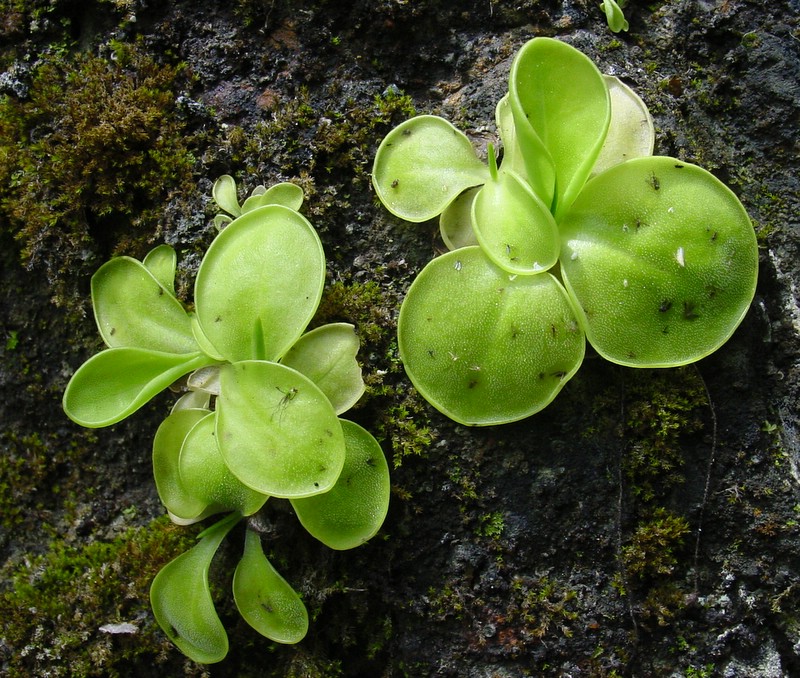
A butterwort of the cloud forests of the Mixteca in Oaxaca that changes shape twice a year: in the rains a broad, palm-sized rosette of thin trapping leaves, in the dry season a cushion barely two centimetres across that you will certainly walk past if it is not flowering. It is precisely in that small winter form that Pinguicula conzattii blooms, and it is the flowers that give it away on the dripping limestone along the road from Santo Tomás Ocotepec to Santiago Nuyoo.
Identification
A species with two kinds of leaf. The summer rosette is 6 to 12 cm across and consists of thin, membranous leaves 28 to 50 mm long and 25 to 48 mm wide, lying flat on the rock and studded with glandular droplets. The winter rosette is a compact cushion only 10 to 20 mm across, built from small, tightly packed leaves 5 to 10 mm long and 2 to 4 mm wide, hairy on both surfaces — a character the original description singled out. One to six scapes 70 to 170 mm tall appear each flowering season. The flower is white to violet-tinged, 18 to 30 mm long including the spur, with lobes 5 to 10 mm long, and the spur is 3 to 6 mm long and meets the corolla tube at an obtuse angle. Flowering runs from September to late February.
Similar species
The closest relative is Pinguicula mirandae from the Tehuacán-Cuicatlán country; both belong to section Heterophyllum and have a kinked corolla tube and a winter rosette of many small leaves. P. mirandae, however, grows much lower, in tropical deciduous forest around 1250 to 1800 m, has a smaller flower of 9 to 17 mm and a shorter spur, and its winter leaves are glabrous. The hairiness of both surfaces of the winter leaves of P. conzattii is the quickest field distinction with a hand lens. Large-flowered species of section Orcheosanthus, such as P. moranensis, have a much longer spur and no compact winter cushion.
The trap and how it works
Catching is done by the thin summer leaves. Their upper surface carries stalked glands with a clear sticky droplet and, between them, sessile glands that release digestive fluid only once prey is lying on the leaf. Small flies drawn to the glitter stick in the droplets; their movements bring more and more glands into contact and start a slow inward bending of the leaf margin, so the fluid pools in a shallow dish. On a wet cloud-forest cliff the supply is generous: midges, small hoverflies, flying ants and aphids. Notably, the plant does not feed in the dry season — the winter rosette has almost no glands and lives on what was stored during the rains.
Habitat and ecology
Wet limestone rock in the bosque mesófilo de montaña, the cloud forest of the Mixteca mountains, at about 2400 m, in company with Chiranthodendron, Cercocarpus, Buddleia and oaks. The plants sit in crevices and on mossy ledges of rock faces over which water seeps continuously during the rains (R1, R2), usually on north-facing slopes where the mist lingers longest. That the species also does well on acid substrates in cultivation suggests it is not strictly tied to lime and might also occur on sandstone or igneous rock; in the field it is so far known from limestone only.
Distribution and elevation
Endemic to the state of Oaxaca, in the Tlaxiaco district in the west of the state, between Santo Tomás Ocotepec and Santiago Nuyoo. The known range is very small — a matter of a few ridges — and the species was only described in 2003, which means the distribution picture may still be incomplete. The Mixteca Alta is botanically under-explored and holds more butterworts with minute ranges, so further finds in neighbouring districts cannot be ruled out. Outside Oaxaca the species has not been recorded.
- Recorded (one-degree cells)
Forms and variation
No wild varieties have been described. The species is known from a handful of closely spaced sites in the same massif, and these offer little environmental contrast for forms to attach themselves to. What varies is chiefly flower colour, which runs from pure white to distinctly violet-tinged, and the size of the summer rosette, which is larger in a wet crevice than on an exposed ledge. For this guide that is variation within one species, not grounds for named forms. No natural hybrids are reported; no close relatives grow in the immediate neighbourhood.
Where and when to see it
Go between November and February, in the middle of the dry season: the plant is then small and inconspicuous but in full flower, and the white corollas on their long scapes are far easier to find than the rosettes themselves. Search the north-facing limestone walls along the mountain roads through the cloud forest, at eye level and above: the plants favour narrow mossy ledges just out of reach. A hand lens is no luxury here — the hairy winter leaves are an identification character you will miss with the naked eye. In the rains the species is easier to see but harder to name, because flowering is over by then.
Conservation status
The species has not been assessed for the global IUCN Red List and is not listed in CITES. What is known fits a pattern that recurs among Mexican butterworts: a very small range, a handful of populations, and a habitat — wet rock faces along mountain roads — vulnerable to road widening, ditching and the cutting back of verges. To that is added the decline of the Mixteca cloud forest itself, where conversion and logging dry out the microclimate of damp rock faces. Illegal collecting for the plant trade plays a part with recently described Mexican Pinguicula as well. A formal assessment is therefore missing, but the available data point to a species with little margin.
Scientific name
Pinguicula conzattii | Zamudio & van Marm, 2003
Described by Sergio Zamudio and Dick van Marm in 2003. The type area lies near Santiago Nuyoo, in the Tlaxiaco district of the Mexican state of Oaxaca, where the species grows on shaded vertical rock walls at around 2700 metres elevation. The species name conzattii honours Cassiano Conzatti, an Italian-born botanist who spent most of his life in Mexico.
World Checklist of Vascular Plants (WCVP), via Plants of the World Online (POWO), Royal Botanic Gardens, Kew.