All species › Caryophyllales › Tropical pitcher plant family › Nepenthes thorelii
Nepenthes thorelii
The species that gave its name to a whole group, and at the same time one of Asia's most enigmatic pitcher plants. Nepenthes thorelii was described in 1909 by Paul Henri Lecomte from material collected in southern Vietnam between 1862 and 1866 by the French botanist Clovis Thorel. After that the species remained untraceable for a century, while all sorts of other plants circulated in horticulture under its name. Only in 2011 was it found again in southern Vietnam, inside a military zone, in a population of fewer than a hundred plants. The plants growing there match Lecomte's description and the herbarium material in Paris exactly.
Identification
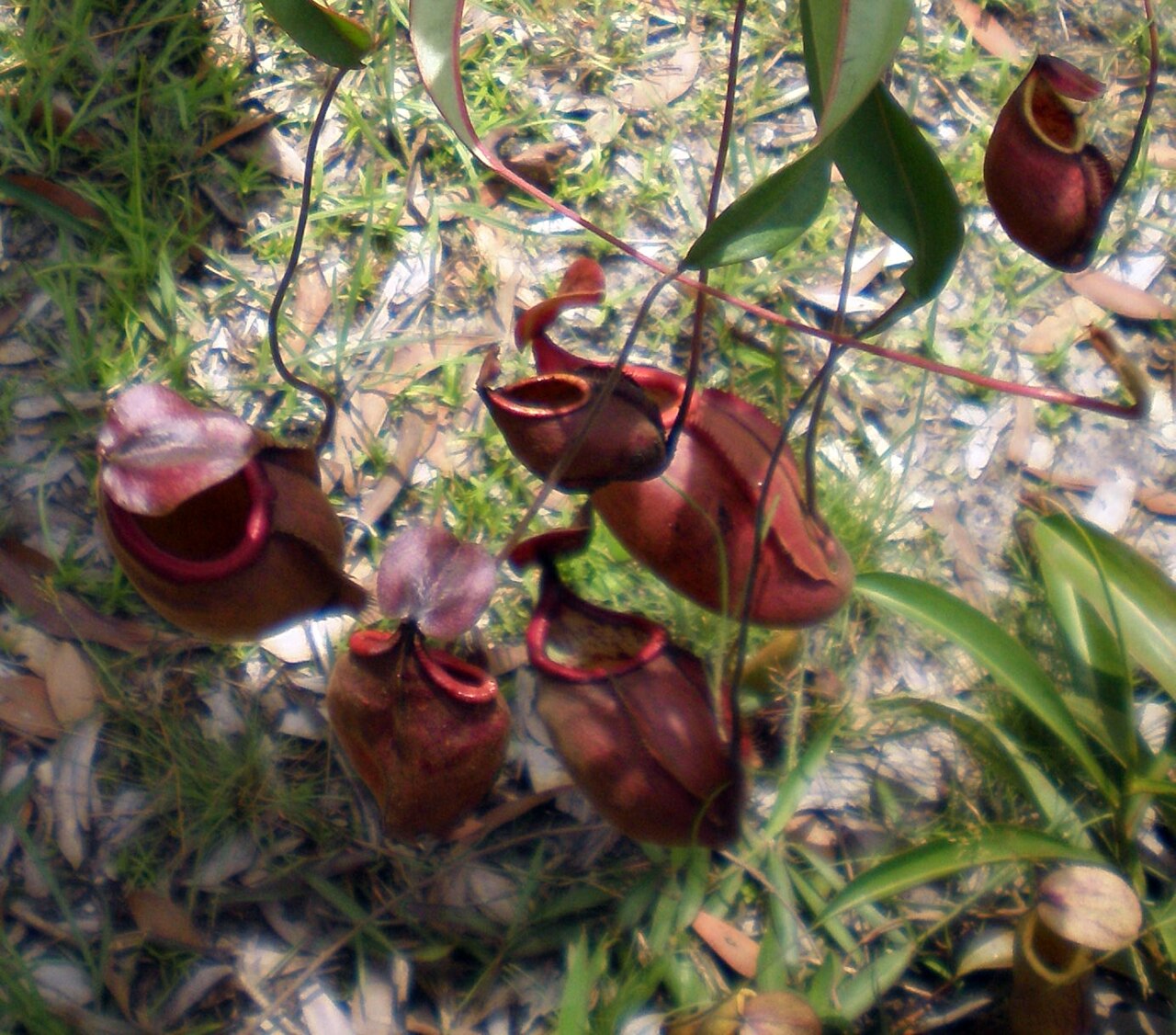
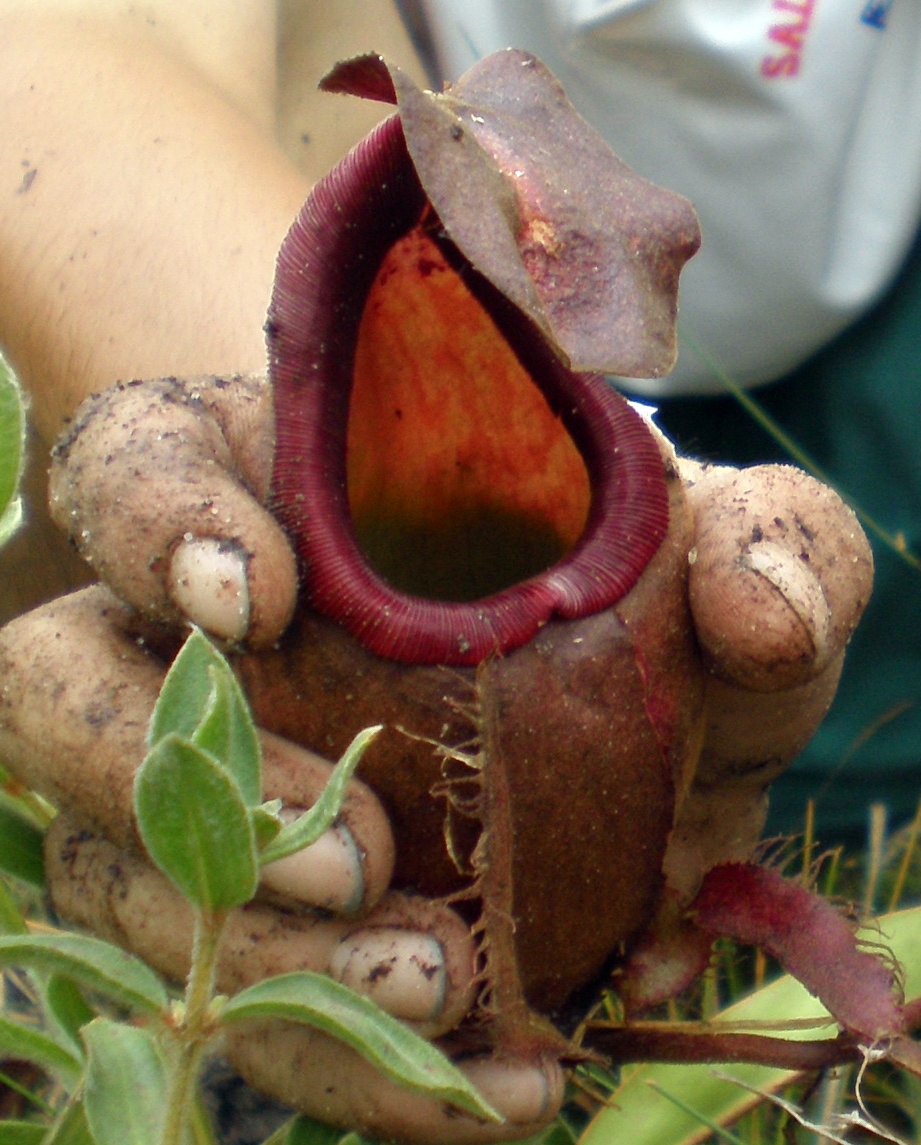
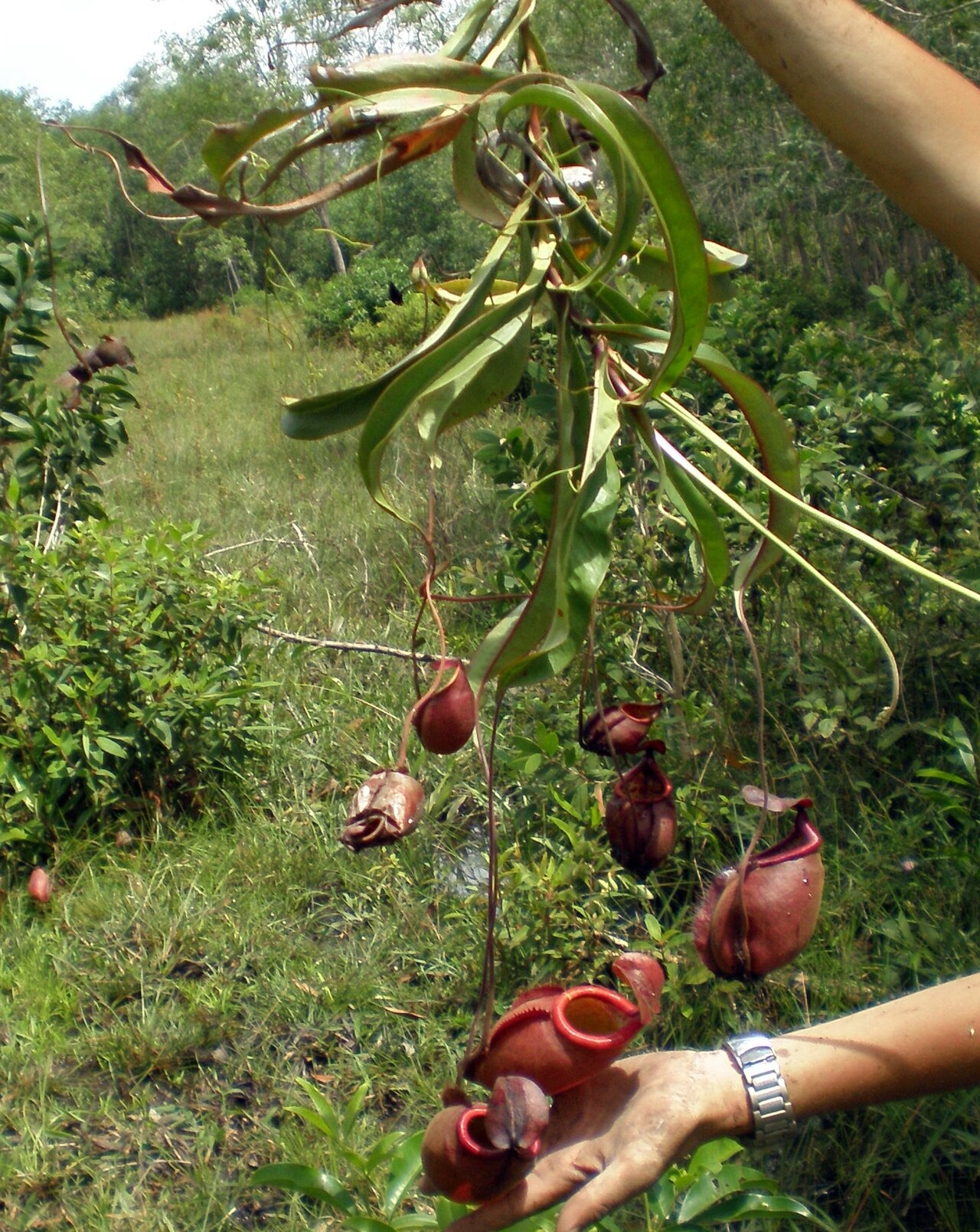
Not a climber but a low, erect plant with stems up to 40 cm tall, on a large, irregularly branched perennial rootstock up to two centimetres thick. The leaves are linear-lanceolate to narrowly obovate, 12 to 26 cm long and up to 3 cm wide, with a base that clasps the stem and runs down it for up to 2.5 cm. Lower pitchers are ovoid, up to 11.5 cm tall and 4.5 cm wide, with broad fringed wings five to eight millimetres wide and a peristome widening from two to four millimetres at the front to seven millimetres at the back. Upper pitchers are obovate and narrow toward the mouth, up to 12.5 cm tall, and hang from tendrils that do not coil. The colour is light green with reddish markings, with a reddish lid; the plant is covered in white, simple or branched hairs. The inflorescence is large, with an erect axis of half a metre or more.
Similar species
Its closest relative is Nepenthes smilesii, which also has narrow leaves with a stem-clasping base and was long traded under the name thorelii. Nepenthes thorelii is distinguished by the large rootstock with which it bridges dry and wet seasons, the uncoiled tendrils of the upper pitchers and the large inflorescence. Nepenthes bokorensis of Cambodia is also related. The delimitation from smilesii and the old name anamensis was long problematic and became clear only with the rediscovered material. Nepenthes mirabilis, with stalked, papery leaves, grows at the same site.
The trap and how it works
A pitfall trap that works for only part of the year. With the coming of the rains the plant sprouts from its rootstock and forms ovoid lower pitchers with broad wings on the ground, and obovate upper pitchers on short, uncoiled tendrils. The wings of the upper pitchers carry fine, pointed fringes. In the dry season the above-ground parts burn or wither. The peristome is narrow at the front and broader toward the back. The digestive fluid of this species has been studied for the enzyme nepenthesin and for its sterility and antimicrobial properties, and naphthoquinones extracted from the plant proved active against malaria.
Habitat and ecology
Seasonally dry savanna and grassland, from sea level to 200 m (W5, D4). The plant survives the dry season and bushfires as a dormant rootstock while everything above ground burns; each rainy season new shoots appear. That is the life pattern of a true pyrophyte: not avoiding fire, but built for it.
Distribution and elevation
Endemic to Indochina and known with certainty only from southern Vietnam, in Tây Ninh Province; the original material came from the area north of present-day Ho Chi Minh City. Our own list also names Cambodia; Mey considered it conceivable in 2010 that the species occurs on the Cambodian side of the border, but no confirmed Cambodian site has been published. The exact location of the rediscovered population is not made public for conservation reasons, and this guide follows suit.
- Recorded (one-degree cells)
Forms and variation
No varieties are recognised. At the rediscovered site both simple and complex crosses with Nepenthes mirabilis occur, which for a small population means a real risk of genetic swamping. Plants known in horticulture as thorelii are largely smilesii or hybrids and say nothing about the wild species.
Where and when to see it
This is not a species to seek out: the only known population lies in a military area, is small, and is deliberately kept secret. Anyone travelling through open, seasonally dry grasslands in southern Vietnam can still watch for low, erect pitcher plants with narrow leaves and ovoid pitchers at ground level, especially shortly after the rains begin. A dated photograph shared with Vietnamese botanists is then the best contribution.
Conservation status
The Red List assesses the species as Data Deficient, based on an assessment from 2000, when it had not been seen for a century. Since the rediscovery it is clear that the only known population numbers fewer than a hundred plants; the researchers called it a critically endangered taxon in their publication. Conversion of savannas to farmland and hybridisation with Nepenthes mirabilis are the main risks. As a member of Nepenthes it is listed in CITES Appendix II, so international trade in wild plants requires a permit.
Scientific name
Nepenthes thorelii | Lecomte, 1909
Described by Paul Henri Lecomte in 1909, in "Les Nepenthes d'Indo-Chine", Notulae systematicae, p. 59-65. Vietnam, with three original localities cited (Ti-tinh, Lo-thieu, Guia-Toan). The lectotype (designated 1997) is a male plant with lower pitchers, housed at the Muséum National d'Histoire Naturelle, Paris; isotypes at Herbarium Bogoriense and the New York Botanical Garden. Rediscovered in 2011 within a military zone, Tây Ninh Province (Sữa Đá site); habitat: seasonally dry savannah grassland, sea level to 200 m. Named after Clovis Thorel, who made the first known collection of this species between 1862 and 1866.
World Checklist of Vascular Plants (WCVP), via Plants of the World Online (POWO), Royal Botanic Gardens, Kew.