All species › Caryophyllales › Tropical pitcher plant family › Nepenthes smilesii
Nepenthes smilesii
The most widespread of the Indochinese savanna pitcher plants, and a plant with a tangled naming history. William Hemsley described Nepenthes smilesii in 1895, but for most of the twentieth century the species was called Nepenthes anamensis, and in the trade it was long sold as Nepenthes thorelii, a quite different and much rarer species. It grows in Cambodia, Laos, Thailand and Vietnam, in open sandy savannas that dry out for months and burn regularly, and is noted for the cold it tolerates on some plateaus.
Identification
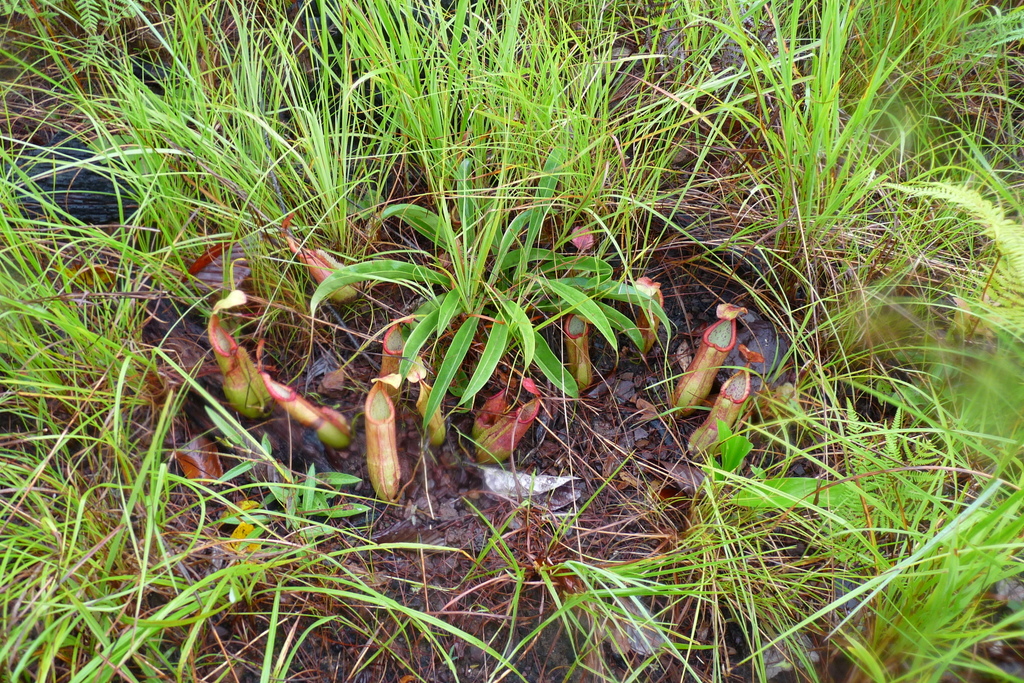
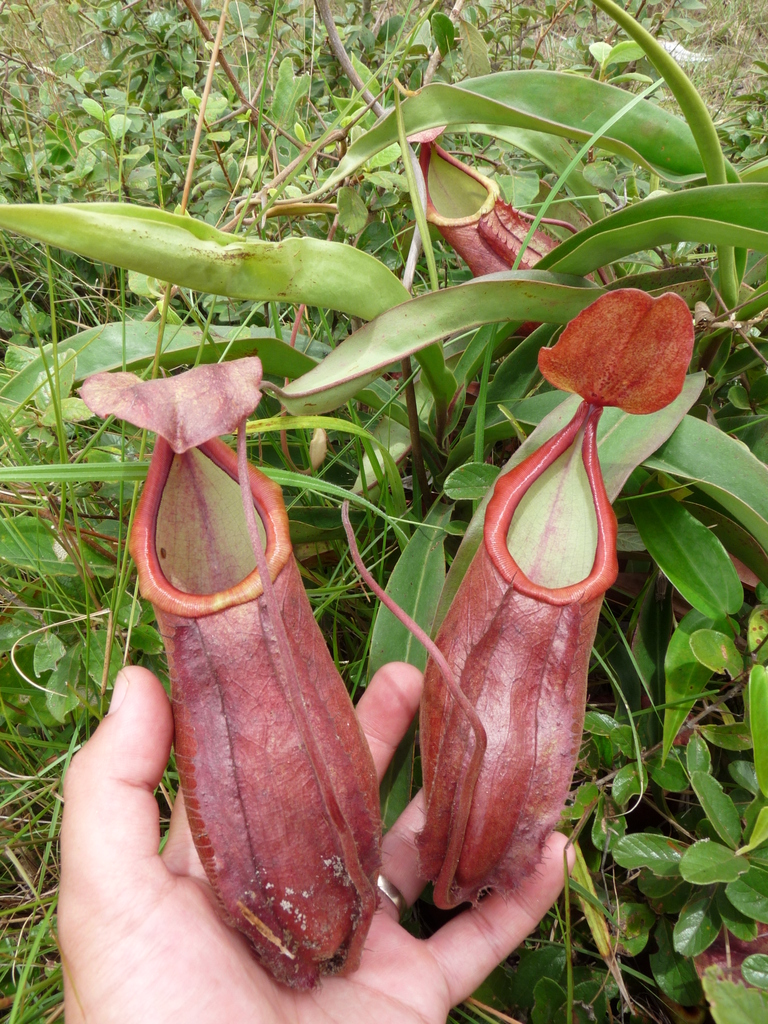
A climber that according to the English Wikipedia can reach five metres, with very narrow, linear to lanceolate, leathery leaves on short stalks. Characteristic according to Mey (2010) is that the whole plant is hairy, and that the tendrils are short. Lower pitchers are often cylindrical with a swollen base; upper pitchers likewise cylindrical with a bulbous base, to funnel-shaped. The peristome is narrow and usually unstriped; the lid is usually elliptic with a heart-shaped base and not vaulted. The flowers stand singly on their own stalks. Precise measurements verifiable from the specialist literature were not available to this guide; the measurement fields are left empty.
Similar species
The species of the thorelii group look very alike. Nepenthes kampotiana is hairless apart from leaf axils, tendrils and pitchers and has long tendrils; some authors consider it a synonym of smilesii. Nepenthes thorelii is a low, erect plant with a large rootstock, uncoiled tendrils on the upper pitchers and a large inflorescence, and is known with certainty only from Vietnam. Nepenthes kongkandana from southern Thailand has obovate leaves with an acuminate tip, longer tendrils and a broader peristome. Nepenthes bokorensis has more robust, more colourful pitchers with a striped peristome.
The trap and how it works
A pitfall trap with two pitcher forms, strongly dependent on season. In the rainy season the plant forms lower pitchers with a swollen base, which stand in the grass on the ground and catch mainly ants and other crawling animals, and upper pitchers on the climbing stems. In the dry season there are few or no fresh pitchers, and the above-ground parts are often withered or burnt. The narrow, unstriped peristome and the nectar glands under the lid lure the prey. No targeted prey study of this species was found in the sources consulted.
Habitat and ecology
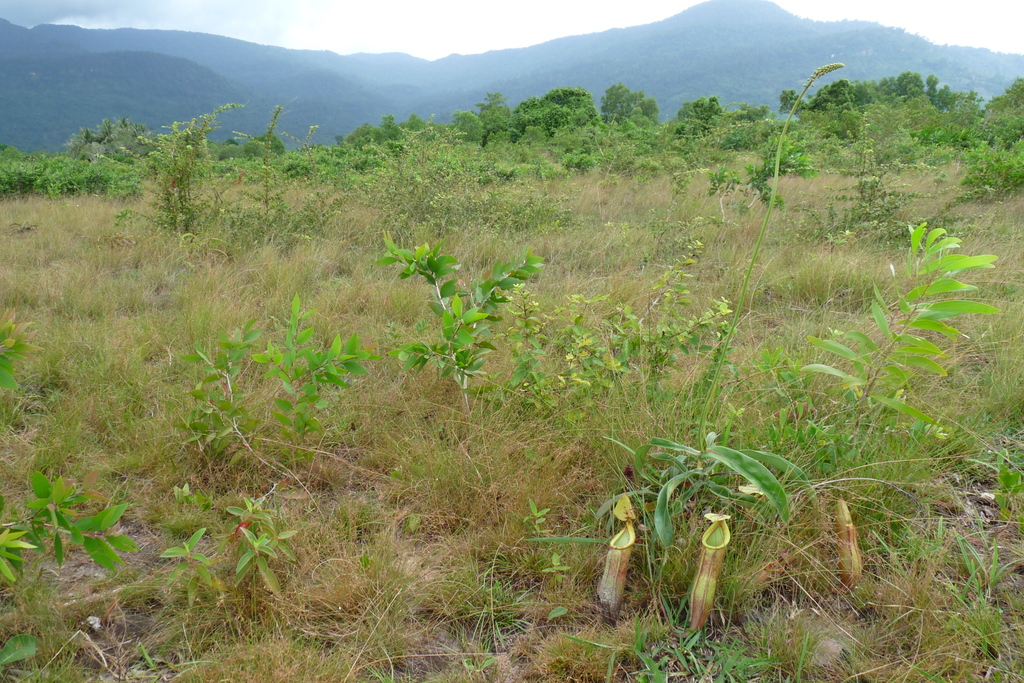
Open, sandy savannas and grasslands, often seasonally wet, with a long dry season in which fire is frequent (W5, D4, D1). In Kirirom National Park in Cambodia the species grows in clearings among pine trees, a savanna woodland strongly reminiscent of wet pine savannas elsewhere in the world. The species is a pyrophyte with a thickened rootstock. Altitude statements vary widely: from sea level near Kampot to 600 or 720 m at Kirirom, elsewhere mostly between 500 and 1000 m, and according to other sources up to 1500 m. The elevation field is therefore left empty.
Distribution and elevation
Cambodia, Laos, Thailand and Vietnam: the most widespread species of the thorelii group. In Cambodia it is known from the Kirirom plateau and a few lowland sites near Kampot; in Thailand mainly from the north-east, in Laos from the south. Our own list names Thailand, Cambodia and Laos; according to the literature Vietnam also belongs to the range.
- Recorded (one-degree cells)
Forms and variation
No varieties are recognised. The name Nepenthes anamensis is a synonym. In horticulture many plants have circulated as 'thorelii' that are really smilesii; anyone reading old sources or growers' reports should bear this in mind. In Cambodia a natural hybrid with Nepenthes mirabilis has been found: a single old, large plant near Kampot, in an open, flooded area by a stream, among Utricularia caerulea and Drosera indica.
Where and when to see it
The Kirirom plateau in Cambodia, with its pine woods and open grasslands, is a good and accessible place. Come in the rainy season or shortly after, when the plants carry pitchers; in the dry season they are often hard to find. Look for low rosettes of narrow, hairy leaves in the grass, and for small cylindrical pitchers with a bulbous base. Sundews and bladderworts often grow on the same ground, so look at the soil too.
Conservation status
The Red List assesses the species as Least Concern, thanks to its large range. Locally the picture differs: Mey (2010) described the lowland populations near Kampot as seriously threatened, with only two known sites, while the population on the Kirirom plateau appeared stable. Conversion of savannas to farmland and changes in the fire regime are the main risks. As a member of Nepenthes it is listed in CITES Appendix II, so international trade in wild plants requires a permit.
Scientific name
Nepenthes smilesii | Hemsley, 1895
Nepenthes smilesii was described in 1895 by William Botting Hemsley — the same botanist as with N. hemsleyana (golf 23) and N. macfarlanei (golf 26). The species has a widespread distribution throughout Indochina, with records in Cambodia, north-eastern Thailand, southern Laos and western Vietnam, at 16-1,500 m elevation; a precise type locality could not be established. The specific epithet honours the plant collector Frederick Henry Smiles, who made the first documented collection of this taxon.
World Checklist of Vascular Plants (WCVP), via Plants of the World Online (POWO), Royal Botanic Gardens, Kew.