All species › Caryophyllales › Tropical pitcher plant family › Nepenthes philippinensis
Nepenthes philippinensis
The pitcher plant of the Palawan lowlands. Where the peaks of Palawan each have their own rare giant, Nepenthes philippinensis is the species most often met on the island: a slender climber with narrow leaves and small, red-speckled pitchers in the scrub of the low hills. It was described early in the twentieth century by Macfarlane, and the name, referring to the whole archipelago, is somewhat misleading: the species is confined to Palawan. The later-described Nepenthes wilkiei has turned out to be the same plant.
Identification
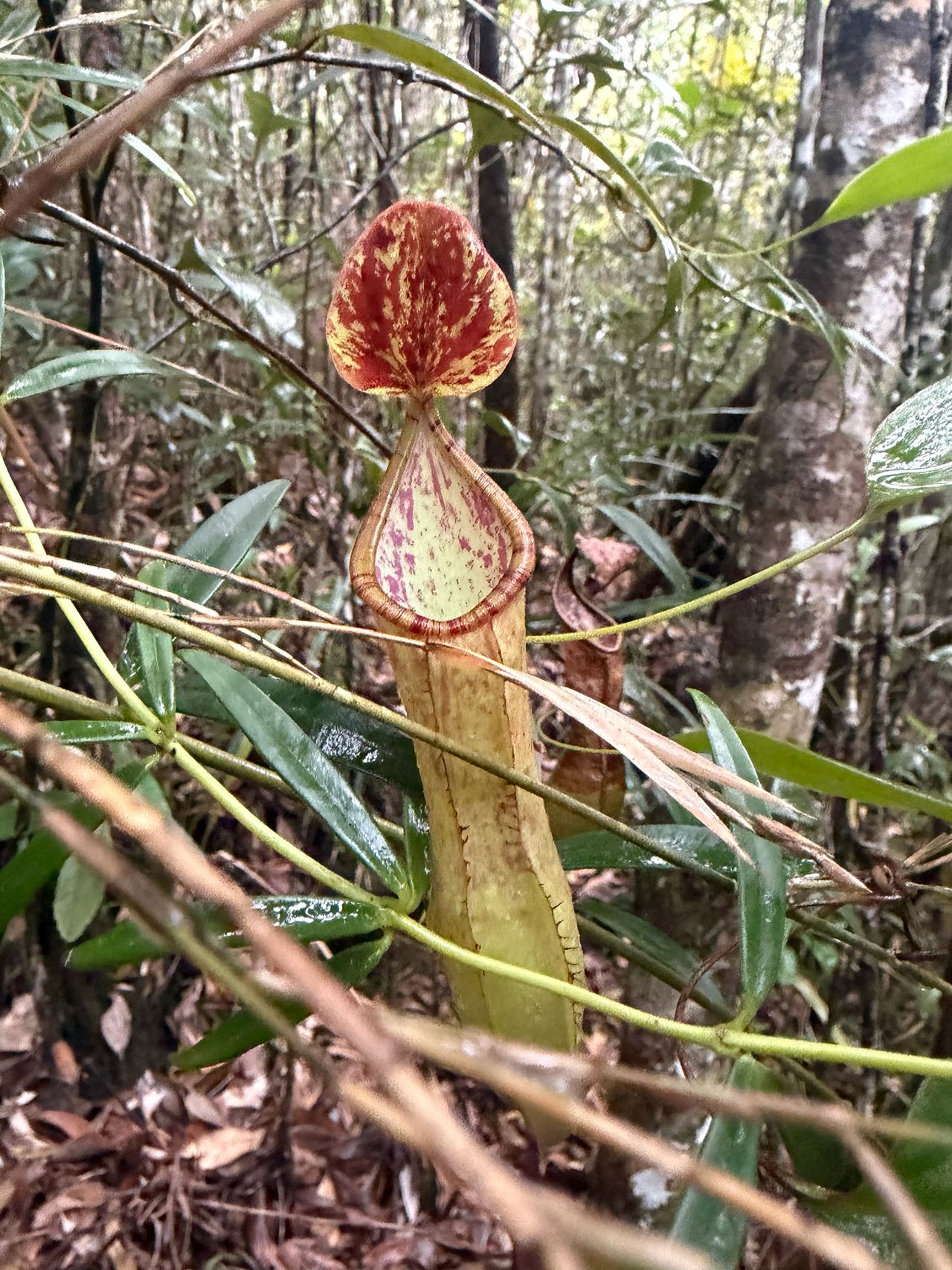
A climber with terete stems 3.5 to 5 mm thick and sessile, papery leaves. On climbing stems the leaves are oblanceolate to strap-shaped, 14 to 28 cm long but only 1.7 to 3.6 cm wide, with four or five conspicuous longitudinal veins in the outer half of each side; rosette leaves are oblong-spathulate, to 16 cm. Lower pitchers are ovoid in the lower half to two thirds and cylindrical toward the mouth, 8.5 to 16 cm tall, with two fringed wings two to four millimetres wide. The peristome is rounded, narrow at the front but broader at the sides, up to 8.5 mm. Upper pitchers are nearly cylindrical, slightly swollen in the lower third, about 18 cm tall. The lid is broadly ovate to nearly round and has no appendages. The colour is characteristic: green speckled maroon below, maroon speckled green above, with a maroon peristome.
Similar species
The absence of appendages under the lid separates the species from the Philippine alata group, whose members have a ridge or appendage beneath the lid. On Palawan itself, Nepenthes mirabilis, where it occurs, is recognised by its distinctly stalked leaves. The large mountain species of Palawan, such as Nepenthes attenboroughii and Nepenthes palawanensis, cannot be confused with it given their broad leaves and huge pitchers, and they grow much higher. The reversed colour pattern, green with brown speckles below and brown with green speckles above, is a handy field character.
The trap and how it works
A pitfall trap with clearly different lower and upper pitchers. Lower pitchers stand at the foot of the plant, are swollen below and carry two fringed wings that guide crawling animals to the mouth. The peristome is narrow at the front and broader at the sides, so that the slippery zone covers mainly the flanks of the mouth. The lid bears nectar glands but no appendage. Upper pitchers hang from the tendrils in the scrub and catch flying and climbing insects. No targeted prey study has been published for this species. Because the plant grows in open, sunny scrub, it hunts in a setting rich in ants and flying insects; in related lowland species ants usually make up most of the prey, but this has not been measured for this species.
Habitat and ecology
Scrub on ultramafic soil, from 25 to 520 m (R3, B6, B5). Large parts of Palawan lie on ultramafic rock, and the low, open vegetation growing on it, with plenty of sun and few nutrients, is where this species is at home. It climbs through shrubs and along forest edges and holds its own well in that open setting. Geologically, Palawan stands apart from the rest of the Philippines: the island is an extension of the Sunda Shelf and has a flora with strong links to Borneo. Ultramafic rock comes to the surface on a large scale, especially in the centre and south, and the lean, open vegetation growing on it holds a remarkable number of endemic plants.
Distribution and elevation
Endemic to Palawan, where it occurs in the lowlands and low hills. Our own list gives Palawan, which agrees with the literature. The species is fairly widespread on the island as far as the ultramafic substrate allows. The name philippinensis suggests a wider distribution, but the species is unknown outside Palawan.
- Recorded (one-degree cells)
Forms and variation
No varieties are recognised. Nepenthes wilkiei, described as a separate species in 1998, has been treated as a synonym since 2001. Colour varies somewhat with light: in full sun plants are redder and stockier, in shade greener. The sources consulted mention no natural hybrids with other Palawan species.
Where and when to see it
Of the pitcher plants of Palawan this is the most accessible: it grows low, in open scrub often reachable from roads and trails. In the ultramafic hill country, search sunny spots for slender stems with narrow, sessile leaves, and look low in the vegetation for lower pitchers and higher for hanging upper ones. The dry season, from December to April, is the most comfortable time to travel on Palawan.
Conservation status
The Red List assesses the species as Least Concern. It is widespread on Palawan and thrives in open, disturbed vegetation. The ultramafic areas of Palawan are, however, targeted by nickel mining, which can remove entire hills, and urbanisation and agriculture also take over lowland scrub. As a member of Nepenthes it is listed in CITES Appendix II, so international trade in wild plants requires a permit.
Scientific name
Nepenthes philippinensis | Macfarlane, 1908
Nepenthes philippinensis was described in 1908 by John Muirhead Macfarlane, in "Nepenthaceae" (in A. Engler's Das Pflanzenreich IV, III, Heft 36: 1-91). The species occurs on Palawan and the neighbouring Calamian Islands (including Busuanga, Coron and Culion) and Linapacan, Philippines, from sea level to 600 m elevation; the precise type locality could not be established more precisely. The specific epithet refers directly to the Philippines, where the species is endemic.
World Checklist of Vascular Plants (WCVP), via Plants of the World Online (POWO), Royal Botanic Gardens, Kew.