All species › Caryophyllales › Tropical pitcher plant family › Nepenthes parvula
Nepenthes parvula
The smallest Australian pitcher plant was described only in 2016, ten years after Nepenthes tenax and in the same catchment. Gary Wilson and Stuart Venter noticed that some of the plants in the swamps of the lower Jardine River on Cape York consistently stayed smaller, had different pitchers and red lid undersides, even when grown next to N. tenax in the glasshouse. They named the species Nepenthes parvula, ‘the little one’. Mature plants are at most half a metre tall, and the upper pitchers barely six centimetres.
Identification
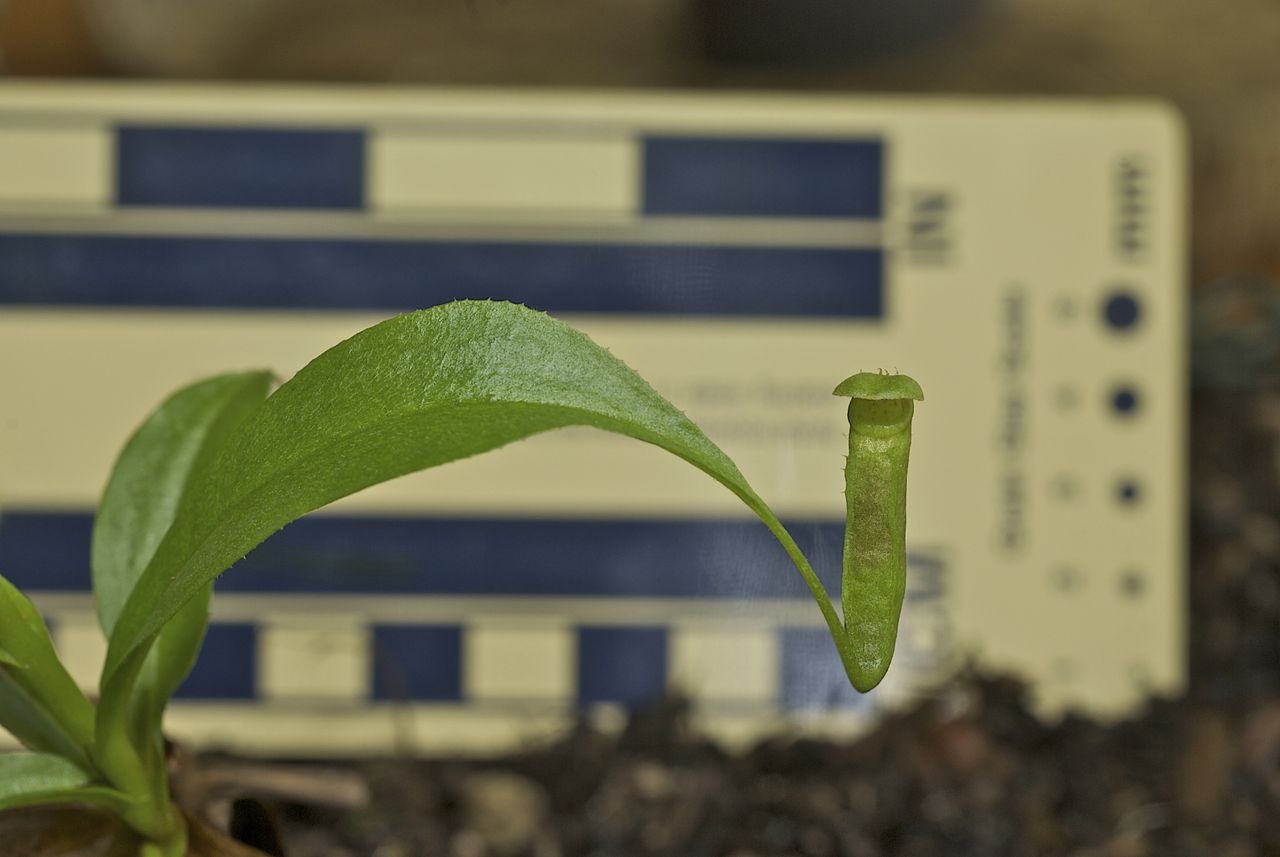
An upright subshrub 35 to 50 cm tall, with round stems 2.5 to 5 mm thick, densely covered in white simple and dark star-shaped hairs. The lower leaves are leathery, sessile and linear-lanceolate, only 10 to 25 mm long and 5 to 10 mm wide; the upper leaves are 30 to 90 mm long and 7 to 14 mm wide and V-shaped in cross-section, with a kinked, sometimes coiled tendril of 3 to 6 cm. Lower pitchers are ovoid, only 15 to 30 mm long and 5 to 10 mm wide, with two fringed wings running their whole length; the peristome is 0.4 to 1.2 mm broad. Upper pitchers are cylindrical, 35 to 60 mm long and 10 to 15 mm wide, with a peristome of 1 to 2 mm and an almost round, vaulted lid of 10 to 20 mm whose underside is always deep red.
Similar species
Nepenthes tenax is the closest relative and grows in the same area. According to the description N. parvula differs in its small upper pitchers (35 to 60 mm against up to 110 mm in N. tenax), the red lid, more densely set nectar glands, smaller flowers, shorter fruits and restriction to permanently wet swamps. N. mirabilis and N. rowaniae, the other two Cape York species, are climbing or robust plants with much bigger pitchers and leaves and are easy to separate in the field. In cultivated material the differences from N. tenax persist, which supports recognising it as a separate species.
The trap and how it works
A miniature pitfall trap, but with all the parts of a large one. The lower pitchers stand in a ‘skirt’ around the base of the plant and catch crawling prey; their wings, with filaments 0.4 to 1.2 mm long, guide ants to the mouth. The upper pitchers stand higher in the vegetation; their red lid underside and the nectar glands on the lid lure flying insects. Gland density in the lower half of the pitcher is high: 900 to 1200 per square centimetre in lower pitchers and 1200 to 1500 in upper ones. The peristome is narrow, with ribs 0.15 to 0.4 mm apart. The catch is necessarily made up of small animals: ants, small flies and other small creatures from the swamp vegetation.
Habitat and ecology
Exclusively freshwater swamps in the lower Jardine River catchment, from 0 to 30 m (W6). The species is restricted to a single regional ecosystem type, vegetated palustrine swamp. These swamps stay permanently wet and therefore do not burn with the surrounding savanna, which lets N. parvula keep its skirt of lower pitchers. In cultivation the species proved sensitive to cold: in the dry season, when night temperatures drop to 10–12 °C, plants die or die back.
Distribution and elevation
Endemic to Australia: Queensland, far north of Cape York, and there only in freshwater swamps in the lower Jardine River catchment, from 0 to 30 m. The range is small: according to the describers no more than 20 km², with an area of occupancy of at most 5 km², but holding more than five thousand plants. It is the fourth species of Cape York, alongside N. mirabilis, N. rowaniae and N. tenax.
- Recorded (one-degree cells)
Forms and variation
No varieties or forms are distinguished; the species has been known only a short time and is fairly uniform within its small range. Natural hybrids are not mentioned in the description, but given how readily N. tenax and N. mirabilis cross in the same area, they cannot be ruled out. Anyone seeing plants with intermediate features should bear that possibility in mind. The red lid underside is the most stable character: it stays red in cultivation too.
Where and when to see it
Northern Cape York is reachable overland only in the dry season (roughly June to October). The species grows in permanently wet swamps in the Jardine catchment; these are hard going and partly on the land of traditional owners, so permission and a local guide may be needed. Look low down: the whole plant barely rises above the sedges, and the little red lids of the upper pitchers are often the first thing to catch the eye. Leave plants and seed where they are; illegal collection is a known threat.
Conservation status
The Red List assesses the species as Least Concern. In 2016 the describers did propose Vulnerable, because of the small range, and named illegal collection of seed and plants and damage by feral pigs as threats. As a member of the genus it is listed in CITES Appendix II, so international trade in wild plants requires a permit; within Australia the collection of wild plants is also restricted by law.
Scientific name
Nepenthes parvula | Wilson & Venter, 2016
Nepenthes parvula was described in 2016 by Gary W. Wilson and S. Venter, in Phytotaxa 277(2): 199-204. Cape York Peninsula, Queensland, Australia. The specific epithet is a Latin diminutive, referring to the diminutive size of mature plants of this species.
World Checklist of Vascular Plants (WCVP), via Plants of the World Online (POWO), Royal Botanic Gardens, Kew.