All species › Caryophyllales › Tropical pitcher plant family › Nepenthes longiptera
Nepenthes longiptera
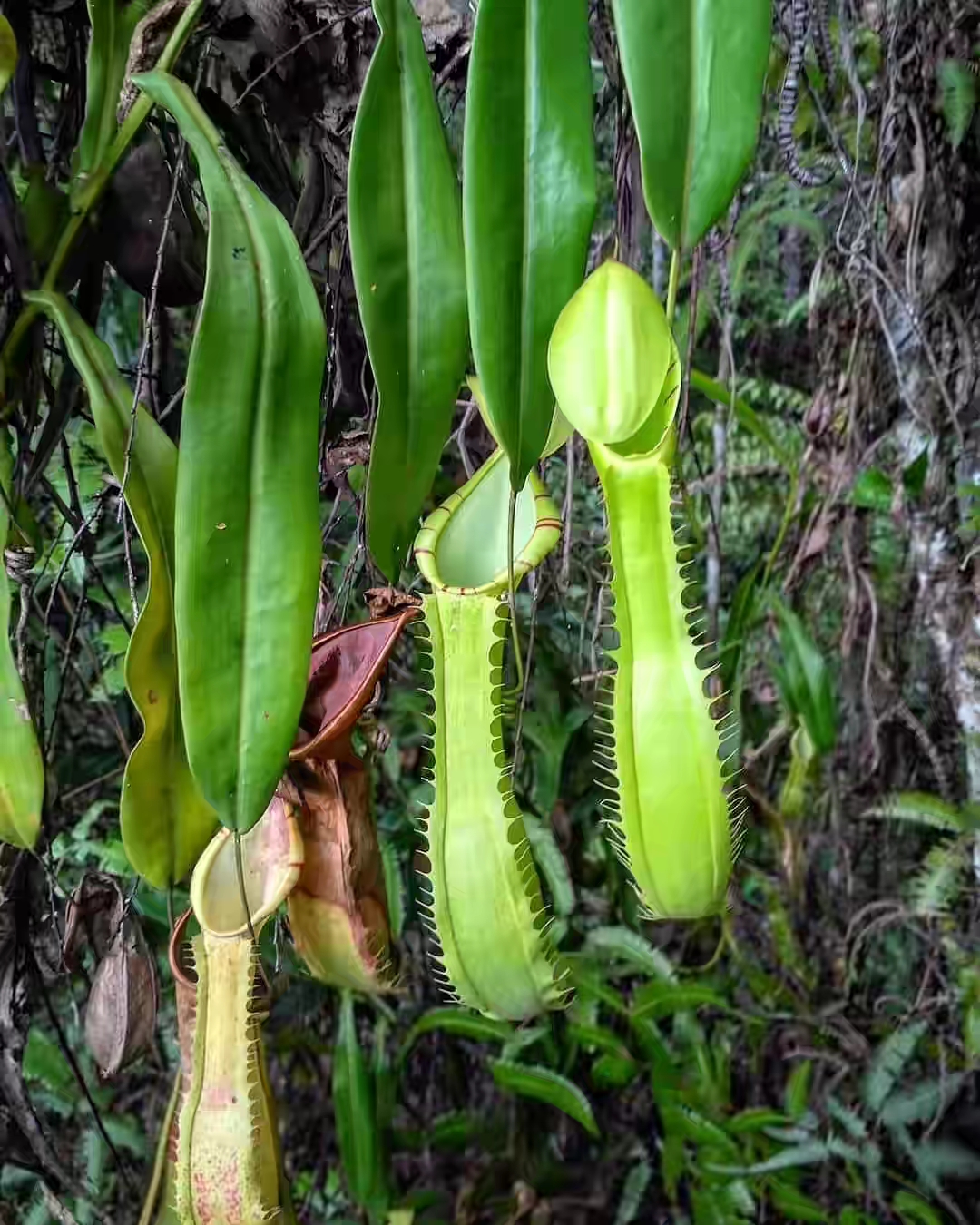
A robust pitcher plant from the mountains of Aceh, at the far northern end of Sumatra, described in 2021. The name, Greek and Latin for 'long wing', points to the character that sets it apart from all other Sumatran species: its upper pitchers too bear two broad, long-fringed wings, where in its relatives they are reduced to ribs. With pitchers to 45 cm tall, Nepenthes longiptera is also among the largest pitcher plants on the island.
Identification
A vigorous climber with a stem rhombic in cross-section, about 12 by 9 mm, with internodes of 3 to 11 cm. The leaves are oblong-lanceolate, 27 to 33 cm long and 4.4 to 6 cm wide, and clasp two-thirds of the stem. Lower pitchers are narrowly funnel-shaped below and cylindrical above, to 40 cm tall and 7 to 8 cm across, with fringed wings of 10 to 12 mm, an ovate mouth of about 8 by 4 cm and a lid of 6 by 5 cm with a small appendage beneath. Upper pitchers are urn-shaped to cylindrical, to 45 cm tall and 7 cm wide, and keep their 10 to 12 mm wings with bristles of 6 to 12 mm; the peristome is about 6 mm wide and the lid 6 by 6.5 cm. Lower pitchers are red to pink or orange with red speckles, upper pitchers green.
Similar species
The species most resembles Nepenthes tobaica, which occurs in the same part of northern Sumatra. That species is smaller in every respect, has upper pitchers with wings reduced to ribs, an obtusely triangular rather than rhombic stem section, and no appendage under the lid. In N. longiptera the long wings on the upper pitchers are the quickest thing to spot. Because the species crosses with both N. tobaica and N. lavicola, intermediates occur in the field; a combination of large pitchers, well-developed upper-pitcher wings and an appendage under the lid points to the pure species.
The trap and how it works
A large-format pitfall that stays winged in both forms. That is unusual: in most Nepenthes the wings serve mainly the lower pitchers, as a ramp for crawling prey. In this species the high-hanging upper pitchers also carry broad wings with long bristles, suggesting that crawling animals are guided up to those pitchers too. Under the lid sits a small appendage of 3 to 4 mm with glands under a millimetre; the spur at the base of the lid is 1 to 2.6 cm long. No prey data have been published.
Habitat and ecology
A terrestrial plant of rainforest at 750 to 1600 m, mostly in or near colonies of the fern Dicranopteris linearis, a pioneer of open and previously disturbed ground (B5, B1). The plant roots in humus or clay and climbs through the ferns and low vegetation with its long tendrils. It is thus not a species of dense closed forest but of light gaps, forest edges and slopes where the fern cover dominates.
Distribution and elevation
Endemic to Sumatra, Indonesia, and known from Aceh province, in the regencies of Nagan Raya and Central Aceh. The known area is under 30 km². Altitude: 750 to 1600 m. The area given in our species list (Aceh) agrees with the description.
- Recorded (one-degree cells)
Forms and variation
No varieties or forms have been described. The difference between the pitcher types lies mainly in colour: lower pitchers are bright red, pink or orange with red speckles, upper pitchers green. Two natural hybrids were reported with the description: N. lavicola × N. longiptera and N. longiptera × N. tobaica. These crosses grow on the same fern slopes and make field identification harder.
Where and when to see it
The area lies in the interior of Aceh and is reached by roads through the central mountains; a local guide is indispensable, and permission is needed to enter forest land. Look for slopes overgrown with the fern Dicranopteris between 750 and 1600 m: the large red lower pitchers lie among the ferns on the ground, the green upper pitchers hang higher. Their size makes them hard to miss. Leave everything in place; the population is small and unprotected.
Conservation status
The Red List data used by this guide hold no assessment for the species (Not Evaluated). In 2021 the describer proposed the category Endangered: the species is known from an area under 30 km² with about 200 mature plants observed, on unprotected land threatened by mining and agriculture. As a large, conspicuous and new species it is also sought after in trade. Like the whole genus, it is listed in CITES Appendix II.
Scientific name
Nepenthes longiptera | Victoriano, 2020
Nepenthes longiptera was described on 7 July 2021 by Malcolm Victoriano, in Reinwardtia 20(1): 17-26. Aceh Province, Sumatra, Indonesia, where the species is endemic; a more precise type locality could not be established with certainty. The name is likely formed from the Latin "longus" ("long") and the Greek "pteron" ("wing"), "long-winged", which would refer to the wings on the pitcher — though an explicit source confirmation of this derivation was not found.
World Checklist of Vascular Plants (WCVP), via Plants of the World Online (POWO), Royal Botanic Gardens, Kew.