All species › Caryophyllales › Tropical pitcher plant family › Nepenthes leyte
Nepenthes leyte
The island of Leyte, in the eastern Visayas, was known until 2013 for only one pitcher plant, the widespread Nepenthes graciliflora. When Martin Cheek and Matthew Jebb revised the alata group, they found among the herbarium material a plant collected in November 1999 by George Argent and colleagues on Mount Lobi near Dagami, climbing over a fallen tree in mossy forest. They described it as Nepenthes leyte, after the island to which it appears unique.
Identification
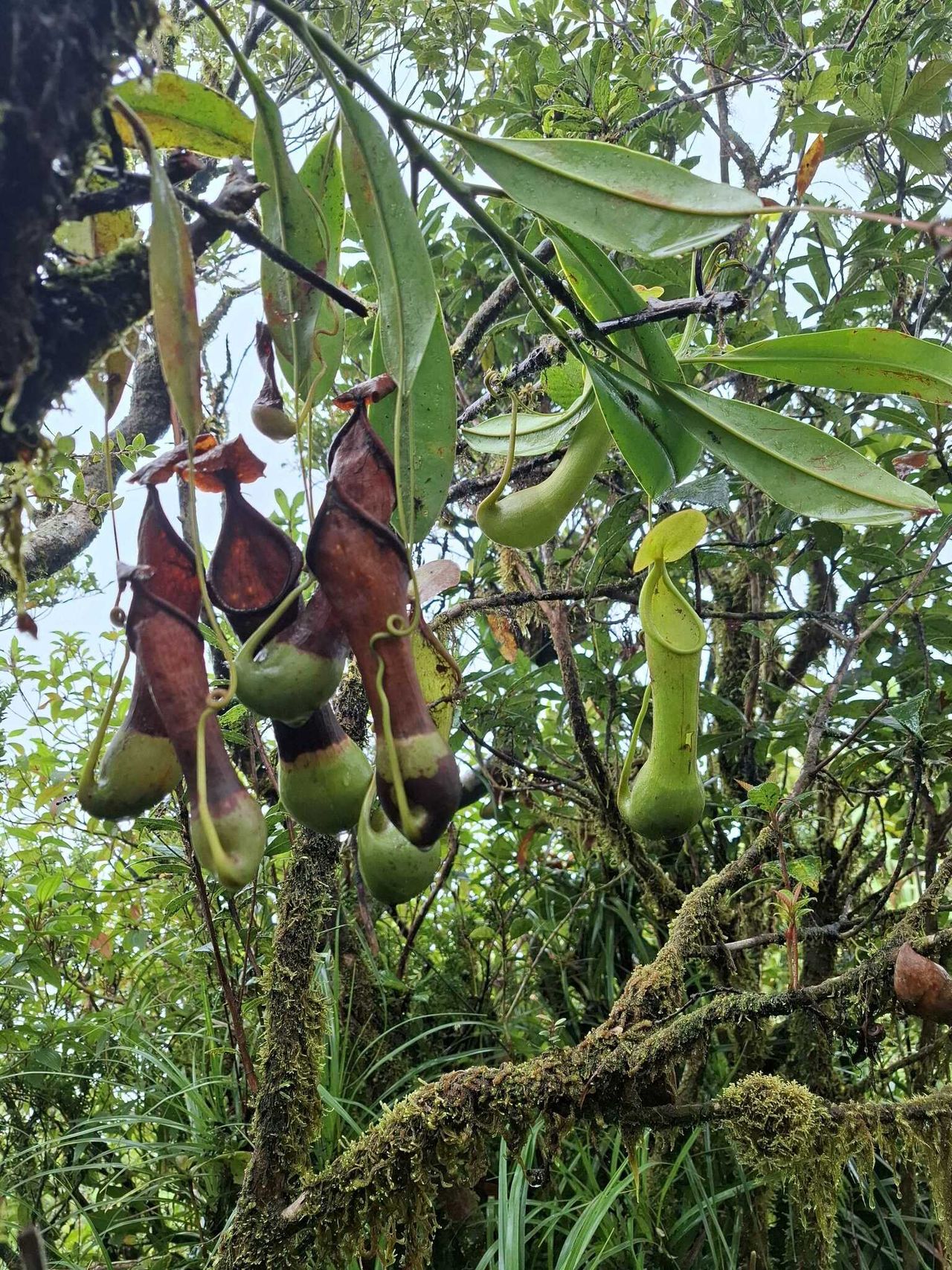
A climber probably two metres tall, with a nearly round stem four to six millimetres thick that is glabrous except in the leaf axils, which hold dense white hairs about a millimetre long. The leaves are thinly leathery, narrowly oblong-elliptic, 13.5 to 16 cm long and 2.5 to 3.8 cm wide, with a single inconspicuous pair of longitudinal nerves and numerous side veins raised on both surfaces; the winged petiole is three to four and a half centimetres. Only upper pitchers are known: 12 to 15 cm tall and 4.5 to 5 cm wide, ovoid-ellipsoid below, cylindrical above, nowhere constricted. They are almost uniformly green with a few purple spots, mainly on the swollen base, and the mouth is glaucous green inside with a few red spots. Fringed wings are absent; there are only inconspicuous ridges. A tenth to a third of the outside is covered in minute red stellate hairs. The peristome is narrow, mostly two to three millimetres, a little wider at the sides. The lid is ovate, just over three centimetres, green, with an undulate margin, a cordate base and a small convex appendage. The spur is completely covered in long grey hairs.
Similar species
On Leyte Nepenthes graciliflora is the only other pitcher plant, and the resemblance is superficial. Nepenthes leyte has stellate hairs on the outside of the pitcher and two kinds of nectar gland under the lid. From Nepenthes alata it differs in the glabrous stem, the lack of fringed wings on the upper pitchers and nectar glands concentrated mainly along the margin and around the appendage rather than evenly spread. Nepenthes negros of the island of Negros has a densely hairy stem, fringed wings and distinct teeth on the inner margin of the peristome.
The trap and how it works
A pitfall of the slender alata type, with an unusually built lid. Under the lid lie two kinds of nectar gland: small, bordered glands on the basal ridge and the appendage, slightly larger glands in bands two to four millimetres wide along the margins, 25 to 40 on each side, and between them a few scattered large elliptic glands. The lure thus lies mainly at the margins and above the mouth, not across the whole lid. The peristome has about four ridges per millimetre; teeth on the inner margin are visible only on dissection. The spur behind the lid is densely hairy. Nothing is known about prey.
Habitat and ecology
Submontane mossy forest on volcanic substrate, at about 900 m (B1). The only known plant was climbing over a fallen tree. Leyte is a volcanic island; its eastern part has been largely deforested in recent decades.
Distribution and elevation
Endemic to Leyte, in the eastern Visayas, and known from one plant on Mount Lobi near Dagami. The label 'Leyte' in our species list is correct and can be narrowed to Mount Lobi. Because most of Leyte's forest has gone and the species has been collected only once, it is unknown whether plants survive elsewhere on the island.
- Recorded (one-degree cells)
Forms and variation
For a species resting on one plant no variation is known. The measurements in the description do show spread, for example in peristome width from one to five millimetres around the mouth, but that is variation within one pitcher. Lower and intermediate pitchers and inflorescences are unknown. No hybrids have been reported.
Where and when to see it
There is no place where this species can be seen with certainty. In the remaining mossy forest on the mountain slopes of central Leyte, around 900 m, watch for a climbing pitcher plant with green, unconstricted pitchers without fringed wings and with fine red hairs on the outside. Anyone finding Nepenthes graciliflora should look a little more closely: a hand lens on the pitcher wall and a photograph of the lid underside make the distinction.
Conservation status
The species has not yet been assessed by the IUCN (Not Evaluated). The authors rated it Critically Endangered: one plant is known, in an unprotected area where most forest has been cleared for timber and agriculture. In 2003 industrial oil-palm plantations reached to within four kilometres of the site. The nearby Lake Danao National Park, some fourteen kilometres to the west, suffers from illegal settlement, slash-and-burn farming and logging. Because the pitchers are inconspicuous, collecting pressure is low. Like all Nepenthes it is listed in CITES Appendix II.
Scientific name
Nepenthes leyte | Jebb & Cheek, 2013
Nepenthes leyte was described in 2013 by Martin Cheek and Matthew Jebb, in "Recircumscription of the Nepenthes alata group (Caryophyllales: Nepenthaceae), in the Philippines, with four new species" (European Journal of Taxonomy 69: 1-23). The island of Leyte, Philippines, in submontane mossy forest at 900 m elevation. The specific epithet refers directly to the island of Leyte, to which the species is endemic.
World Checklist of Vascular Plants (WCVP), via Plants of the World Online (POWO), Royal Botanic Gardens, Kew.