All species › Caryophyllales › Dewy pine family › Drosophyllum lusitanicum
Drosophyllum lusitanicum | Dewy pine
The only carnivorous plant that does not stand in wet ground but on dry, stony soil in full sun, among heath and cork oak. It shows up from a distance as a tussock that glitters, it smells of honey, and it catches without moving anything at all. For anyone in Europe who wants to see a carnivorous plant in the wild, this is the most reachable species in the guide.
Identification
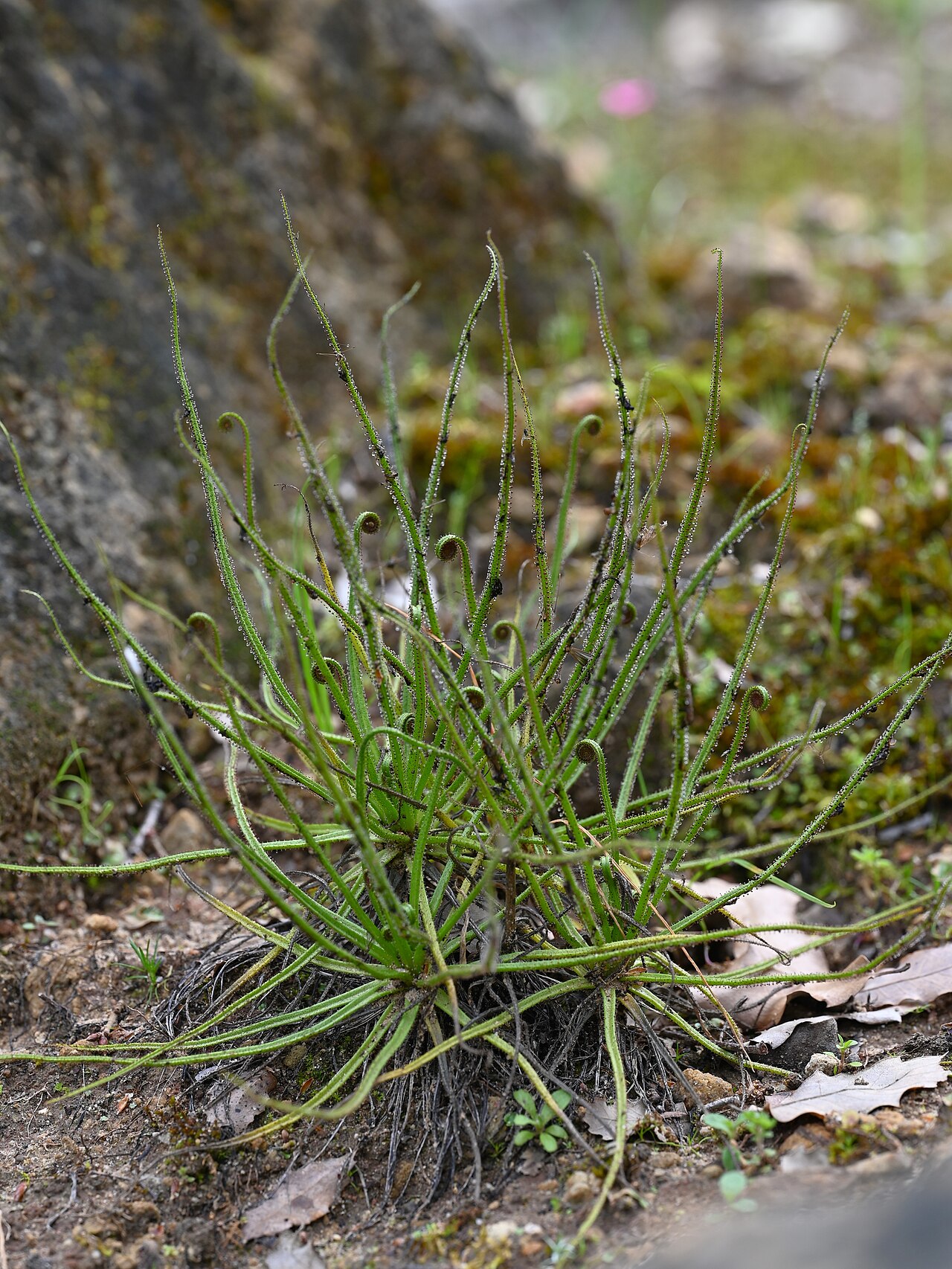
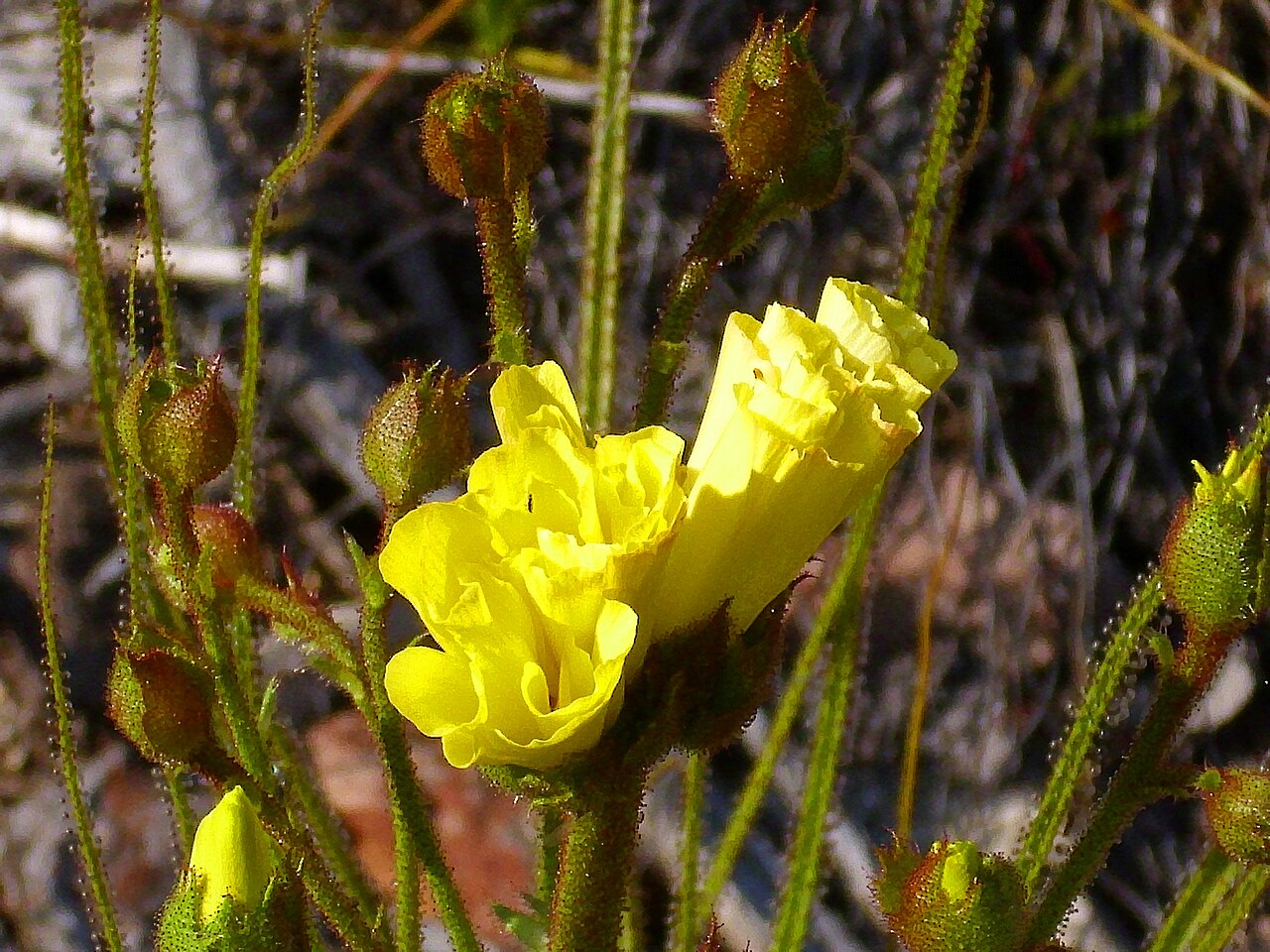
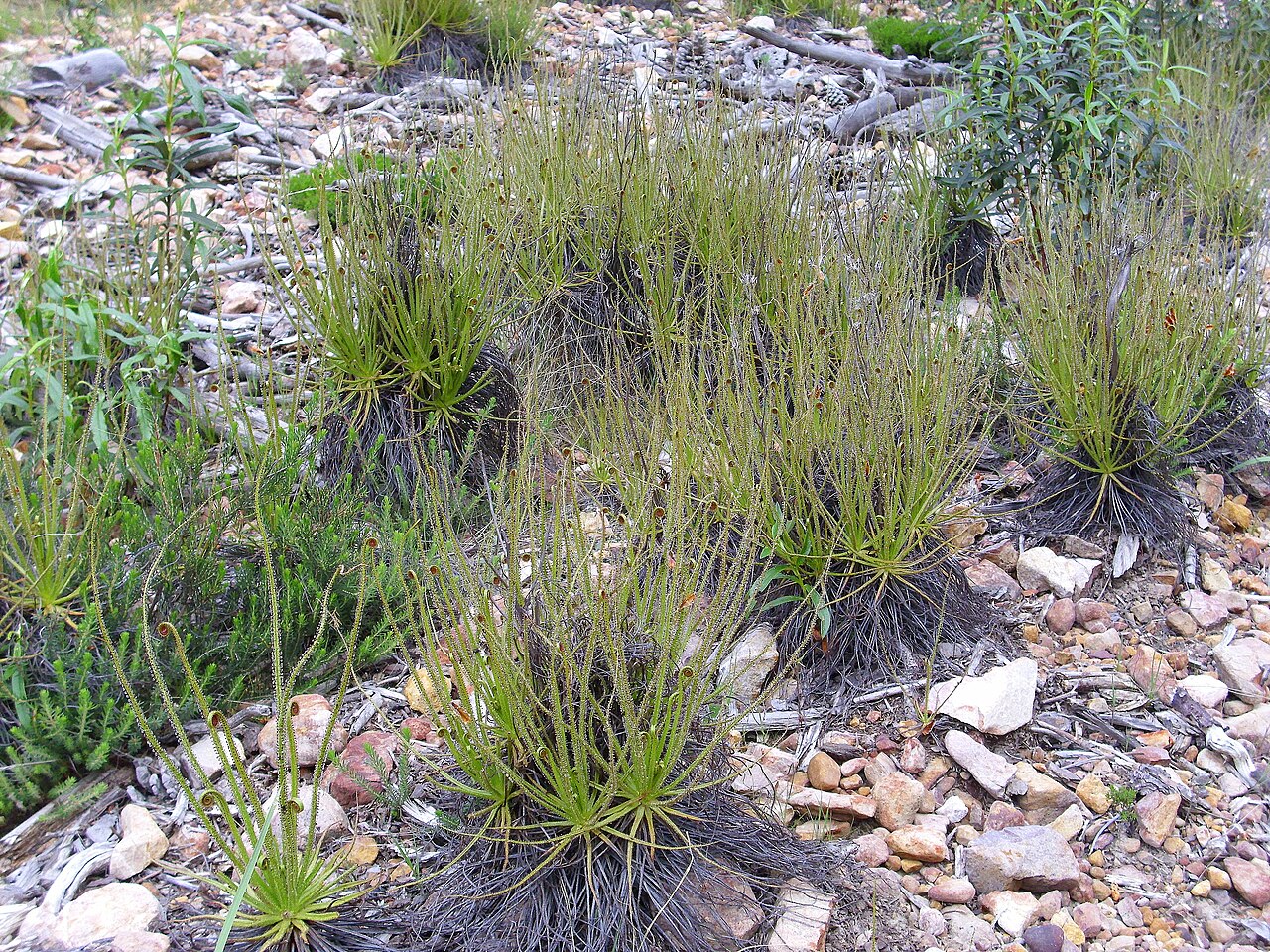
A subshrub with a woody, often branched base, 20 to 35 and at most 45 cm high, carrying a tuft of leaves at the top. The leaves are thread-like, 10 to 20 cm long and only 2 to 3 mm wide, three-angled in section, and bear two kinds of gland: rows of red-stalked glands with a clear droplet, and sessile glands between them. Old leaves die off and hang on as a grey skirt around the stem. In spring loose racemes of large yellow flowers appear; the petals are (18)20 to 30 mm long and 12 to 18 mm wide, broadly obovate. The fruit is an egg-shaped capsule that opens by three to five teeth.
Similar species
From a distance the plant looks like a coarse sundew, or, out of flower, like a tussock of rushes. The sundews of the Iberian Peninsula always grow on wet ground and have round or spoon-shaped blades on a stalk; Drosophyllum stands on a dry slope with long, thread-like, upward-pointing leaves. In this landscape the yellow flower is the best character: no other carnivorous plant in Europe has one. Anyone standing over it in spring sees the second character: the young leaf uncoils outwards, away from the bud — the reverse of nearly every other plant, which rolls its leaves inwards.
The trap and how it works
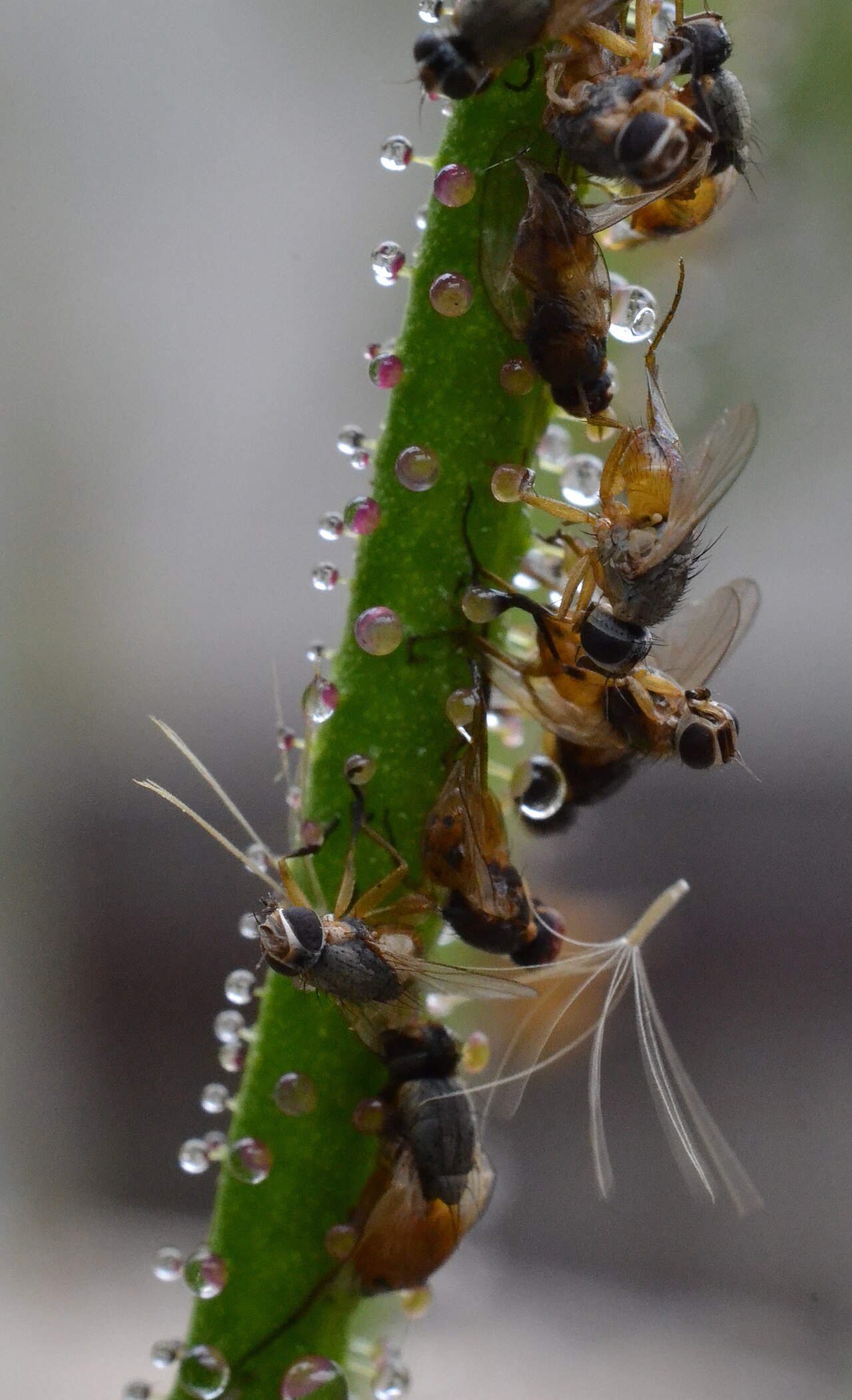
A purely passive flypaper trap. The stalked glands carry a thick drop of glue that shines in the sun and gives off a sweet, honeyed scent; an insect that lands is held, and the more it struggles the more drops it meets. The leaf itself does not move: no tentacle bends, no margin rolls over. That is the real difference from the butterworts, where the leaf margin curls around the prey over the course of hours. Digestion is the work of the second kind of gland, the sessile ones, which only secrete once something is actually lying on them. The catch is large: a good plant carries dozens of flies, beetles and wasps at once, and for a plant on gravel that is the only road to nitrogen.
Habitat and ecology
Dry, poor, lime-free ground: openings in heath, cork oak woodland and pine woodland, on sand, gravel or shale, often on somewhat disturbed ground such as road cuttings and old burns. The climate is mediterranean, with a wet winter and a dry summer; the plant roots deeply and in summer draws moisture from the night fog coming off the sea. Fire helps it: after a burn the ground lies open and the seed germinates in quantity, until the scrub closes again after a decade.
Distribution and elevation
South-western Europe and north-western Africa: Portugal, Spain and Morocco, and nowhere else. The centre of gravity lies in Portugal and in the provinces on both sides of the Strait of Gibraltar; scattered stands also occur inland in Extremadura and in the mountains of northern Morocco. The distribution is strongly fragmented — separate populations on suitable slopes — and in Iberia runs from sea level to about 1200 m.
- Recorded (quarter-degree cells)
Forms and variation
One species in the genus, one genus in the family, and no recognised varieties within the species. What differs is the size of the plant and the number of stems, and that follows from the time since the last fire and the depth of the soil, not from inherited forms. There are no natural hybrids: there is no related species to cross with.
Where and when to see it
April to June, and preferably early in the morning: the yellow flowers are open then and the droplets glitter against the light. The Serra de Monchique and the south-west coast of the Algarve in Portugal, and the heath and cork oak country of Cádiz province in Spain, are the best-known districts. It often stands on the top metres of a road cutting, so that you can look at it from the road without walking into the vegetation. Look for ground that burned a few years ago. Do not pull a plant up to see the root: it does not survive being moved.
Conservation status
Not assessed on the global Red List — that assessment is simply missing, for a species that carries a monotypic family on its own. What does exist is a national assessment: Portugal counts it among its vulnerable species. Locally it is common, and a single slope can carry hundreds of plants, but the number of sites is falling: heath is converted to eucalypt and pine plantation, the coast is built over, and the fire regime has become too frequent in one place and too rare in another.
Scientific name
Drosophyllum lusitanicum | (Linnaeus) Link, 1805
Linnaeus described the species in 1753 in Species Plantarum as Drosera lusitanica, among the sundews. Heinrich Friedrich Link placed it in the new, separate genus Drosophyllum in 1805 — hence the brackets around the author's name. The type locality lies in Portugal (Lusitania), where the species still grows today, alongside scattered populations in south-western Spain and northern Morocco. The genus name Drosophyllum comes from the Greek drosos ('dew') and phyllon ('leaf'), referring to the glistening sticky droplets on the leaves — the same origin as Drosera. The species epithet lusitanicum means 'of Lusitania', the Roman province roughly corresponding to present-day Portugal.
World Checklist of Vascular Plants (WCVP), via Plants of the World Online (POWO), Royal Botanic Gardens, Kew.