All species › Caryophyllales › Sundew family › Drosera parvula
Drosera parvula
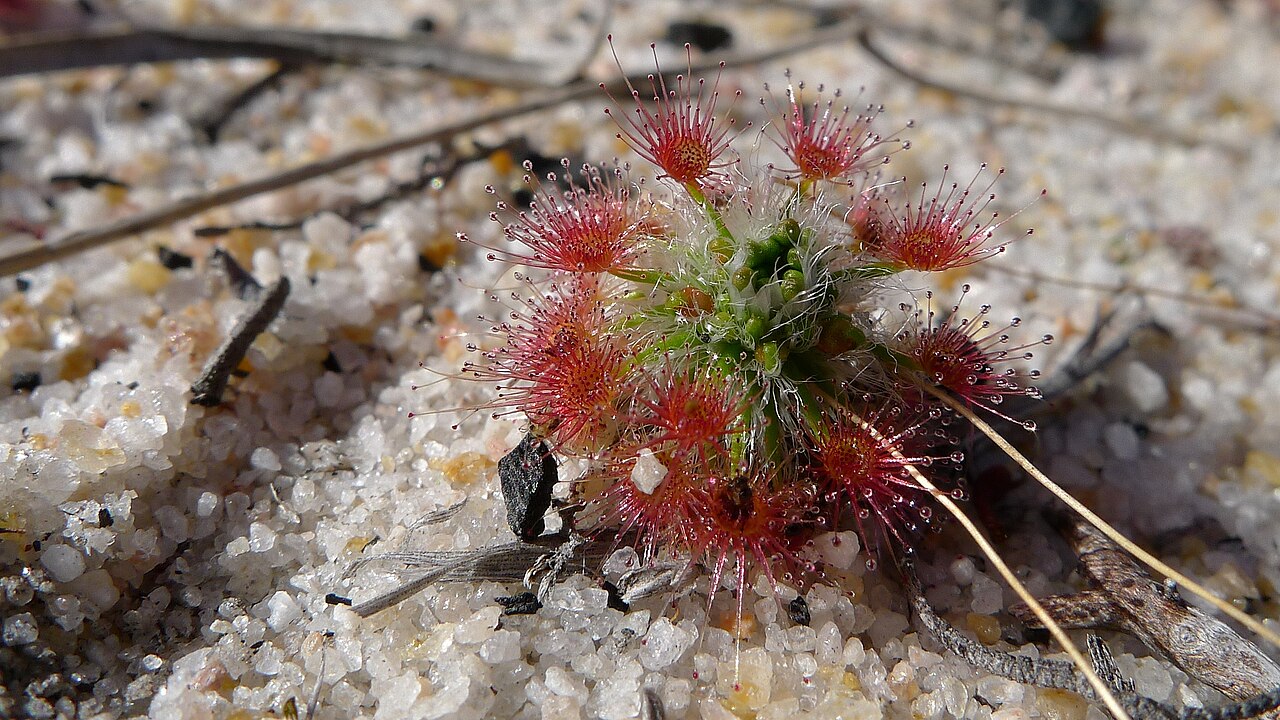
A pygmy sundew of southern Western Australia, so small that a full-grown plant fits on a fingertip. Drosera parvula — the name literally means 'the very small one' — belongs to the forty-odd pygmy species for which this part of Australia is famous: minute rosettes that appear in winter, retreat into a protective bud in summer and reproduce mainly by asexual means.
Identification
A flat or slightly domed rosette of spatulate leaves each ending in a small round blade; including the inflorescence the plant reaches at most 5 cm. The centre of the rosette is filled with silvery stipules that together form a dense bud — typical of the pygmy sundews and strongly developed in this species. The flowers are white and appear from October to December on a slender scape. Exact leaf and flower measurements are not published in the sources consulted.
Similar species
South-west Australia has dozens of pygmy sundews, and many cannot be told apart without a lens. Drosera pedicellaris, described in 2002, is a close relative; it has conspicuously long flower stalks and is confined to a few areas further north. Other white-flowered pygmies differ in the shape and colour of the stipule bud, the hairiness of the scape and the shape of the stigmas — characters that can only be judged close up and preferably with a good key.
The trap and how it works
An active flypaper trap in miniature. Each leaf blade, often no larger than a pinhead to a few millimetres, carries stalked glands on its margin and upper surface, each holding a glistening sticky droplet; the marginal tentacles are usually the longest. A small animal that touches the droplets sticks fast, after which the tentacles bend towards the centre of the blade and press the prey against the digestive glands. The glands secrete enzymes and absorb nitrogen, phosphorus and minerals from whatever dissolves. Given the scale, the catch consists of the very smallest: springtails, mites, aphids, thrips and minute midges moving over or just above the sandy ground.
Habitat and ecology
Deep white quartz sand (D1), usually in open heath and scrub on sandplains (B5). This is extremely nutrient-poor, fast-drying sand that holds enough moisture only in the wet winter. That is exactly why the dense stipule bud matters: in the hot, dry summer it shields the growing point from desiccation and fierce sun.
Distribution and elevation
Endemic to southern Western Australia, in a belt from around Perth via Albany to Ravensthorpe. Altitudinal limits are not published.
Forms and variation
The species was described in 1848 by Jules Émile Planchon. FloraBase, the online flora of the Western Australian Herbarium, no longer lists Drosera parvula as the current name in the strict sense: the present treatment recognises subspecies, among them subsp. sargentii, noted for an exceptionally large stipule bud relative to the plant. Which populations belong to which subspecies is not worked out in the sources consulted, which is a point of uncertainty. Like almost all pygmy sundews it forms gemmae in the centre of the rosette in autumn and winter, from which genetically identical new plants grow.
Where and when to see it
Search from midwinter into spring, preferably on a sunny morning, and get down on your knees: the rosettes lie among lichens and bare sand and only stand out when the droplets catch the light. From October to December the white flowers stand above them. Do not step into open sand between the shrubs — that is where the pygmies grow, and a single footstep flattens dozens.
Conservation status
Assessed as Least Concern (LC) on the IUCN Red List; not listed in CITES, and rated not threatened in FloraBase. The species has a broad range. Even so, sandplains in the wheatbelt and around Perth have been cleared on a large scale, and there the plant survives only on road verges, in reserves and in remnant bushland.
Scientific name
Drosera parvula | Planchon, 1848
Drosera parvula was described in 1848 by the French botanist Jules Émile Planchon, in the Annales des Sciences Naturelles, Botanique, third series, volume 9, page 287. The species is endemic to south-western Western Australia, where it grows on white siliceous sandy soils, including near Cataby, Wanneroo and Pinjarra. However, the precise locality, collector and collection date of the original 1848 type material could not be established with certainty. The epithet parvula is the Latin diminutive of parvus ("small"), meaning "very small, tiny." It is a descriptive name for this minute plant, which belongs to the so-called "pygmy sundews."
World Checklist of Vascular Plants (WCVP), via Plants of the World Online (POWO), Royal Botanic Gardens, Kew.