All species › Caryophyllales › Sundew family › Drosera patens
Drosera patens
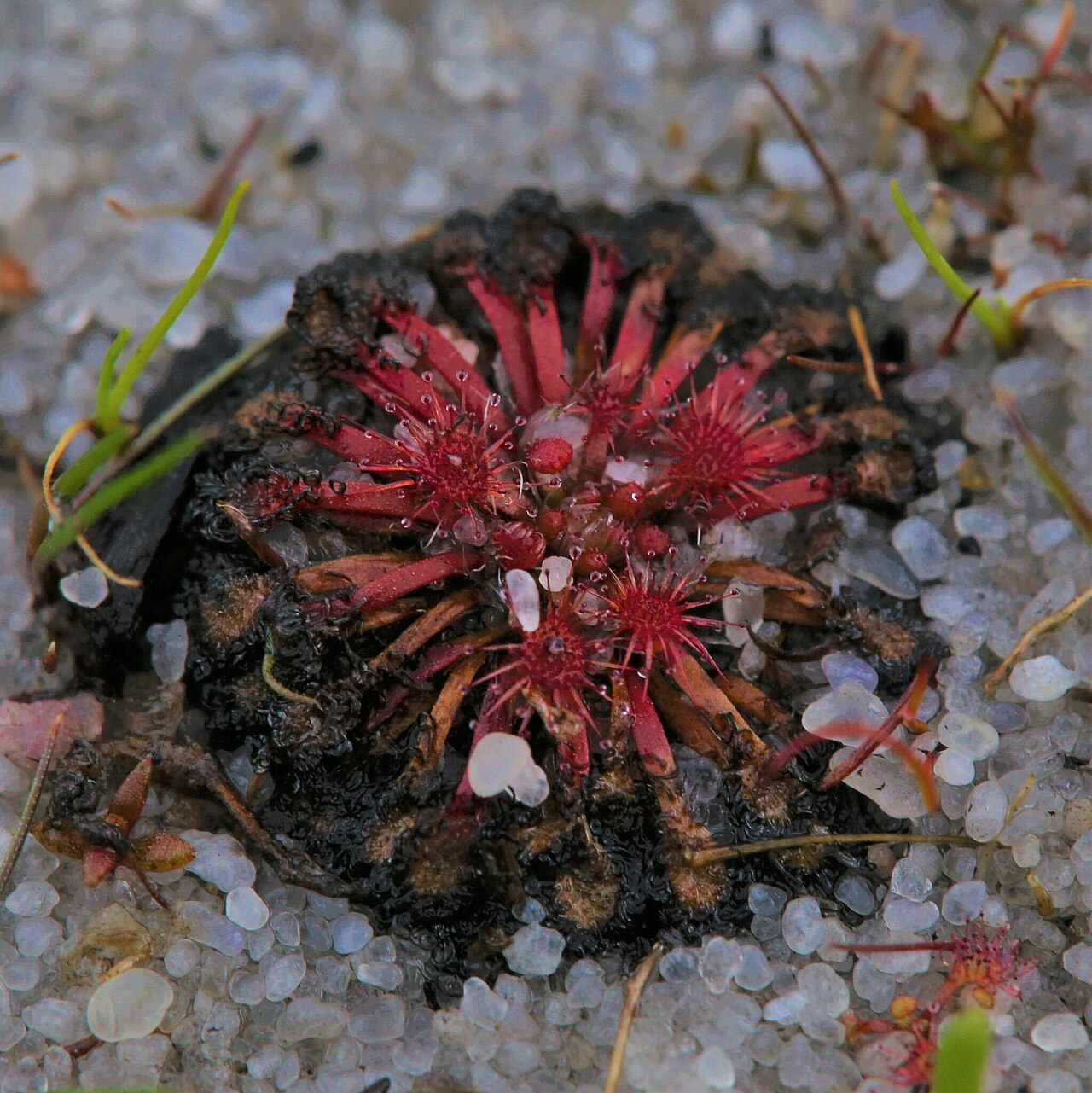
A pygmy sundew that received its name only in 2007 and ranks among the rarest sundews of the Perth region. Drosera patens was described by Allen Lowrie and John Conran in their revision of the difficult group around D. omissa and D. nitidula. Its flowering time is striking: not in spring, like most of its relatives, but in the middle of the hot summer.
Identification
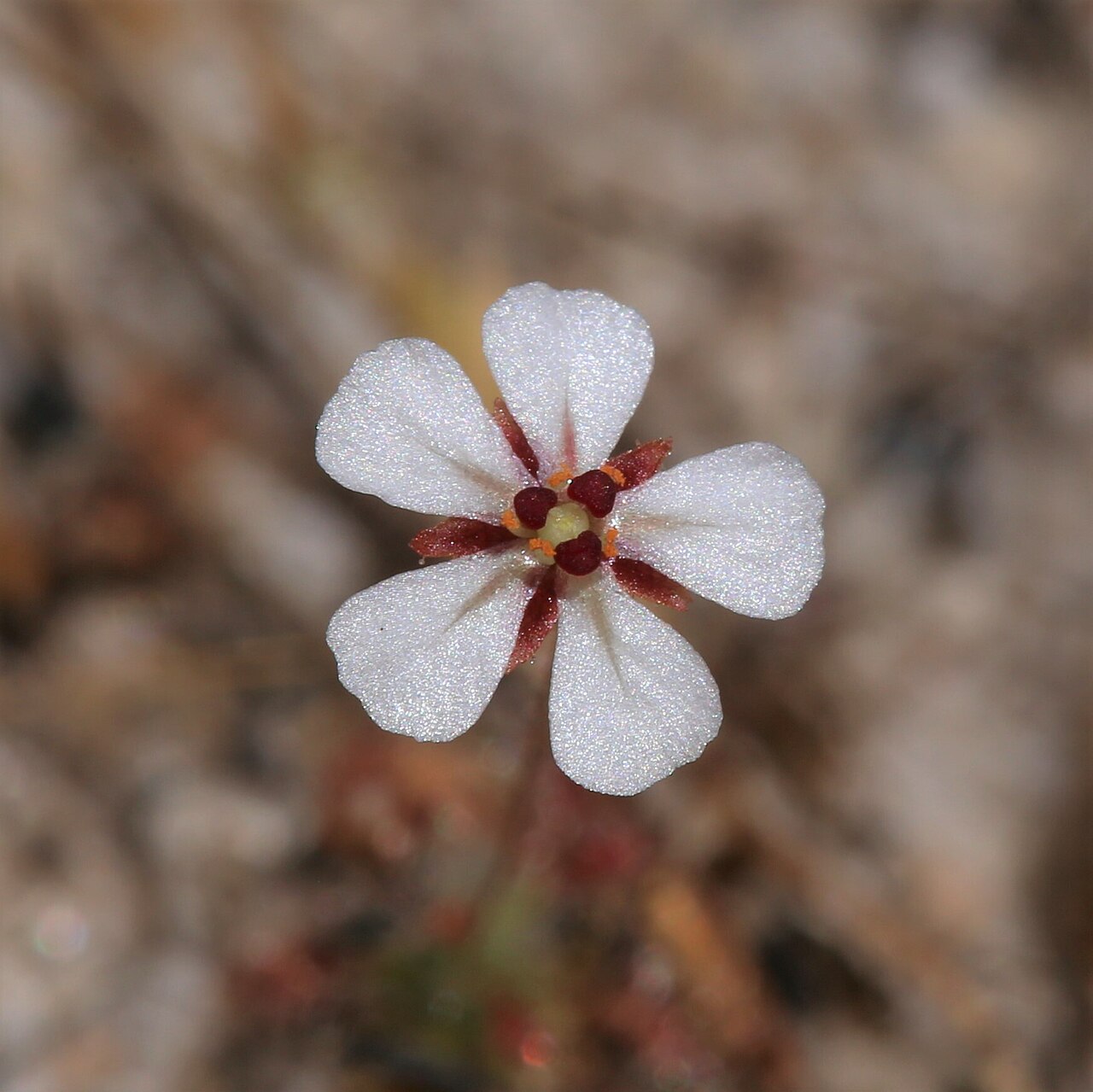
A fibrous-rooted perennial rosette plant at most 5 cm tall including the inflorescence, with the small stalked leaf blades around a bud of stipules typical of the pygmy sundews. The flowers are white and appear in December or February. That is an unusually late flowering time for a pygmy sundew and one of the best clues in the field. The epithet patens means 'spreading'. Further measurements of leaf, flower and inflorescence are found only in the original description, which was not accessible; those fields are left empty.
Similar species
Its closest relatives are the species from the same revision, around Drosera nitidula and D. omissa, and the natural hybrids that occur in that group. Among these is Drosera × sidjamesii, also named by Lowrie and Conran in 2007 and also from lake margins on the coastal plain near Perth, which flowers greenish pink. The combination of white flowers, summer flowering and the wet edge of a seasonal lake is the best guide to D. patens, but a firm identification needs the original description and a lens.
The trap and how it works
An active flypaper trap in miniature. Each leaf blade, often no larger than a pinhead to a few millimetres, carries stalked glands on its margin and upper surface, each holding a glistening sticky droplet; the marginal tentacles are usually the longest. A small animal that touches the droplets sticks fast, after which the tentacles bend towards the centre of the blade and press the prey against the digestive glands. The glands secrete enzymes and absorb nitrogen, phosphorus and minerals from whatever dissolves. Given the scale, the catch consists of the very smallest: springtails, mites, aphids, thrips and minute midges moving over or just above the sandy ground.
Habitat and ecology
Sandy soils on the margins of seasonally wet depressions, swamps and lakes (W7, W4). In winter such margins are flooded or saturated; in summer the water drops back and a damp sandy fringe remains. That probably explains the late flowering: the plant grows and flowers on the strip exposed only as the water retreats.
Distribution and elevation
Endemic to the coastal plain of south-west Australia, in the Perth area. It is known from only a small number of sites. Because it is regarded as endangered, this guide gives no further localities.
- Recorded (one-degree cells)
Forms and variation
No subspecies or varieties are recognised. The species was published in 2007 in the journal Taxon; that original description is virtually the only detailed source. Like other pygmy sundews it can probably also reproduce by gemmae, but this is not specifically recorded for this species in the sources consulted.
Where and when to see it
This is not a species to go looking for on your own. Its few sites lie in a heavily built-up urban area, in a fragile, narrow shore zone where trampling does immediate damage. Anyone wanting to see it is best off joining an excursion of a local plant society or of the land manager. Outside its summer flowering it is barely recognisable among the shoreline plants.
Conservation status
Assessed as Endangered (EN) on the IUCN Red List; not listed in CITES. In Western Australia it is registered as a Priority One taxon: known from very few sites, often on unprotected land, and urgently in need of further assessment. The threats are those facing all lake margins on the coastal plain near Perth: development, falling groundwater, altered water levels, eutrophication and weeds.
Scientific name
Drosera patens | Lowrie & Conran, 2007
Drosera patens was described in 2007 by Allen Lowrie and John G. Conran, in the journal Taxon, volume 56, issue 2, pages 533–544, as part of a revision of the Drosera omissa/D. nitidula complex from south-western Western Australia. Plants now assigned to this species had previously been treated as a subspecies of D. nitidula. The type material was collected by Allen Lowrie on 17 January 1998, in the Swan region of Western Australia, on the margins of swamps, lakes and winter-wet depressions, on sandy soil. The specimen is held at the PERTH herbarium under number PERTH 7881274. The epithet patens is Latin for "spreading, open" (from the verb patere, "to lie open, to spread"). It is likely a descriptive name referring to the open, spreading growth habit of the rosette or leaves, by which this species is distinguished from the closely related Drosera omissa. This could not, however, be confirmed with an explicit source statement.
World Checklist of Vascular Plants (WCVP), via Plants of the World Online (POWO), Royal Botanic Gardens, Kew.