All species › Caryophyllales › Sundew family › Drosera latifolia
Drosera latifolia
The broad-leaved counterpart of Drosera villosa, and the most widespread species of that complex. Drosera latifolia was described in the nineteenth century by August Wilhelm Eichler as a variety of D. villosa in the Flora Brasiliensis, and raised to species rank in 2015 by Paulo Gonella and Fernando Rivadavia. It is a sundew of the south-east and south Brazilian mountains that, unlike many relatives, is common and even tolerates disturbed ground.
Identification
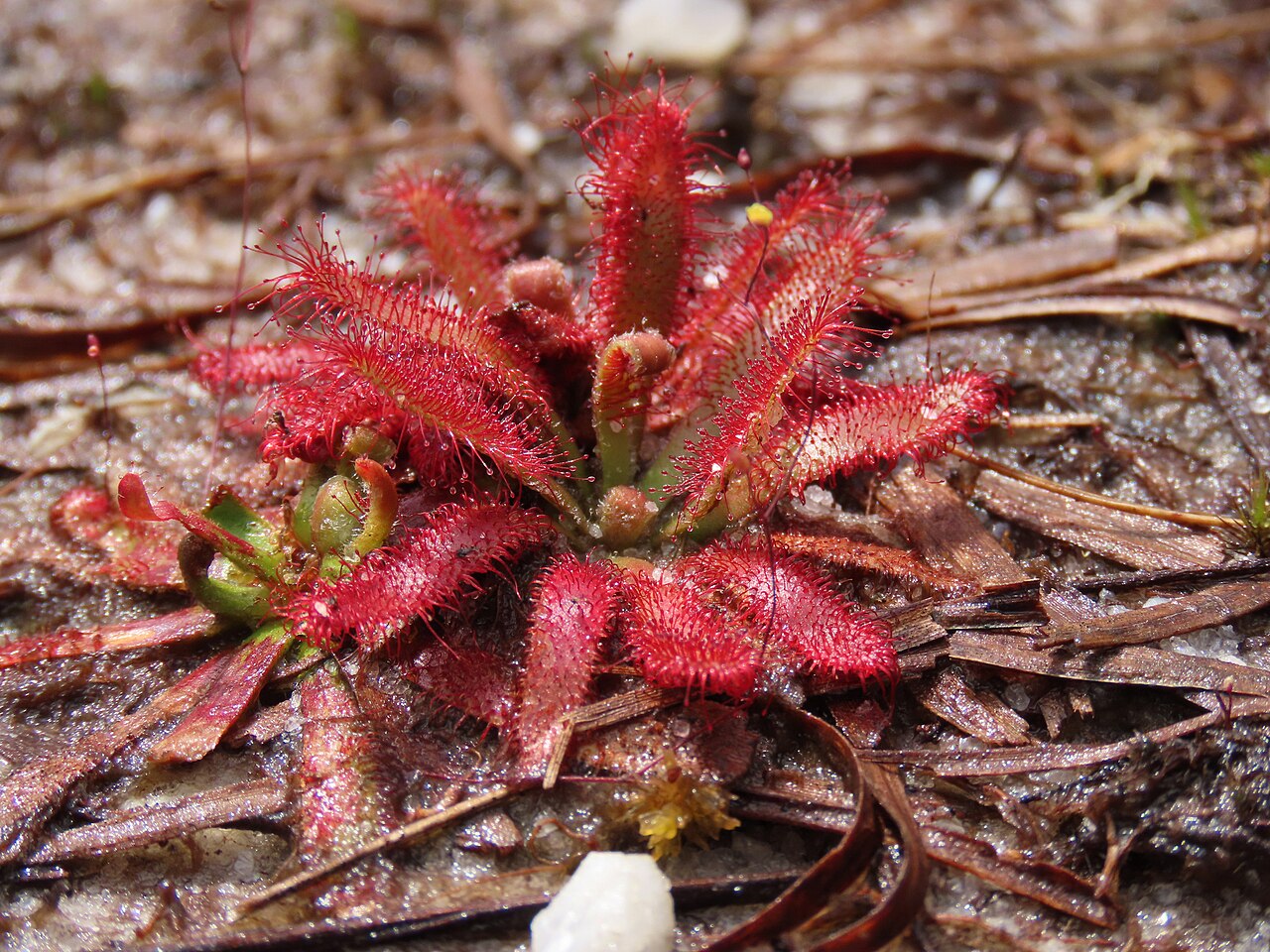
A perennial, stemless rosette that sometimes forms short upright columns up to 10 cm. The leaves are semi-erect and unroll from a coiled tip. The petiole is flat, 1 to 3, sometimes 4 mm wide, almost smooth on the upper side and much to slightly shorter than the lanceolate to oblong blade. The stipules are rectangular with a fringed upper edge. The scape is glabrous to sparsely hairy at the base and glandular at the tip; the pink petals are 5 to 8.5 mm long. The seeds are fusiform, 0.8 to 1 mm, with a reticulate testa.
Similar species
The main confusion species is Drosera villosa, of which it long counted as a variety; that has longer petioles and is more hairy. Drosera graminifolia has grass-like leaves without a clearly defined blade; Drosera chimaera and Drosera ascendens are Minas Gerais species of the same complex. On the Espinhaço range sterile hybrids with Drosera tomentosa have been found, intermediate between the two parents.
The trap and how it works
An active flypaper trap. The tentacles on the broad blade catch gnats, small flies and ants; the surrounding tentacles bend towards the prey and the leaf can curl lengthwise around the catch. Because the leaves are semi-erect, flying insects are also caught.
Habitat and ecology
In the Serra do Mar and Serra da Mantiqueira: high-altitude grasslands and disturbed places, usually on a thin organic layer over rock or on clay. In the Espinhaço range: rocky grasslands and strips of vegetation along streams on sand or peat. It is one of the few Brazilian sundews that also grows in riparian forest (R1, W4, H2, B3). Elevation 700 to 2,550 m.
Distribution and elevation
Endemic to Brazil, in the south-eastern states of Espírito Santo, Minas Gerais, Rio de Janeiro and São Paulo and the southern states of Paraná and Santa Catarina, spread over three major mountain regions: the Serra do Mar, the Serra da Mantiqueira and the Espinhaço range. According to the synopsis the extent of occurrence is nearly half a million square kilometres.
- Recorded (quarter-degree cells)
Forms and variation
No formal varieties are recognised, but the species is highly variable: the synopsis distinguishes six regional morphotypes that differ in size, hairiness and leaf shape. Where D. latifolia and D. tomentosa grow together, sterile hybrids arise. Flowering runs from September to February in the Serra do Mar and Mantiqueira, and from June to September in the Espinhaço, with a second peak in February and March.
Where and when to see it
One of the easiest mountain sundews to find in Brazil. In the national parks of the Serra da Mantiqueira and Serra do Mar, search wet open places along trails and streams, and bare wet verges of mountain roads. Compare petiole and hairs to separate it from D. villosa.
Conservation status
Not assessed for the global IUCN Red List and not listed in CITES. The authors of the synopsis assessed the species as least concern (LC), given the large range, the many populations and its occurrence in numerous national and state parks. That is the authors' proposal, not an official IUCN assessment; the IUCN field therefore remains not evaluated.
Scientific name
Drosera latifolia | (Eichler) Gonella & Rivadavia, 2014
Basionym Drosera villosa var. latifolia by August Wilhelm Eichler in 1872, in "Flora Brasiliensis", volume 14, no. 2, p. 395, plate 91, fig. 1. Raised to species rank as Drosera latifolia (Eichler) Gonella & Rivadavia in 2014, in Phytotaxa, volume 156, no. 1, p. 21 (3 January 2014) — the same publication as the previously mentioned D. chimaera (golf 39). The type locality is explicitly not specified in the sources, neither for the basionym nor for the new combination. The species occurs in Brazil. From the Latin latus ("broad") and folium ("leaf") — "broad-leaved", probably distinguishing it from narrower-leaved relatives within the D. villosa complex.
World Checklist of Vascular Plants (WCVP), via Plants of the World Online (POWO), Royal Botanic Gardens, Kew.