All species › Caryophyllales › Sundew family › Drosera leucostigma
Drosera leucostigma
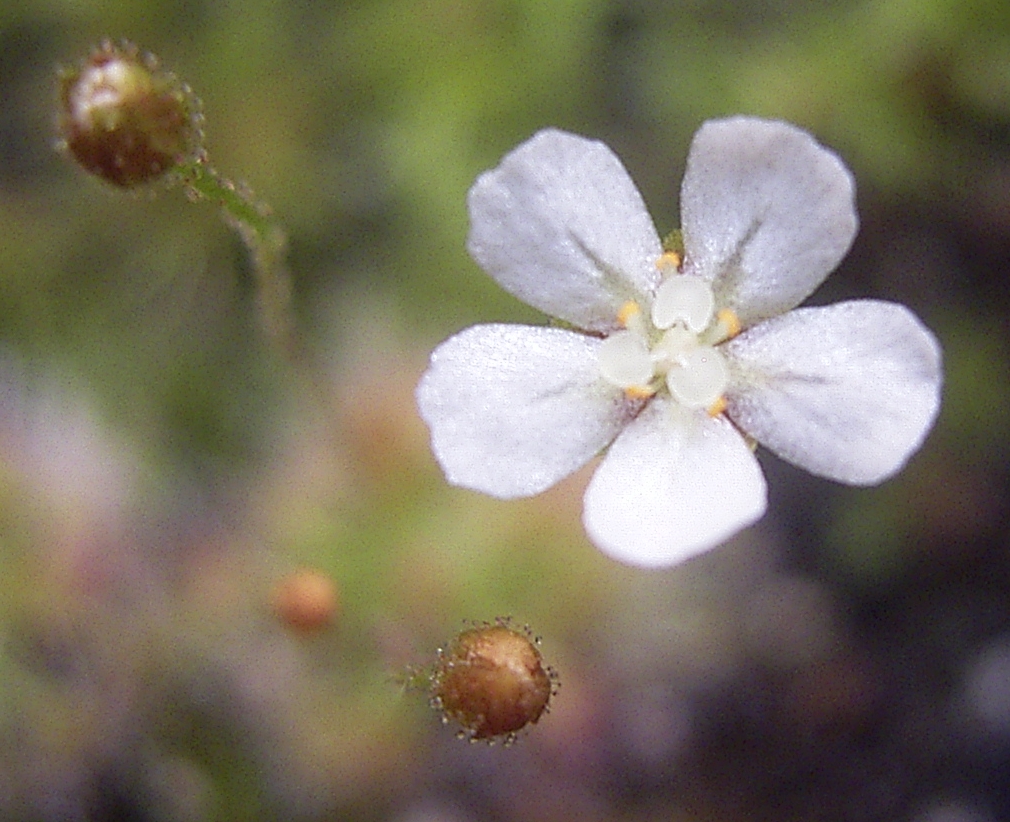
A white-flowered pygmy sundew that blooms late in the season, when most of its relatives are already entering their summer rest. The name leucostigma means 'white stigma'. Neville Marchant and Allen Lowrie described the plant in 1992 as a subspecies of another pygmy sundew, in all likelihood Drosera nitidula; Lowrie and John Conran later raised it to species rank, which explains the double author citation.
Identification
A small, fibrous-rooted, perennial rosette reaching up to 5 cm tall, with the tuft of stipules at its heart that marks all pygmy sundews. The flowers are white and appear from November to December, sometimes into January — late for a pygmy sundew. As the name says, the stigmas are white too. We did not find precise leaf and flower measurements in any source consulted.
Similar species
There are several white-flowered pygmy sundews in the south-west, and none can be reliably recognised without flowers. The late flowering and the white stigmas are the best leads. Species with coloured (for instance red or black) stigmas or with orange or pink flowers are thereby ruled out. A secure identification needs the key in Lowrie (2013).
The trap and how it works
An active flypaper trap in miniature. The leaf blades carry stalked glands with a sticky droplet; the long marginal tentacles catch the prey and bend it to the centre of the leaf, where shorter glands take over digestion. The prey consists of the smallest soil animals and flies.
Habitat and ecology
Sandy soils on the margins of hollows that are wet in winter (W7, D1). Because the plant grows at the edge of such a hollow, the ground stays moist longer than on the surrounding sandplain, which makes the late flowering possible.
Distribution and elevation
Endemic to south-west Australia. FloraBase lists the Geraldton Sandplains (Lesueur Sandplain subregion) and Jarrah Forest (Northern Jarrah Forest) bioregions, that is, the area north and north-east of Perth.
- Recorded (one-degree cells)
Forms and variation
There are no subspecies or varieties; the plant was itself once a subspecies. Like most pygmy sundews it forms gemmae in the heart of the rosette, dispersed by raindrops.
Where and when to see it
Search late in spring, at the end of November or early December, along the margins of wet hollows in the sandplains north of Perth. The white flowers are small and open only in sun. Because the species is regarded as threatened and poorly known, every well-documented record is valuable to the Western Australian Herbarium; report it rather than publicising the site.
Conservation status
On the global IUCN Red List the species is listed as Vulnerable (VU). In Western Australia it is listed as Priority One among poorly known flora: known from few sites, some of them outside protected areas. It is not listed in CITES. Drainage of wet hollows, clearing and declining rainfall in the south-west are the main threats. Uncertainty: we could not verify in a source the name of the species of which it was originally a subspecies.
Scientific name
Drosera leucostigma | (Marchant & Lowrie) Lowrie & Conran, 1996
Originally described as Drosera nitidula subsp. leucostigma by N.G. Marchant & Lowrie (the same revision of 34 Western Australian taxa mentioned earlier in the guide, 1992, Kew Bulletin 47(2)). Raised to full species rank by Lowrie & Conran in 2007, in Taxon, volume 56, no. 2, p. 539, as part of "A Revision of the Drosera omissa/D. nitidula Complex". The precise type locality could not be established. The species is endemic to south-western Western Australia and is considered vulnerable. From the Greek leukos ("white") and stigma — "white stigma", probably referring to a white floral stigma distinguishing it from related taxa.
World Checklist of Vascular Plants (WCVP), via Plants of the World Online (POWO), Royal Botanic Gardens, Kew.