All species › Caryophyllales › Sundew family › Drosera elongata
Drosera elongata
A little-known sundew of the plateaux of Angola and surroundings, described in 1955 by Exell and Laundon. The name elongata — 'elongated' — refers to the long stem the plant forms. It is listed on the IUCN Red List as Data Deficient: too little is known to assess its threat.
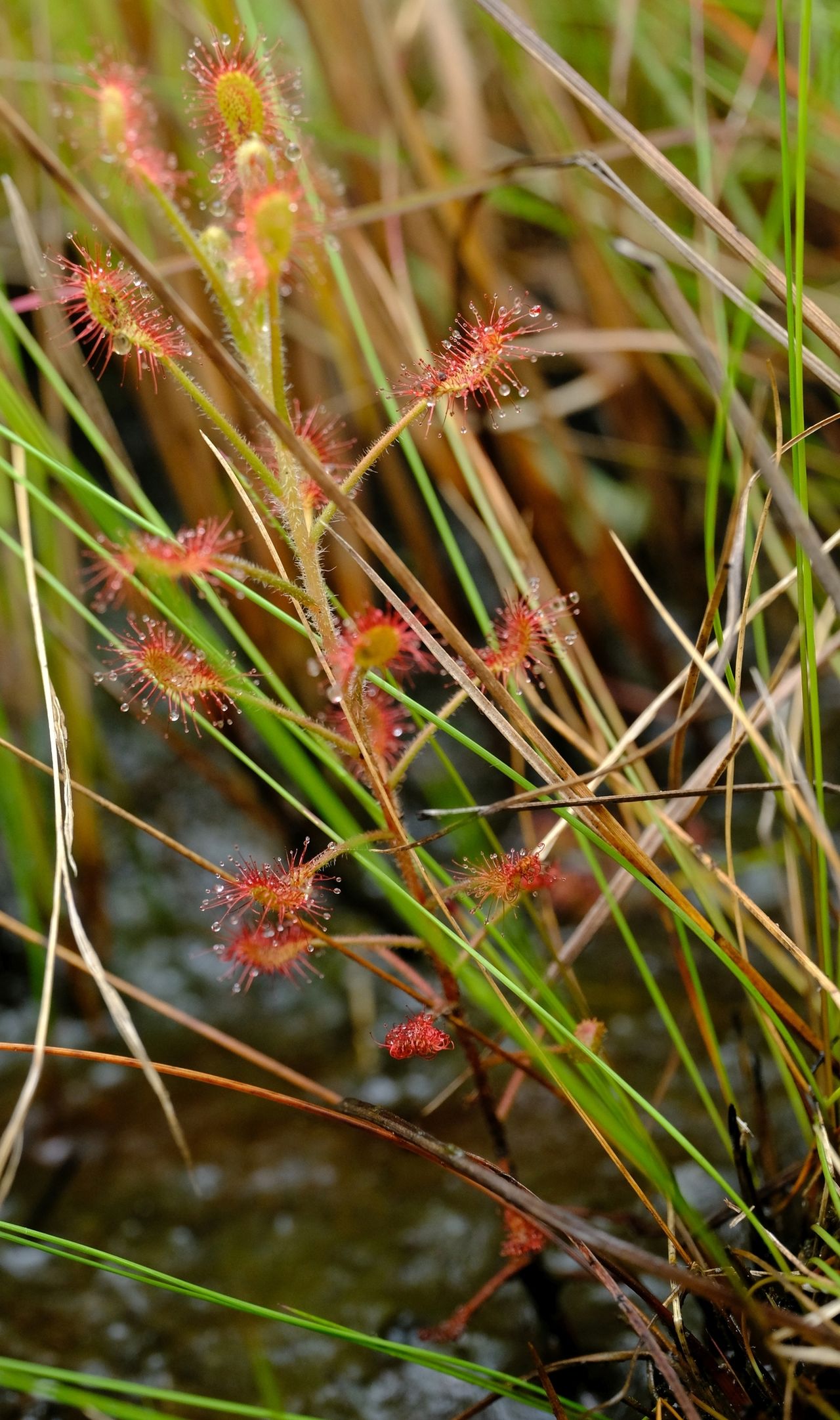
Identification
A sundew with an elongated, ascending stem along which narrow glandular trapping leaves are scattered, as in the related D. madagascariensis and D. affinis. Reliable measurements from a flora were not available for this text; the measurement fields are left empty.
Similar species
Drosera madagascariensis and D. affinis share the same habit; the distinction rests on details of leaf and flower and is difficult in the field. The rosette species of the region, such as D. burkeana and D. bequaertii, form no long stem.
The trap and how it works
An active flypaper trap. The leaves scattered along the stem catch small insects at different heights in the vegetation; after contact the tentacles bend towards the prey and the glands secrete digestive enzymes.
Habitat and ecology
Wet, open places on the plateaux: waterlogged grassland, dambos and marsh margins in savanna and open woodland (W4, W7, B6). Specific habitat data are scarce.
Distribution and elevation
Central Africa: known for certain from Angola; records from Zambia and southern DR Congo, as in this guide's working list, are plausible but not confirmed in the sources consulted. Altitudinal limits were not found.
- Recorded (one-degree cells)
Forms and variation
No varieties are recognised. The species is known from few collections, and its delimitation from D. madagascariensis and D. affinis deserves new study.
Where and when to see it
Field records are rare and therefore valuable. Document stem, leaf and flower with photographs and have the identification checked by a specialist.
Conservation status
Assessed on the IUCN Red List as Data Deficient; not in CITES. That does not mean the species is safe, but that data on range and numbers are lacking.
Scientific name
Drosera elongata | Exell & Laundon, 1955
Described by Exell & J.R. Laundon in 1955, in Boletim da Sociedade Broteriana, series 2, volume 29, p. 42. Type material collected on 27 April 1937 by A.W. Exell & F.A. Mendonça, in Lunda Sul, Angola, locality "Tenga", near Luma-Cassai (holotype at BM). "Tenga", near Luma-Cassai, Lunda Sul province, Angola — an African species, unlike most other species in this golf. The species also occurs in Burundi, Congo, DR Congo, Tanzania and Zambia. From the Latin elongatus ("elongated") — probably referring to the elongated, scrambling stems (up to 90 cm), though this is not literally confirmed in a source.
World Checklist of Vascular Plants (WCVP), via Plants of the World Online (POWO), Royal Botanic Gardens, Kew.