All species › Caryophyllales › Sundew family › Drosera depauperata
Drosera depauperata
Of all the species in this series, Drosera depauperata is the most poorly documented. Allen Lowrie and John Conran described it in 2014 in Lowrie's Carnivorous Plants of Australia Magnum Opus, and in 2018 the name was added to the Western Australian plant census. The epithet means 'impoverished' or 'meagre', a term botanists use for plants that are smaller or more sparingly built than their relatives. Publicly accessible knowledge barely goes further.
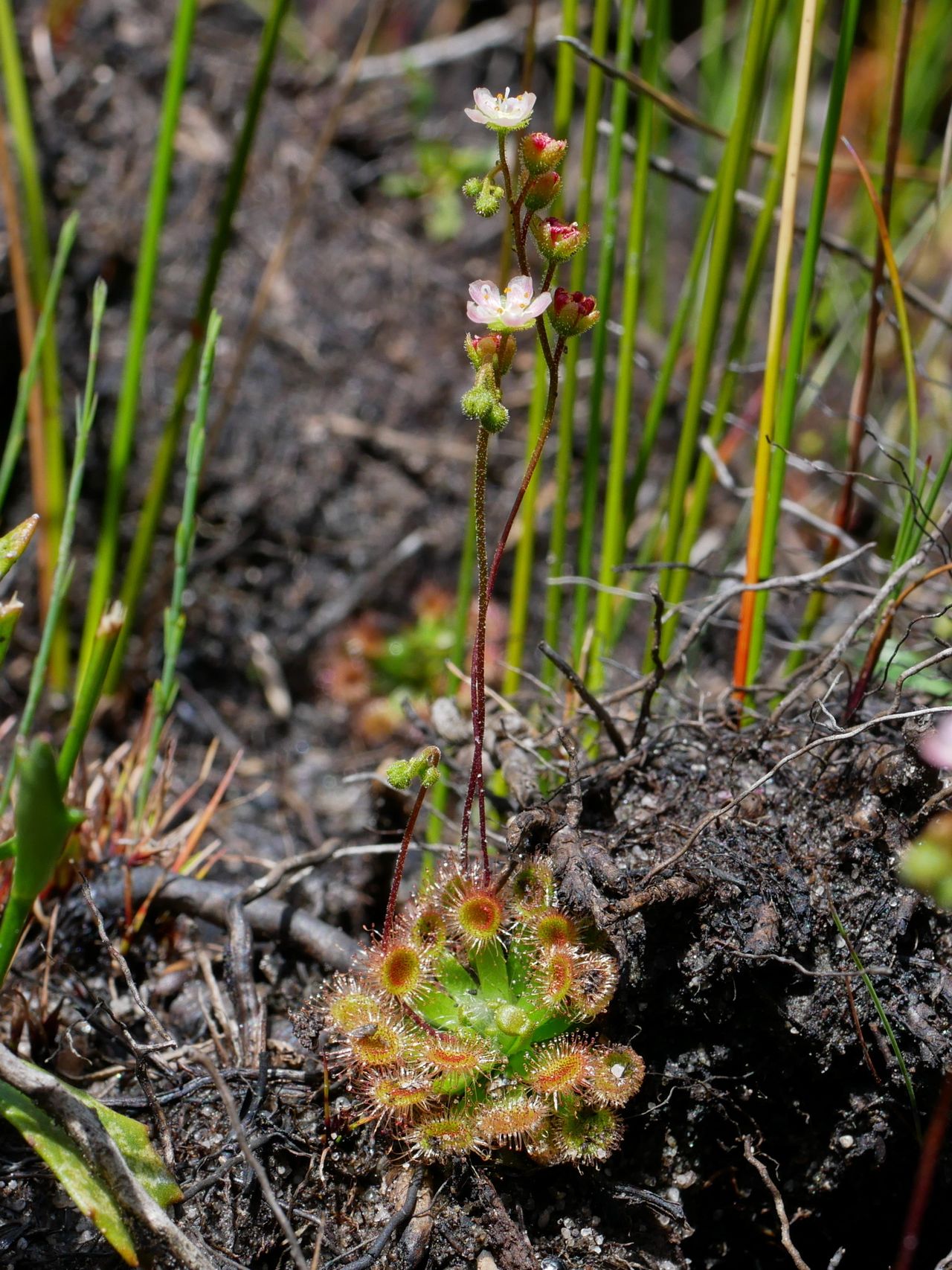
Identification
No description of the plant could be found in the sources accessible for this guide: growth form, leaves, flowers, measurements and flowering time remain unknown, and its position within the genus could not be established either. All measurement fields are therefore left empty. Anyone wishing to recognise the species depends on the original description by Lowrie and Conran (2014).
Similar species
Without a description no comparison with related species is possible. Judging by the name it is probably a small, sparingly built plant easily confused with other small sundews; that, however, is an inference from the name, not an established character.
The trap and how it works
Like all sundews the plant catches with an active flypaper trap: stalked glands on the leaf carry sticky droplets in which small insects become stuck, after which the tentacles bend towards the prey and secrete digestive enzymes. Specific data for this species are lacking.
Habitat and ecology
Nothing about the habitat is recorded in the accessible sources. Code B5 (heath and shrubland) is a provisional assignment based on the most common habitat of sundews in the south-west and should be checked against the original description.
Distribution and elevation
According to the base list endemic to the south-west of Western Australia; the name has been in the state plant census since 2018. A more precise distribution could not be established for this guide; no reachable FloraBase profile was found for this species.
- Recorded (one-degree cells)
Forms and variation
No subspecies or varieties have been described. Because the species was described only in 2014 and has hardly appeared in other literature since, its boundaries have not yet been tested by other researchers.
Where and when to see it
No concrete field tip can be given for this species. Anyone photographing sundews in the south-west that do not fit a known species can have the images assessed by specialists at the Western Australian Herbarium; that is how little-known species such as this one can be better mapped.
Conservation status
The IUCN code in this guide is Vulnerable (VU). Not in CITES. That a species so little known is listed as vulnerable points to a small range or few known sites. The source base for this text is exceptionally thin: the original description by Lowrie and Conran (2014) is the only good source and could not be consulted for this guide. This text is therefore deliberately short and contains no measurements.
Scientific name
Drosera depauperata | Lowrie & Conran, 2013
Described by Lowrie & Conran, in "Carnivorous Plants of Australia Magnum Opus", volume 3, p. 1270 (2013/2014). Collected by Allen Lowrie (no. 2734) on 16 November 2001, on the southern shore of Lake Pleasant View, east of Manypeaks, Western Australia (34°50'1"S, 118°10'56"E); holotype at PERTH, isotype at MEL. Southern shore of Lake Pleasant View, east of Manypeaks, Western Australia (34°50'1"S, 118°10'56"E). From the Latin depauperatus ("impoverished, weakened") — a conventional botanical term for plants with a reduced or sparse growth form; a specific explanation from the describers themselves was not found.
World Checklist of Vascular Plants (WCVP), via Plants of the World Online (POWO), Royal Botanic Gardens, Kew.