All species › Caryophyllales › Sundew family › Drosera eneabba
Drosera eneabba
Named after Eneabba, a town on the northern sandplains of Western Australia, in the middle of a landscape of white sands and rich kwongan heath. Drosera eneabba was described in 1992 by Neville Marchant and Allen Lowrie as one of the many pygmy sundews in their revision of the group. It is a plant of the bare white silica sand that characterises this region.
Identification
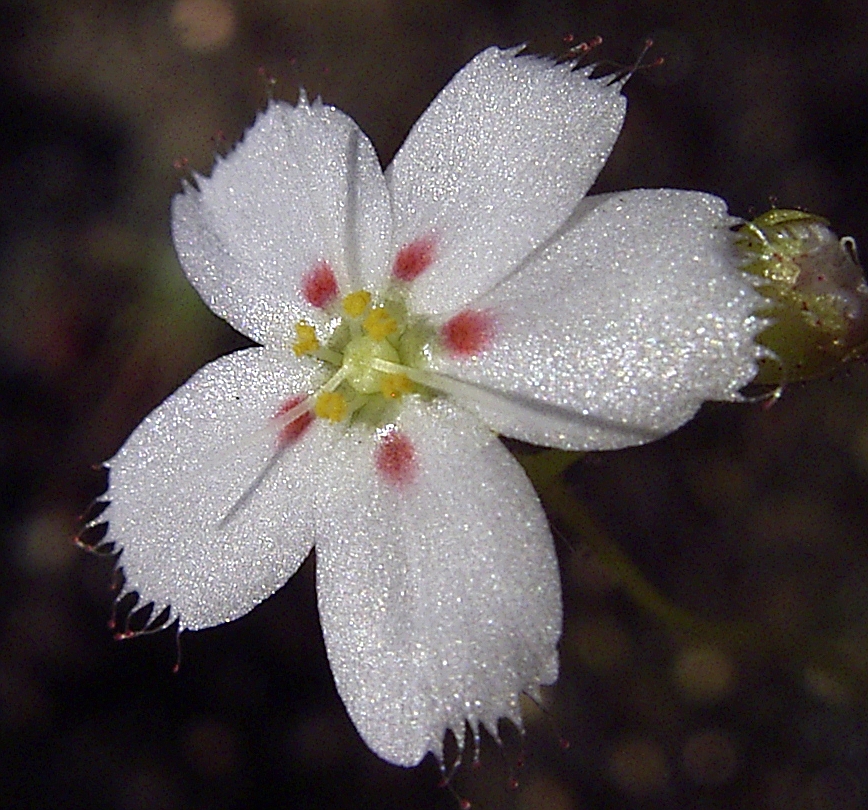
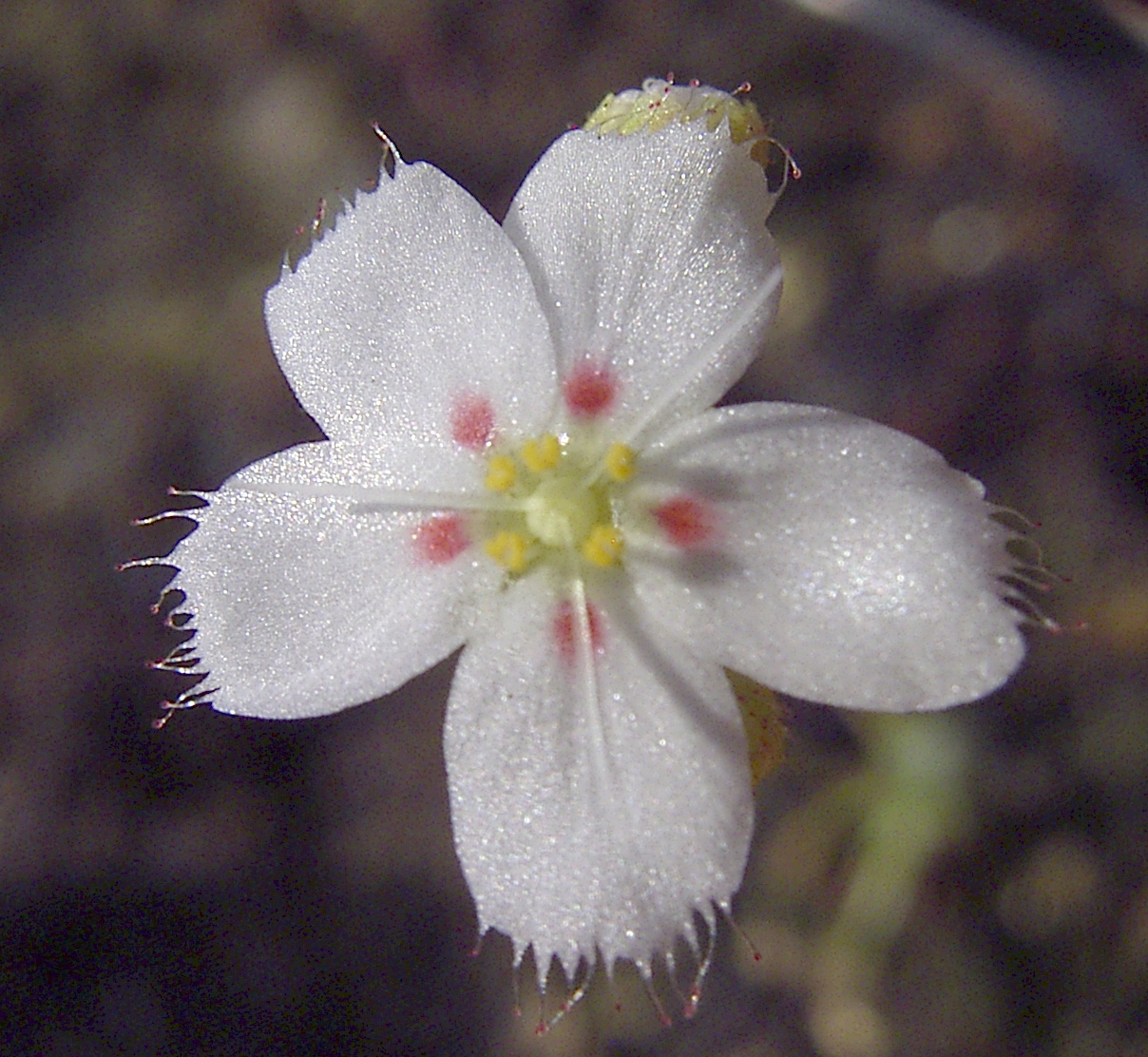
A perennial, fibrous-rooted pygmy sundew with a rosette no more than 2 cm across; with its flowering stem the plant reaches 8 cm. At its heart stands the cone of silvery stipules. The flowers are white to pink and appear in October and November. Leaf and flower measurements were not available in the accessible sources.
Similar species
Other white- or pink-flowered pygmy sundews grow on the same sandplains, such as Drosera closterostigma, which grows at the edges of wet depressions, and Drosera dichrosepala. The habitat on dry white silica sand and the late flowering help to distinguish it; certainty comes only from the features of stipules, calyx and stigmas under a lens.
The trap and how it works
An active flypaper trap. The small leaves bear stalked glands with droplets of glue in which springtails, ants and small flies are caught. The tentacles bend towards the prey and secrete digestive enzymes. On the extremely nutrient-poor white silica sand this by-catch is a real source of nitrogen and phosphorus.
Habitat and ecology
White silica sand (FloraBase), in the open kwongan heath of the northern sandplains (D1, B5). The sand holds little water; the plant grows in the wet winter and survives the summer as a resting bud of stipules.
Distribution and elevation
Endemic to the south-west of Western Australia. FloraBase lists the Geraldton Sandplains and Swan Coastal Plain bioregions, with records in the shires of Carnamah, Coorow, Dandaragan and Irwin, a band north of Perth to beyond Eneabba.
- Recorded (quarter-degree cells)
Forms and variation
No subspecies or varieties have been described. Like all pygmy sundews the species also reproduces by gemmae, which form at the heart of the rosette in late autumn and are dispersed by raindrops.
Where and when to see it
October is the best month. The Eneabba district is a wildflower destination in spring, and on bare sandy patches among the flowering heath stand the small rosettes of this species. Search open white sand in sunshine around midday. Note that mineral sand mining takes place around Eneabba; do not enter mine sites.
Conservation status
Assessed as Least Concern (LC) on the IUCN Red List and listed as not threatened in Western Australia. Not in CITES. The white sands of this region have partly been mined for mineral sands and partly cleared for farming; remaining heath lies in reserves and along roads.
Scientific name
Drosera eneabba | Marchant & Lowrie, 1992
Described by N.G. Marchant & Lowrie in 1992, in Kew Bulletin, volume 47, no. 2, p. 322 — the same publication as D. echinoblastus. Near Eneabba, Western Australia; the species occurs around Eneabba and Badgingarra, on gravelly/sandy soils in heathland. Named directly after the Western Australian town of Eneabba, near where it was first discovered.
World Checklist of Vascular Plants (WCVP), via Plants of the World Online (POWO), Royal Botanic Gardens, Kew.