All species › Caryophyllales › Sundew family › Drosera communis
Drosera communis
The name means common, and so it is: Drosera communis is one of the most widespread sundews in South America. Anyone driving through the Brazilian interior in the wet season can find it in boggy savannas, along ditches and even on bare roadsides. That very ordinariness makes it a good way into the rich sundew flora of the continent.
Identification
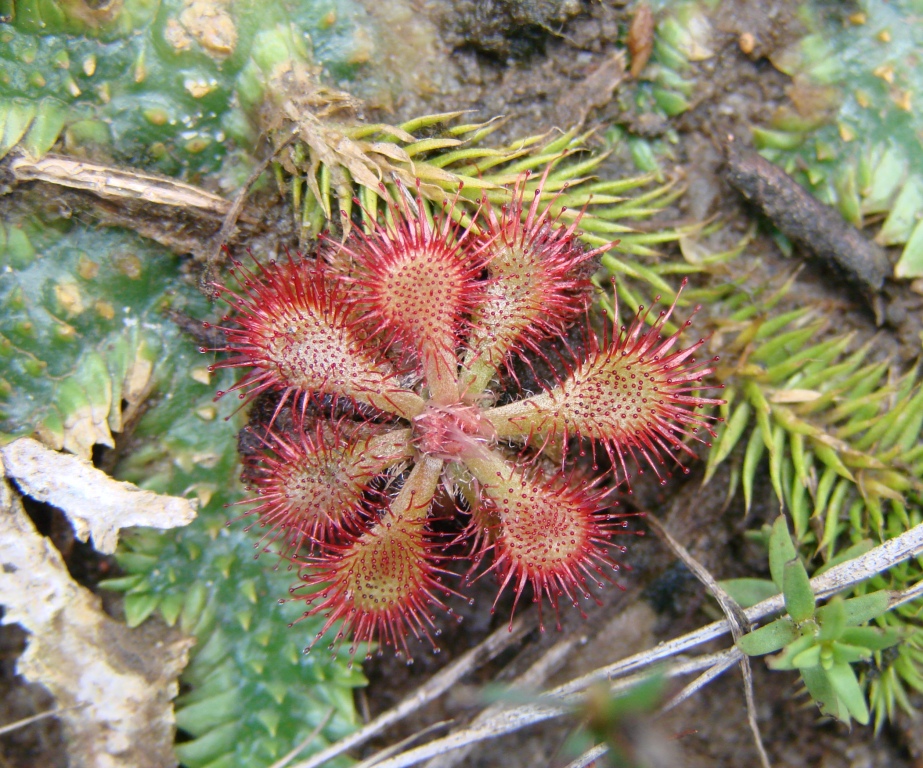
A flat to slightly raised rosette of obovate to spatulate leaves that narrow gradually into a short petiole. In full sun the rosette turns deep red, in shade greenish with red tentacles. One or more slender scapes with a coiled tip rise from the centre and carry several pink to lilac flowers; the flowers open one at a time, usually only in the morning and in sunny weather. No reliable measurements from a recent treatment of the species were found, so the size fields are left empty.
Similar species
Its nearest relative is Drosera viridis from southern Brazil, which has almost the same shape but stays entirely green even in full sun; where the two meet, rare hybrids are known. In northern South America it resembles Drosera cayennensis, and in the Brazilian cerrado Drosera grantsaui. Separating them in the field needs attention to details such as hairs on the scape, the shape of the stipules and the seed; when in doubt, a close photograph of the scape is most useful.
The trap and how it works
An active flypaper trap. The tentacles catch small insects with their droplets of mucilage and then bend towards the prey; with larger prey the whole blade can curl slightly around the catch. On open sand and roadsides the plant catches mainly ants, springtails and small flies, animals that walk over the ground or fly low above it.
Habitat and ecology
Wet, acid, nutrient-poor sandy and loamy soils in open country: seasonally boggy patches in savannas and grasslands, the edges of marshes and pools that dry out in the dry season, and ground disturbed by people such as roadsides, ditches and excavated land (W7, B6, H2). The plant copes well with alternating wet and dry seasons and quickly colonises new open ground.
Distribution and elevation
Much of tropical and subtropical South America, centred on Brazil, where it occurs in almost every region; it is also reported from neighbouring countries including Bolivia, Paraguay and countries in the north of the continent. The boundary with D. cayennensis and other relatives is not everywhere sharp, so the exact limits of the range are uncertain. No published altitudinal range was found.
- Recorded (quarter-degree cells)
Forms and variation
No varieties are recognised, but the species varies in size and colour. The very similar D. viridis was described as a separate species in 2003 on the basis of its entirely green rosette and other characters. The chromosome number of D. viridis (2n = 20) and the occurrence of hybrids underline the close relationship between the two.
Where and when to see it
One of the easiest South American sundews to find: in the wet season look along unpaved roads with bare, wet margins and in boggy patches of open savanna. The plant flowers best on sunny mornings. Bear in mind that related species may grow in the same area, and check colour and scape before settling on a name.
Conservation status
Not assessed for the global IUCN Red List and not listed in CITES. The species is widespread, common and even benefits from disturbed ground; there is no cause for concern at species level. Conversion of savanna to cropland and plantations does destroy sites locally.
Scientific name
Drosera communis | Saint-Hilaire, 1824
Described by Auguste de Saint-Hilaire in 1824, possibly in "Plantes Usuelles des Brasiliens", no. 15, p. 1, or in "Histoire des Plantes les plus Remarquables du Brésil et du Paraguay" (1824-1826), p. 267 — sources differ slightly on the exact publication title. The precise type locality could not be established. The species occurs in Colombia, Venezuela, Brazil (São Paulo state and elsewhere), Bolivia, Paraguay and Argentina, at 1100-1800 m elevation. Lectotype held in Paris (P). From the Latin communis ("common, widespread") — refers to the fact that this is the most widespread Drosera species in South America.
World Checklist of Vascular Plants (WCVP), via Plants of the World Online (POWO), Royal Botanic Gardens, Kew.