All species › Caryophyllales › Sundew family › Drosera montana
Drosera montana
A sundew of the Brazilian mountains, as the name says. Drosera montana was described by Auguste de Saint-Hilaire in 1826 and for a long time served as a catch-all name for various small, hairy rosette species from the highlands of south-eastern Brazil. Since a revision in 2014 the species has been defined much more narrowly, with several former varieties split off as species in their own right.
Identification
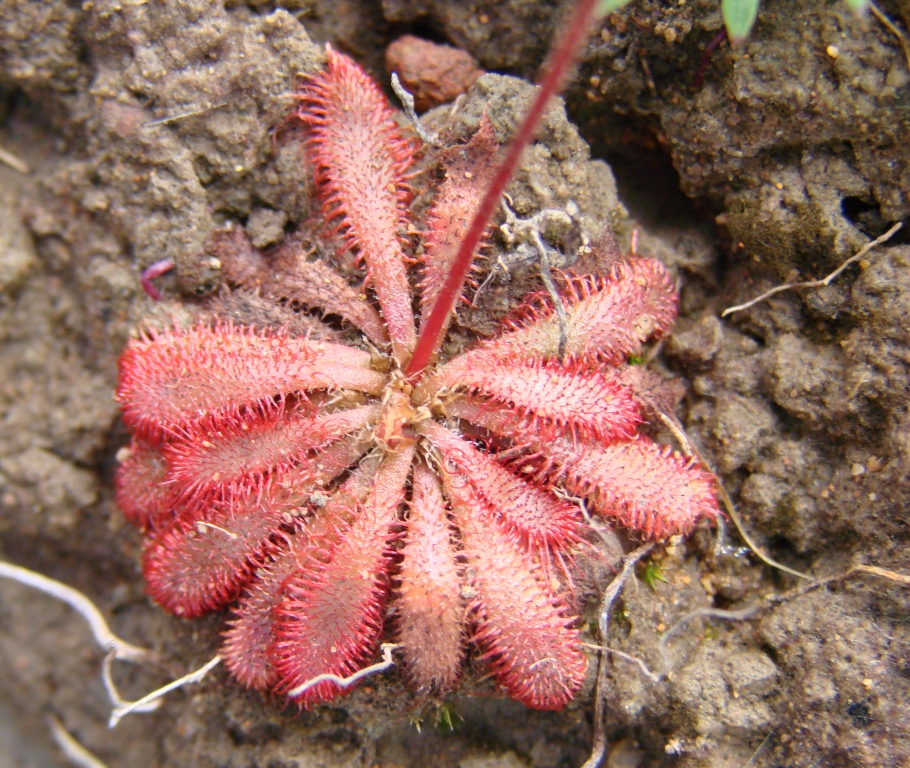
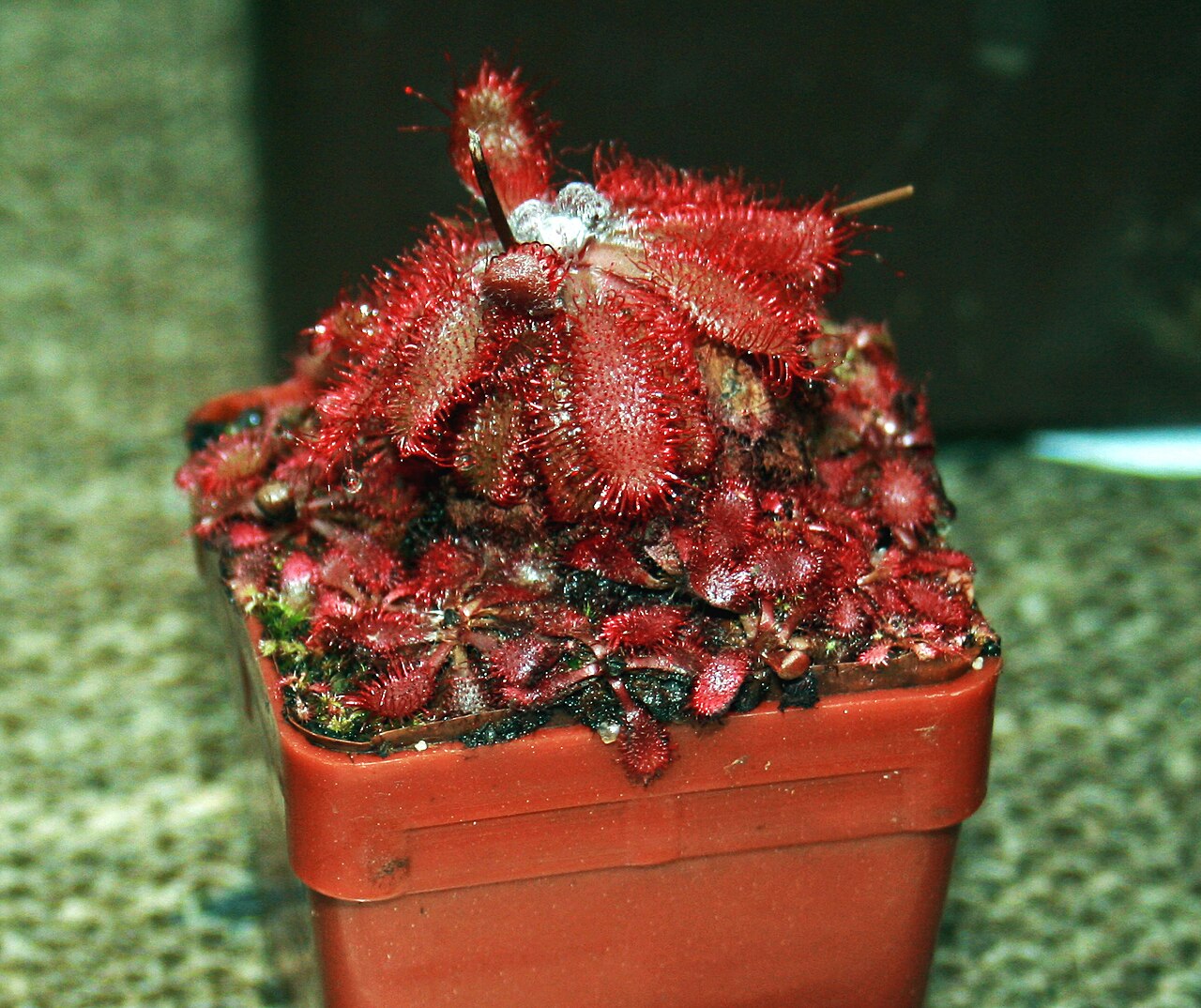
A small perennial rosette of spatulate leaves in a dense whorl on or just above the ground, sometimes on a short stem of old dead leaves. The blade is rounded and carries red tentacles; in full sun the whole rosette turns red, in shade it stays greener. The scape arises from the centre of the rosette and bears a few flowers, usually pink, sometimes white. Because the species has recently been narrowed so much, reliable measurements for the species in the strict sense have not been adopted here.
Similar species
The greatest confusion is with the species formerly included in D. montana: Drosera tomentosa, with a dense woolly indumentum on the scape and often on the leaves, and Drosera schwackei, which grows elsewhere in Minas Gerais. Drosera spirocalyx also belongs in this alliance. It differs from the common lowland Drosera communis in its mountain habitat and long life; D. communis is a plant of wet sandy flats and roadsides at lower elevations.
The trap and how it works
An active flypaper trap. The tentacles on the blade carry droplets of sticky mucilage in which small insects are caught; the surrounding tentacles then bend towards the prey and the blade can curl slightly round the catch. On open, sunny mountain slopes the catch consists mostly of ants, small flies and springtails moving across the wet ground.
Habitat and ecology
Wet, acid, nutrient-poor places in the highlands: seeping rock faces and the wet edges of quartzite slabs, and boggy, sandy or peaty ground in mountain grassland and along small streams (R1, W4). The plant needs wet feet for almost the whole year and full sun or light shade. In the dry season the rosette can contract to a smaller, compact form.
Distribution and elevation
South-eastern Brazil, in the high-altitude campos rupestres and campos de altitude of Minas Gerais and Rio de Janeiro among others; photographs in the 2022 national synopsis show it near Diamantina, in Itatiaia National Park and in the Ibitipoca state park. It is therefore endemic to Brazil. No published altitudinal range for the species in the strict sense was found.
- Recorded (quarter-degree cells)
Forms and variation
Under the broad concept several varieties were recognised, including var. tomentosa and var. schwackei. The 2014 revision recognised these as separate species; anyone using older literature or old herbarium labels should therefore bear in mind that D. montana there may refer to what is now D. tomentosa, D. schwackei or D. spirocalyx. Within the species in the strict sense colour varies from red to green depending on light.
Where and when to see it
The best chance is in the wet season, November to March, when the rosettes are full grown and the flowers open. Search seepages at the foot of rock slabs and along small streams in the mountain grasslands of the large Brazilian parks. Look closely at the hairs on the scape to separate it from D. tomentosa.
Conservation status
Not assessed for the global IUCN Red List and not listed in CITES. Many sites lie in protected areas. Threats to the Brazilian mountain grasslands in general are frequent fires, invasive grasses, tourism and changes to the water regime. Because the species has only been defined narrowly since 2014, its true rarity is not yet well known.
Scientific name
Drosera montana | Saint-Hilaire, 1824
Drosera montana was described by Augustin de Saint-Hilaire, in Histoire des plantes les plus remarquables du Brésil et du Paraguay, volume 1, p. 260. Bibliographic sources give the publication year variously as 1824 or 1826; the exact publication year could not be established with full certainty. According to database records, type material (Berlin herbarium, B 10 0272051) is based on a collection by Ludwig Riedel, dated January 1825, from Serra da Carassa in Minas Gerais, Brazil. It is not certain whether this specimen is truly the material Saint-Hilaire used, or whether the species was originally based on Saint-Hilaire's own collections made during his Brazil expedition (1816–1822); this could not be resolved with certainty. The name derives from Latin montanus/montana, "of the mountains, mountain-dwelling" — a descriptive name referring to the mountainous habitats (including highland campo vegetation) where the species grows in South America, and thus not a reference to one specific place name.
World Checklist of Vascular Plants (WCVP), via Plants of the World Online (POWO), Royal Botanic Gardens, Kew.