All species › Caryophyllales › Sundew family › Drosera graminifolia
Drosera graminifolia
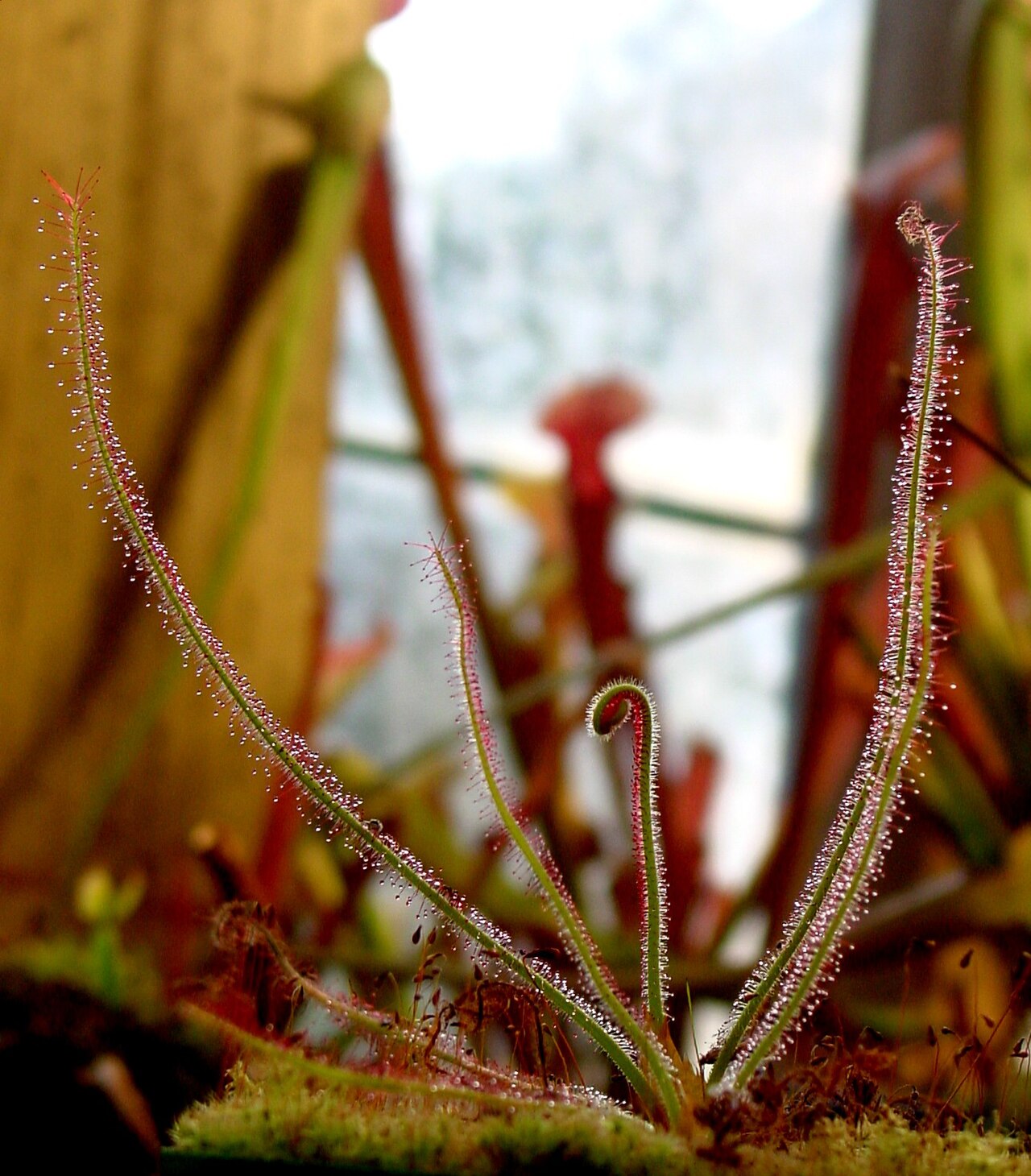
A sundew with leaves like blades of grass. Drosera graminifolia belongs to the group of long-leaved perennial species from the mountains of south-eastern Brazil clustered around Drosera villosa. Saint-Hilaire described it as early as 1826, but only the 2015 revision of that complex gave it a clear place again, and a much smaller range than the older literature suggests.
Identification
A rosette of long, narrow, erect leaves in which petiole and blade merge almost imperceptibly, so that the whole looks more like a tuft of grass than a sundew. Only the upper part of the leaf carries tentacles; young leaves are coiled inwards at the tip, as in many relatives. The scape is long, rises well above the rosette and carries a series of pink flowers. Because the measurements in the revision could not be consulted and older figures refer to a broader concept, the size fields are left empty.
Similar species
Its relatives in the D. villosa complex are the most similar: Drosera villosa itself has a more clearly defined blade on a long hairy petiole; Drosera latifolia has shorter petioles and broader, lanceolate blades; Drosera chimaera and Drosera ascendens are other Minas Gerais species of the same group. The long, narrow grass-like leaves are the best field character, but because of the many intermediates and local morphotypes identification with a recent key is strongly advised.
The trap and how it works
An active flypaper trap, but one that works differently from the flat rosette species because of the leaf shape. Because the leaves stand upright they mainly catch flying insects that bump into or land on the sticky tips. The tentacles bend towards the prey and the narrow leaf can partly curl around it.
Habitat and ecology
Wet open places in the high campos rupestres: seepage over and around rock slabs, and boggy sandy or peaty ground along small streams and in seepage areas of mountain grassland (R1, W4). The plant often stands among grasses and sedges, where its grass-like form camouflages it well. It needs full sun and permanently wet ground in the growing season.
Distribution and elevation
According to the 2022 Brazilian synopsis endemic to the state of Minas Gerais in south-eastern Brazil; records from other states in older literature largely refer to species then included in D. graminifolia or D. villosa. A published altitudinal range has not been adopted here.
- Recorded (one-degree cells)
Forms and variation
No varieties are recognised. The tangled naming history of the D. villosa complex is the main point: in 2015 Saint-Hilaire's almost two-century-old, long-neglected species concepts were restored, giving D. graminifolia a sharper definition, and new species such as D. chimaera were described. Names on old labels and in hobby literature are therefore often unreliable.
Where and when to see it
In the wet season look for grass-like tufts with glistening leaf tips on seepages in the mountain grasslands of Minas Gerais. The plant is most conspicuous in flower, when the long pink scapes rise above the grass. Look carefully at leaf shape and take photographs of leaf and scape for identification later.
Conservation status
Not assessed for the global IUCN Red List and not listed in CITES. Since the revision shows the range to be confined to a single state, the species is more vulnerable than was once assumed. The campos rupestres are threatened by fire, invasive grasses, mining and tourism, but some sites lie in protected areas.
Scientific name
Drosera graminifolia | Saint-Hilaire, 1824
Described by Auguste de Saint-Hilaire, in "Histoire des plantes remarquables du Brésil et du Paraguay", volume 1, p. 269 — sources differ on the exact year (1824 or 1826), likely due to the difference between the fascicle and bound-volume dates. The precise type locality could not be confirmed. The species is endemic to the Serra do Caraça, Minas Gerais, Brazil — however, this concerns the current distribution, not necessarily the type locality itself. From the Latin gramen/graminis ("grass") and folium ("leaf") — "grass-leaved", referring to the narrow, grass-like leaves.
World Checklist of Vascular Plants (WCVP), via Plants of the World Online (POWO), Royal Botanic Gardens, Kew.